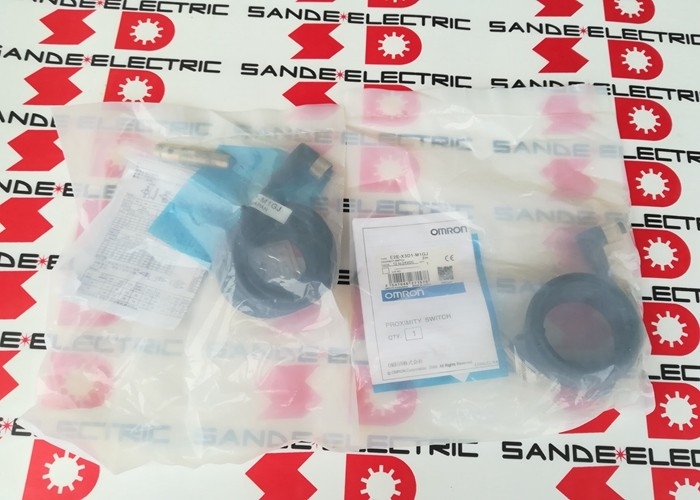
Omron E2E-X3D1-M1CJ | Inductive Proximity Sensor — M12 Shielded, 3mm NO, DC 2-Wire, 12–24VDC, 1kHz, Panel Mount, M12 A-Coded Connector, IP67
Overview
The Omron E2E-X3D1-M1CJ is a panel-mount variant of the E2E series M12 shielded proximity sensor — the same sensing element as the standard E2E-X3D1 M12 sensor but configured for installation in a control panel or equipment door rather than a machine frame or bracket.
Where the standard M12 sensor threads directly into a machine structure at the detection point, the panel mount version is designed to mount in a panel cutout and connect to field cabling via the M12 A-coded connector, with the sensor face oriented to detect through the panel or positioned at a panel opening.
The M12 A-coded connector is the distinguishing electrical interface. A-coding is the standard M12 key configuration used for DC sensors and actuators in factory automation — 4-pin M12 A-coded connectors are the dominant interface on Omron's E2E connector-type sensors and are compatible with the vast range of M12 A-coded field cables and T-connectors used in European and global machine automation wiring.
The A-code alignment prevents accidental mating with B-coded connectors (used for profibus/fieldbus) or D-coded connectors (Ethernet), eliminating a common source of field wiring errors.
The DC 2-wire NO output provides the same installation simplicity found in all E2E DC 2-wire models: two wires carry both supply and signal, connecting in series with the load between the supply positive and common.
With the panel mount housing and M12 connector, the E2E-X3D1-M1CJ can be installed in the panel, connected to field cabling from the front, and replaced without disturbing the machine's fixed wiring harness.
Key Specifications
| Parameter |
Value |
| Sensing Distance |
3 mm (±10%) |
| Setting Distance |
0–2.4 mm |
| Standard Target |
Iron 12 × 12 × 1 mm |
| Housing |
M12 × 1mm, shielded |
| Output |
DC 2-wire, NO |
| Supply Voltage |
12–24V DC |
| Operating Range |
10–30V DC |
| Switching Capacity |
3–100 mA |
| Leakage Current |
0.8 mA max |
| Response Frequency |
1 kHz |
| Connection |
M12 A-coded connector |
| Mounting |
Panel mount |
| IP Rating |
IP67 |
Panel Mount Configuration — Sensor at the Panel, Not the Machine
Panel mount inductive sensors serve a different installation function than machine-mounted position sensors. Rather than detecting a target on a moving machine axis or work fixture, panel mount sensors in automation equipment detect components at close range through the panel face — small component presence in a fixture viewed through a panel opening, label presence on a panel-mounted dispensing mechanism, or target proximity in a compact inline device assembly.
The panel mount housing format allows the sensor to be installed and oriented from the panel front — mounting hardware secures the sensor body in the panel cutout, and the M12 connector provides the field cable connection at a defined, accessible location on the panel surface.
For machine builders and system integrators who design equipment with standardised panel layouts, the panel mount sensor format integrates cleanly into the panel engineering with a defined mounting hole size and connector location, consistent across multiple units.
DC 2-Wire NO on M12 A-Coded Connector — Wiring Simplicity and Standard Compatibility
The DC 2-wire circuit on an M12 A-coded connector reduces the interface to two functional wires — supply positive (pin 1, brown) and output/load (pin 4, blue) in the standard A-coded 4-pin assignment. Pins 2 and 3 of the 4-pin M12 connector are not used in the 2-wire configuration and are left open at the sensor.
The M12 A-coded connector standard means the cable assembly side is sourced from any of dozens of global manufacturers of standard M12 A-coded cordsets — straight and right-angle body styles, PVC and PUR jacket materials, shielded and unshielded variants, in lengths from 0.5m to 15m.
This standardisation eliminates single-source cable dependency and simplifies spare parts management in facilities maintaining multiple E2E sensors across multiple machines.
3mm Sensing from Shielded M12 — Flush Mount, Precise Gap
The 3mm sensing distance of the shielded E2E-X3D1-M1CJ is rated for the standard 12 × 12 × 1mm iron test target — appropriate for detecting small metal components at close range with a defined sensing zone.
Shielded construction focuses the field axially, which means the sensing zone is well-defined and predictable — adjacent metal panels, mounting hardware, and neighbouring components have minimal influence on the switching point when the installation is made with standard flush-mounting clearances.
The 0–2.4mm setting distance (80% of the 3mm nominal) is the stable detection zone accounting for temperature and voltage variation.
For panel mount applications where the target is presented at a fixed, controlled gap, setting within 1–2mm provides the maximum possible detection margin and the highest reliability across production variation in both the sensor population and the target.
FAQ
Q1: What is the M12 A-coded pin assignment for the E2E-X3D1-M1CJ?
The M12 A-coded 4-pin connector on the E2E-X3D1-M1CJ uses the standard DC sensor assignment: Pin 1 (brown) = +V supply (connect to +12–24V DC), Pin 3 (blue) = 0V/output (connect in series with load to supply common). Pins 2 and 4 are not connected for the 2-wire configuration.
In A-coded M12 field cable assemblies, confirm the cable's wiring colour-to-pin correspondence against the IEC 60947-5-2 standard pinout to ensure correct connection.
Q2: The output is DC 2-wire — does this sensor require a minimum load current like other 2-wire sensors?
Yes. The DC 2-wire circuit requires a minimum load current of 3 mA for the output to switch reliably between ON and OFF states. Standard PLC digital input modules at 24V DC draw 5–20mA, which exceeds this minimum.
The 0.8mA off-state leakage current must not exceed the PLC input's OFF-state threshold — standard PLC inputs with OFF thresholds of 3V or equivalent current handling manage the 0.8mA leakage without false triggering.
Q3: Can the E2E-X3D1-M1CJ be used in outdoor equipment exposed to rain?
IP67 covers complete dust ingress protection and temporary immersion up to 1 metre for 30 minutes. Outdoor rain exposure — direct precipitation at low pressure — is within the IP67 rating. High-pressure water jets, power washing, or sustained immersion beyond 30 minutes would require IP68 or IP69K ratings.
For outdoor panel installations in sheltered locations (IP54 environment), IP67 provides margin above the minimum requirement.
For exposed outdoor installations receiving direct weather, verify the M12 connector's IP rating in the unmated condition and ensure the connected cable assembly's connector also meets the IP67 sealing requirement when mated.
Q4: What target size is the 3mm distance characterised for, and how does a smaller target affect the sensing range?
The 3mm distance is rated for a 12 × 12 × 1mm iron test plate — approximately matching the sensing face area of the M12 sensor. For smaller targets: approximately 6 × 6mm iron produces approximately 80–85% of the rated distance (2.4–2.55mm); 4 × 4mm iron produces approximately 70% (2.1mm).
For panel mount applications where a small component — a pin, ball, or stamping — is the detection target, verify the actual switching distance with the specific target size and material before finalising the sensor-to-target gap in the panel design.
Q5: Can multiple E2E-X3D1-M1CJ sensors be mounted adjacent to each other in the same panel without mutual interference?
Shielded sensors have reduced susceptibility to mutual interference compared to unshielded types, but at very close side-by-side spacing — within approximately 30–40mm face-to-face for M12 standard frequency models — simultaneous oscillation can cause adjacent sensors to interfere.
For multi-sensor panel arrays where spacing is less than 40mm, Omron's different-frequency E2E variants (E2E-X3D15 series) allow adjacent units to operate at different oscillation frequencies, enabling installation at spacings as close as 20–25mm without interference.
Verify the minimum spacing requirement from Omron's E2E mutual interference data for the specific configuration.



 Your message must be between 20-3,000 characters!