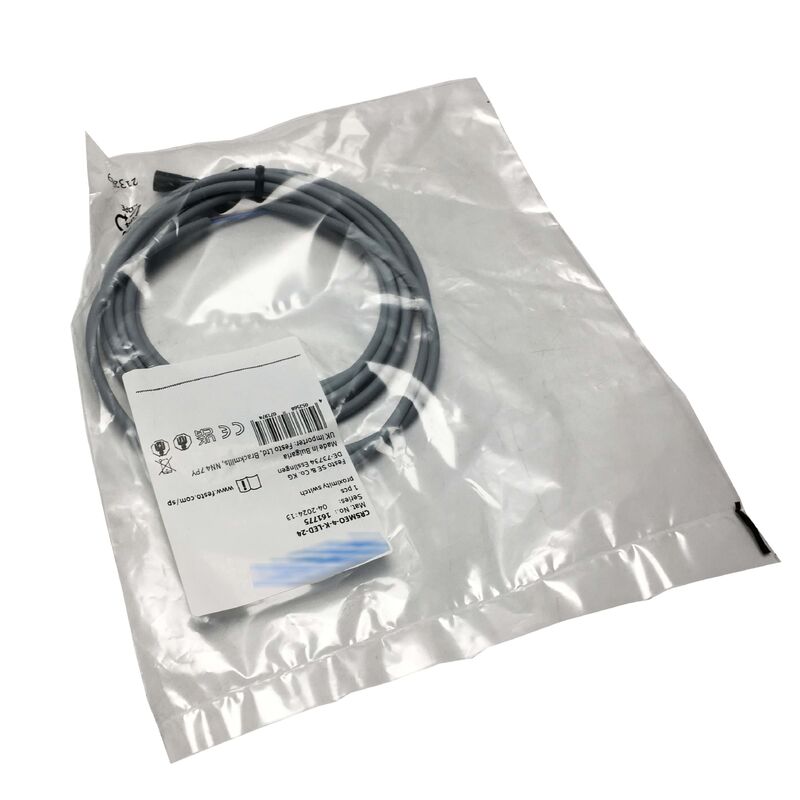
Festo CRSMEO-4-K-LED-24 | Magneto-Resistive Reed Proximity Sensor — 12–30V DC, 500mA, 800Hz, IP67, LED, 2.5m Cable, Cu-Free / PTFE-Free
Overview
The Festo CRSMEO-4-K-LED-24 is a magneto-resistive reed proximity sensor from Festo's CRSMEO series, designed specifically to detect the position of magnetic pistons inside pneumatic cylinders.
It mounts in the T-slot or groove of Festo actuators, aligns with the passing magnetic ring embedded in the piston, and switches when the magnetic field exceeds the detection threshold — confirming end-of-stroke or intermediate positions without any physical contact with the piston itself.
The "CRSMEO" designation signals the corrosion-resistant specification that distinguishes this sensor from the standard SMEO series variants.
Cu-free (copper-free) and PTFE-free material construction satisfies the material specifications of food-grade and pharmaceutical manufacturing environments, where both copper contamination and PTFE particle contamination are regulated concerns.
The polypropylene housing and corrosion-resistant component selection across the sensor body make this appropriate for use in washdown zones, acidic cleaning environments, and food-contact-adjacent installations where standard sensor plastics and coatings would be restricted.
At 800 Hz maximum switching frequency, the CRSMEO-4-K-LED-24 responds far faster than any practical pneumatic actuator can move — this headroom ensures the sensor never misses a detection event regardless of how quickly the cylinder cycles.
The 500mA maximum output current is generous for a position sensor and allows it to drive indicator lights, relay coils, or PLC input cards directly without concerns about fan-out current loading.
The 2.5m integrated cable (K suffix in the part number) is a deliberate design choice for pneumatic cylinder mounting: the sensor body sits close to the cylinder, the cable routes back to the control cabinet, and a fixed cable avoids the connector vibration failures that sometimes affect connector-type sensors in high-cycle pneumatic applications.
The LED indicator gives immediate visual confirmation of the sensor's switched state during machine commissioning and fault-finding without requiring an instrument.
Key Specifications
| Parameter |
Value |
| Measuring Principle |
Magneto-resistive Reed |
| Supply Voltage |
12–30V DC (24V nominal) |
| Output |
Bipolar contacting, NO |
| Max Switching Frequency |
800 Hz |
| Max Output Current |
500mA |
| Max Switching Capacity (DC) |
10W |
| Cable |
3-core, 2.5m integrated |
| Housing Material |
PP (polypropylene) |
| IP Rating |
IP67 |
| Operating Temperature |
−20°C to +60°C |
| Design |
Cu-free, PTFE-free |
| LED Indicator |
Switching status |
| Shape |
Cylindrical smooth |
| Festo Part No. |
161775 |
Magnetic Reed Technology in Pneumatic Position Sensing
Reed sensors work by detecting the magnetic field of the piston magnet — when the piston approaches the sensor's position in the cylinder bore, the magnetic field strength crosses the threshold that closes the reed contact.
The magneto-resistive variant used in the CRSMEO series has improved sensitivity and more defined switching characteristics compared to older purely reed-based designs, which translates to more precise and repeatable switching positions across the cylinder's operational life.
The CRSMEO-4-K-LED-24's bipolar output means the internal reed contact opens and closes with the same polarity relationship regardless of which direction the magnetic field approaches from — an advantage in fast-reversing actuator applications where the piston might approach the sensor from either travel direction at different points in the machine cycle.
Cu-Free / PTFE-Free — Regulatory Context
In food, beverage, and pharmaceutical production, certain materials are restricted near product contact zones by hygiene standards and industry regulations. Copper and its alloys can contaminate food products; PTFE particles from gaskets or coatings can break off and appear in regulated products.
The CRSMEO series' Cu-free, PTFE-free specification provides documented compliance for sensor installations in these environments — confirming through the material specification that the sensor itself does not contribute these regulated contaminants to the production area, even under washdown or incidental contact conditions.
FAQ
Q1: Which Festo cylinder series is the CRSMEO-4-K-LED-24 compatible with?
The CRSMEO-4 sensor is designed for Festo's round cylinder and profile cylinder series that include a magnetic piston and a C-slot or groove for sensor mounting.
Compatible cylinder families include the DZF, DZH, DSBC, DSNU, DSNUP, and other Festo standard cylinder series that specify sensor groove mounting.
The "4" in the part number relates to the sensor's form factor and groove compatibility.
Festo's product configurator and cylinder documentation will confirm which specific sensor groove form factor applies to each cylinder series.
Q2: Is the LED indicator always active, or only when the sensor is triggered?
The LED changes state when the switching output activates — it illuminates when the sensor detects the piston magnet and the NO contact closes. It turns off when the piston moves away and the contact opens.
This provides direct visual confirmation of detection status during installation: the technician positions the sensor in the cylinder groove, moves the cylinder to end-of-stroke by hand or command, and confirms LED illumination to verify correct sensor placement and magnetic coupling before locking the sensor in position.
Q3: Can the CRSMEO-4-K-LED-24 be used with non-Festo cylinders that have a C-slot?
Yes, provided the C-slot dimensions match the CRSMEO-4 sensor's mounting dimensions and the cylinder piston carries a magnet of sufficient field strength to trigger the sensor at the sensing distance through the cylinder wall material.
Festo publishes the CRSMEO-4 mounting dimensions and minimum required magnetic field; compare these against the target cylinder's groove specification and piston magnet specification. The sensor itself is not electrically or logically exclusive to Festo cylinders.
Q4: What is the significance of the bipolar output, and how does it affect wiring?
Bipolar in this context means the reed contact switches current in both polarities — the sensor does not have a directional requirement for the DC polarity applied across its output. In practice, this means the sensor can be wired into either PNP-style or NPN-style PLC input circuits as a simple contact closure, without the sensor electronics imposing a current direction requirement.
The 3-core cable carries supply positive, supply negative, and the switched output. Consult the wiring diagram in Festo's CRSMEO series documentation for the specific conductor assignment of the 2.5m cable.
Q5: What maintenance does the CRSMEO-4-K-LED-24 require over its service life?
Reed sensors are passive contact devices with no powered electronics in the switching element itself, giving them a very long service life under normal operating conditions.
The main wear mechanism is contact erosion at the reed element from the switching current over millions of cycles — the 500mA / 10W maximum ratings should not be continuously approached to maximise contact life.
Periodic cleaning of the sensor body and cable entry point in washdown environments prevents chemical ingress around the cable seal. The most common failure mode on integrated-cable sensors is cable damage from repeated flexing or mechanical stress near the sensor body — protect the cable entry area from mechanical strain during installation.



 Your message must be between 20-3,000 characters!