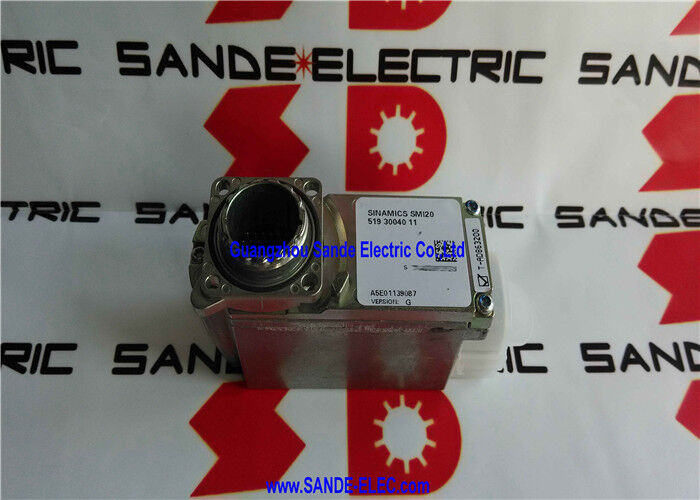
Siemens 6SL3055-0AA00-5MA0 | SINAMICS SMI20 Sensor Module — Motor-Integrated SIN/COS Incremental & Absolute Encoder Evaluation, DRIVE-CLiQ Output, for SINAMICS S120
Overview
The Siemens 6SL3055-0AA00-5MA0 is the SMI20 — the motor-integrated sensor module that handles encoder signal evaluation at the motor itself rather than in the drive cabinet. Unlike cabinet-mount sensor modules (SMC10, SMC20, SMC30) that sit in the panel next to the drive amplifier, the SMI20 mounts inside the motor's terminal box or encoder housing. The encoder signals — sine and cosine feedback from a SIN/COS 1Vpp encoder — never leave the motor as analog signals.
The SMI20 evaluates them locally, converts the position and velocity data to DRIVE-CLiQ digital protocol, and transmits the result over a single DRIVE-CLiQ cable to the SINAMICS S120 Control Unit in the panel.
The significance of this architecture is signal integrity. SIN/COS encoder signals are small-amplitude analog voltages — typically 1Vpp — that are vulnerable to electromagnetic interference, common-mode noise, and signal degradation over long cable runs.
A motor-side drive outputs PWM pulses at hundreds of volts and kilohertz frequencies; these switching transients couple inductively and capacitively into nearby cables. Running raw SIN/COS signals from the motor back through a cabinet full of drive electronics is an EMC challenge.
The SMI20 eliminates that challenge: the vulnerable analog signals travel only the short distance inside the motor to the SMI20, where they are digitised.
From there, the noise-immune DRIVE-CLiQ digital signal travels to the Control Unit — resistant to the EMI environment that would corrupt an analog signal.
The SMI20 designation in the 6SL3055-0AA00-5MA0 part number corresponds to the specific motor-integrated variant in Siemens's sensor module taxonomy: SMC (cabinet-mounted), SME (external, IP67-rated), SMI (integrated into the motor).
All three families share the same conceptual function — encoder signal evaluation and DRIVE-CLiQ conversion — but differ in mechanical form factor and installation location.
Key Specifications
| Parameter |
Value |
| Function |
SIN/COS encoder → DRIVE-CLiQ conversion |
| Encoder Type |
SIN/COS 1Vpp (incremental / absolute) |
| Output |
DRIVE-CLiQ |
| Form Factor |
Motor-integrated (SMI) |
| Drive System |
SINAMICS S120 |
| Control Unit |
CU320-2, CU310-2 etc. |
SIN/COS Encoder Signals — What the SMI20 Evaluates
SIN/COS encoders produce two sinusoidal signals (sine and cosine) that are in quadrature — 90 degrees phase offset — as the encoder disc or linear scale moves. Unlike older incremental encoders that produce digital square-wave pulse trains (TTL/HTL), SIN/COS encoders output true sinusoidal voltages with an amplitude of 1Vpp differential.
The quadrature relationship between the sine and cosine channels allows the detection of motion direction, and crucially, allows electronic interpolation — dividing each electrical cycle into many smaller position increments by computing the arctangent of the sine/cosine ratio.
A physical SIN/COS encoder might produce 1024 sinusoidal cycles per revolution (1024 lines). Without interpolation, this gives 4096 quadrature edges per revolution — a resolution of approximately 0.088 degrees.
The SMI20 applies internal interpolation to divide each electrical cycle into many more increments — the exact interpolation factor depends on the module's specification.
At 16384 interpolation points per cycle (a common figure for high-resolution sensor modules), the effective resolution becomes 1024 × 16384 = ~16.7 million steps per revolution, which for a servo motor corresponds to sub-arc-second angular resolution.
This is the resolution that precision machine tool axes, printing press registration systems, and high-accuracy robotic arms require.
DRIVE-CLiQ — The Digital Output That Connects to S120
DRIVE-CLiQ (Drive Component Link with Intelligence) is Siemens's proprietary serial interface that connects all SINAMICS S120 drive components — power modules, motor modules, sensor modules, and control units — into a unified digital network.
The protocol carries not just feedback data (position, velocity, temperature) but also identification data (the connected component identifies itself to the Control Unit) and diagnostic information.
The SMI20's DRIVE-CLiQ output means that a standard DRIVE-CLiQ cable — four twisted pairs in a shielded jacket with RJ45-style connectors — runs from the motor to the S120 Control Unit.
The Control Unit reads the motor's position and velocity data from the SMI20 at the configured servo cycle rate (typically 125µs or 250µs) and uses it to close the position and speed control loops.
No separate encoder cable is needed — the SMI20 handles the encoder interface entirely and presents the result on DRIVE-CLiQ.
This single-cable connection also simplifies machine commissioning: the Control Unit automatically detects the SMI20 via DRIVE-CLiQ's self-identification protocol, identifies the encoder type and configuration, and pre-populates the drive parameters accordingly.
The manual entry of encoder resolution, signal type, and interface parameters that was required with analog encoder connections is replaced by automatic configuration.
Motor-Integrated vs Cabinet-Mounted Sensor Modules
The choice between SMI (motor-integrated), SMC (cabinet-mounted), and SME (external) sensor modules depends on the installation scenario:
SMI (motor-integrated, this module): Best for new installations where the motor is specifically designed or adapted to house the SMI20 inside its encoder compartment.
Provides the shortest possible analog signal path and the most EMI-resistant installation.
Requires access to the motor's encoder terminal for installation.
SMC (cabinet-mounted): Used when the sensor module must reside in the drive cabinet — either because the motor cannot accommodate an internal module, or because the cable routing between motor and cabinet is fixed and the cabinet is the more practical location.
The analog SIN/COS signals run from the motor to the cabinet via screened cable, then into the SMC for evaluation.
SME (external, IP67): Designed for motors where the encoder module mounts externally on the motor housing (not inside), typically in IP67-rated enclosures for environments where moisture, coolant, or contamination exposure requires high protection ratings.
FAQ
Q1: Can the SMI20 (6SL3055-0AA00-5MA0) work with any SIN/COS encoder, or only specific Siemens encoder models?
The SMI20 evaluates standard SIN/COS 1Vpp differential signals — the most widely used signal standard in high-resolution servo encoders from major manufacturers including Heidenhain, Stegmann (now Sick), Fagor, and others.
Provided the encoder outputs 1Vpp SIN/COS differential signals and its supply voltage and current requirements are compatible with the SMI20's encoder supply output, third-party encoders can be evaluated.
The encoder's line count (resolution) is entered as a parameter in the SINAMICS drive configuration — the SMI20 itself handles any SIN/COS 1Vpp source without being limited to Siemens-branded encoders.
Q2: Does the SMI20 support absolute encoders, or only incremental SIN/COS?
The SMI20's -5MA0 designation covers the SIN/COS incremental and absolute encoder variant — meaning it supports encoders that produce both SIN/COS incremental tracks for high-resolution velocity feedback and an absolute position word (typically via a serial channel such as EnDat or similar protocol superimposed on the SIN/COS signals).
At power-up, the absolute position is read from the encoder, eliminating the need for a homing cycle. During operation, the incremental SIN/COS tracks provide the high-resolution velocity and position feedback for the closed-loop servo control.
This dual-function capability covers the most capable servo encoders used in precision CNC and robotics applications.
Q3: How is the SMI20 physically installed in the motor?
The SMI20 is designed to fit within the encoder compartment of compatible Siemens servo motors — the same compartment that normally houses the encoder disc and circuit board. Installation involves removing the motor's encoder cover, fitting the SMI20 module to the encoder interface connector inside the motor, routing the DRIVE-CLiQ cable through the motor's cable gland, and reassembling the encoder cover.
The motor must be compatible with the SMI20 form factor — not all motor types accommodate an SMI-type module.
The specific motors compatible with the SMI20 are listed in the SINAMICS S120 Motor Manual and the SMI20 documentation.
Q4: What is the maximum DRIVE-CLiQ cable length between the SMI20 and the S120 Control Unit?
The maximum DRIVE-CLiQ cable length between any sensor module and the S120 Control Unit is 100 metres using standard DRIVE-CLiQ cables. This figure applies equally to SMI, SMC, and SME variants.
Within a machine tool cabinet where the Control Unit and motor are in close proximity, the actual length is typically much shorter — often 2–5 metres from motor to cabinet.
The 100-metre limit supports applications where the drive cabinet is remote from the machine, such as in gantry systems or large machining centres with a central drive room.
Q5: The SMI20 is listed as having phased-out later revisions. What does this mean for procurement?
The -5MA0 suffix identifies a specific hardware revision of the SMI20 in the SINAMICS sensor module family. Siemens periodically introduces new revisions (-5MA1, -5MA2, etc.) that incorporate hardware improvements, extended specifications, or updated firmware.
Older revisions are phased out of production but typically remain interchangeable with newer revisions in existing installations.
For procurement of a specific revision for maintenance purposes, the industrial surplus market is the primary source for discontinued revisions.
For new machine builds, the latest current revision from Siemens's production should be specified.
The SINAMICS compatibility matrices in Siemens Industry Online Support confirm which SMI20 revisions are compatible with each S120 firmware version.



 Your message must be between 20-3,000 characters!