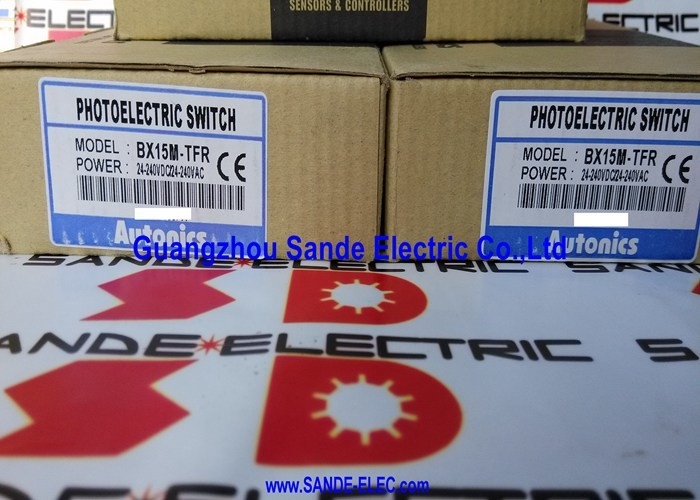
Autonics BX15M-TFR AC/DC Through-Beam Sensor
Overview
The BX15M-TFR is a through-beam photoelectric sensor designed for long-range industrial detection in control systems that use wide-range AC/DC power. Autonics lists this model with a 15 m sensing distance, relay output, Light ON / Dark ON switching, and 24 to 240 VAC or VDC operation, which makes it especially useful in plant environments where sensor selection has to accommodate mixed supply conditions and straightforward relay-based integration.
This model is not just about range. Its real strength is how it combines long-distance sensing with practical control features such as built-in sensitivity adjustment, relay output, and support from the BX series platform, which includes self-diagnosis indication, IP66 protection, and timer functionality in the series.
That makes it well suited to conveyors, material handling lines, gate monitoring, long-path object detection, and general industrial automation where reliability and ease of integration matter more than compact size alone.
For daily factory use, the BX15M-TFR also fits well into legacy and retrofit work. The broad power range and relay output reduce interface concerns when replacing older sensors, while the through-beam format supports more dependable long-distance detection than many reflective alternatives in dusty or visually inconsistent applications.
Key Specifications
| Parameter |
Value |
| Model |
BX15M-TFR |
| Sensing Type |
Through-beam |
| Sensing Distance |
15 m |
| Sensing Target |
Opaque material, min. Ø15 mm |
| Light Source |
Infrared LED (850 nm) |
| Response Time |
Max. 20 ms |
| Power Voltage |
24 to 240 VAC ±10%, 50/60 Hz / 24 to 240 VDC ±10% |
| Control Output |
Relay |
| Operation Mode |
Light ON / Dark ON |
| Sensitivity Adjustment |
Built-in sensitivity adjuster |
| Connection Type |
Terminal block |
| Current Consumption |
Emitter/Receiver: Max. 3 VA |
| Protection Rating |
IP66 |
| Series Features |
Self-diagnosis, timer support, protection circuits |
Relay Output and Wide Supply Range — Strong for Retrofit Work
The relay output is one of the main reasons this model is attractive in industrial replacement projects. In many older or mixed-control systems, a relay contact is easier to integrate than a transistor output, especially when the machine logic already expects a dry contact or simple switched interface rather than a low-voltage signal stage.
The wide AC/DC supply range adds to that flexibility.
By supporting 24 to 240 VAC and VDC, the BX15M-TFR can be applied in a broader range of existing installations without forcing a redesign of the panel power scheme, which is often a major benefit in maintenance-oriented projects.
BX Series Features — More Than Basic Beam Detection
Autonics’ BX series is published with additional platform features such as self-diagnosis indication, built-in timer functions in the series, IP66 protection, and protection circuits. Those details matter because they move the sensor beyond simple beam interruption and make it easier to deploy in real factory conditions where signal confidence, panel simplicity, and predictable field behavior are important.
This also improves usability at the machine level.
A stable-operation indicator can help technicians during alignment and troubleshooting, while timer support and sensitivity adjustment give the installer more control over how the sensing event is interpreted in the actual production environment.
FAQ
Q1: What kind of applications is BX15M-TFR best suited for?
It is best suited for long-range object detection in conveyors, material handling systems, transfer lines, entrance monitoring, and other industrial automation tasks where a through-beam sensor provides better sensing certainty than a reflective type. Its 15 m range makes it especially useful where the emitter and receiver must be installed across a wide machine span.
Q2: Why is relay output important on this model?
Relay output makes the sensor easier to integrate into many existing control systems, particularly older panels or applications that expect a contact-based signal rather than a transistor output. In retrofit projects, that can reduce interface complexity and make replacement work more straightforward.
Q3: What is the advantage of the wide AC/DC power range?
The wide supply range makes this model more flexible across mixed plant standards and legacy installations. Instead of being limited to a narrow low-voltage DC range, it can be used in a wider variety of industrial control environments with less concern about supply mismatch.
Q4: Does BX15M-TFR offer any features beyond basic beam detection?
Yes. The published model and series information includes built-in sensitivity adjustment, selectable Light ON / Dark ON operation, and BX series support for self-diagnosis and timer-related functionality. These features help improve setup, troubleshooting, and application flexibility in real production equipment.
Q5: What should buyers verify before ordering?
Buyers should confirm the sensing distance, target size, mounting space, relay-interface requirement, available supply voltage, and whether the machine needs through-beam architecture rather than reflective detection. For replacement work, terminal arrangement and alignment space should also be checked before purchase.



 Your message must be between 20-3,000 characters!