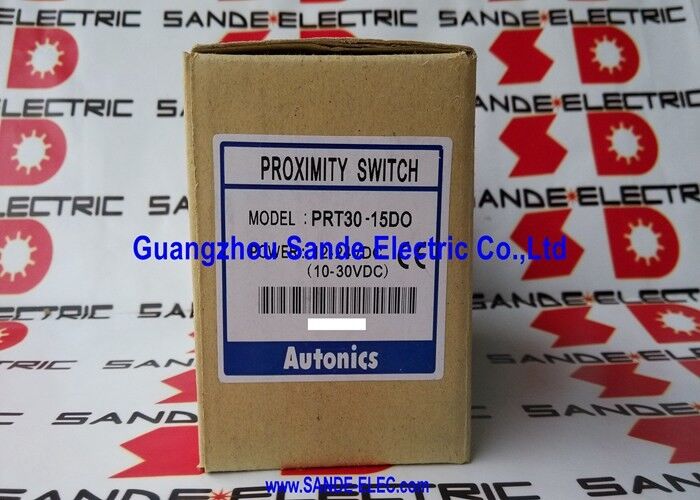
PRT30-15D0 Inductive Proximity Sensor
Product Overview
The PRT30-15D0 is a cylindrical inductive proximity sensor built for reliable metal target detection in industrial automation systems.
With a Ø30 mm sensing face, 15 mm sensing distance, and non-flush installation design, it is well suited to applications where stable detection, simple mounting, and repeatable switching performance matter more than unnecessary complexity.
This model is typically used in machine automation, conveying systems, production fixtures, and general factory equipment where metal objects need to be detected without physical contact.
In daily operation, that means fewer wear-related issues than mechanical switches and more predictable response in repetitive motion environments.
A rated response frequency of 200 Hz gives the sensor enough speed for many standard industrial positioning and object detection tasks.
Combined with a visible red LED operation indicator, the PRT30-15D0 offers practical usability for both machine builders and maintenance teams.
Key Features
Stable Inductive Detection for Metal Targets
The PRT30-15D0 is designed to detect metallic targets through an inductive sensing principle.
This makes it a dependable choice for automation systems that require contactless detection of iron or similar conductive metal parts.
15 mm Sensing Distance
With a 15 mm sensing distance, the sensor provides a useful balance between installation tolerance and detection reliability.
This range is especially practical in machinery where the target position may vary slightly but the detection signal still needs to remain stable.
Ø30 mm Cylindrical Body
The Ø30 mm sensing side diameter gives the sensor a robust industrial form factor that is easy to integrate into brackets, machine frames, and mounting assemblies.
Larger-body proximity sensors are often preferred where stronger mechanical presence and clearer installation geometry are desired.
Non-Flush Installation
This model is built for non-flush mounting, which is important for maintaining the intended sensing field. In actual installations, non-flush sensors are often chosen when more sensing distance is required and sufficient clearance around the sensing face can be provided.
Visible Red LED Indicator
A built-in red LED operation indicator helps technicians confirm sensor status directly on the machine.
This is useful during installation, setup, troubleshooting, and preventive maintenance.
Industrial DC Power Compatibility
The sensor supports 12 to 24 VDC operation, with an operating voltage range of 10 to 30 VDC, making it suitable for common industrial DC control systems.
This simplifies integration into standard automation panels and machine wiring layouts.
Technical Data
| Parameter |
Specification |
| Model |
PRT30-15D0 |
| Sensor Type |
Inductive proximity sensor |
| Installation |
Non-flush |
| Sensing Side Diameter |
Ø30 mm |
| Sensing Distance |
15 mm |
| Hysteresis |
Max. 10% of sensing distance |
| Standard Sensing Target |
45 × 45 × 1 mm (iron) |
| Response Frequency |
200 Hz |
| Indicator |
Operation indicator (red LED) |
| Power Voltage |
12 - 24 VDC |
| Operating Voltage Range |
10 - 30 VDC |
| Leakage Current |
Max. 0.6 mA |
| Control Output |
2 to 100 mA |
| Residual Voltage |
Max. 3.5 V |
| Unit Weight |
Approx. 170 g |
| Packaged Weight |
Approx. 207 g |
Performance in Industrial Use
In real factory environments, a proximity sensor has to do more than switch on paper. It needs to detect consistently, resist installation variation, and remain easy to inspect when something in the system changes. The PRT30-15D0 is positioned well for that kind of work.
Its non-contact sensing method reduces mechanical wear, which is valuable in repetitive automation cycles.
The 15 mm sensing distance offers more installation flexibility than shorter-range compact sensors, especially in applications where metal targets may not pass extremely close to the sensor face.
The 200 Hz response frequency is appropriate for typical machine automation speeds, including part presence detection, indexing confirmation, stop-position sensing, and fixture status feedback.
The sensor’s maximum hysteresis of 10% of sensing distance also plays an important role.
In practice, hysteresis helps prevent unstable output switching when a target is near the threshold point.
That means less output chatter and more dependable signal behavior in moving equipment.
Application Areas
The PRT30-15D0 is suitable for a wide range of industrial uses, including:
- Metal part detection on conveyors
- Position sensing in assembly machines
- Limit detection in automated fixtures
- Presence confirmation in packaging equipment
- Motion sequence feedback in production systems
- Basic machine interlock and status sensing
Because it is designed for iron target detection with a clearly defined standard sensing object, it is particularly useful in applications involving steel brackets, machine components, jigs, or moving metal workpieces.
Design Advantages for Engineers and Buyers
From an engineering standpoint, the PRT30-15D0 offers a practical combination of body size, sensing range, and electrical compatibility.
It does not require a specialized power architecture, and its cylindrical format works well in standard industrial mounting arrangements.
From a purchasing perspective, sensors in this class are often selected because they are easy to standardize across multiple machines.
A Ø30 mm non-flush inductive model with 15 mm sensing distance can cover many ordinary metal detection points without forcing unnecessary customization.
That helps simplify spare parts planning and long-term maintenance support.
For users who need a robust inductive proximity sensor for standard automation duties, the PRT30-15D0 is a solid, application-friendly option.
FAQ
Q1: What kind of target is the PRT30-15D0 designed to detect?
The PRT30-15D0 is designed for metal target detection, with its standard sensing target specified as 45 × 45 × 1 mm iron. In industrial use, this means it performs best when detecting ferrous metal objects such as steel plates, machine parts, brackets, or fixtures.
It may also respond to other metals, but the actual sensing distance can vary depending on the material, size, and shape of the target. For applications where precise repeatability is important, target material should always be considered during design validation.
Q2: Why does this sensor require non-flush installation?
A non-flush inductive sensor needs free space around the sensing face because its electromagnetic field extends outward beyond the body. If the sensor is mounted flush in surrounding metal, the sensing field can be distorted and the usable sensing distance may drop.
For the PRT30-15D0, proper non-flush mounting helps preserve the intended 15 mm sensing performance and keeps switching behavior more stable in actual machine operation.
Q3: Is 200 Hz response frequency fast enough for automation equipment?
For many general industrial applications, 200 Hz is entirely suitable.
It allows the sensor to detect repeated target events in common automation tasks such as part transfer, position confirmation, indexing, and sequence detection.
In practical terms, the sensor can handle standard machinery speeds well, provided the target presentation and PLC input handling are correctly matched.
Extremely high-speed counting applications may require a different sensor class, but for routine industrial positioning and presence detection, 200 Hz is a solid working range.
Q4: What is the purpose of hysteresis in this sensor?
Hysteresis helps prevent unstable switching when the target is close to the detection threshold. Without it, the output could chatter on and off if vibration, target variation, or mechanical tolerance causes the sensing point to fluctuate slightly.
On the PRT30-15D0, the hysteresis is specified as maximum 10% of sensing distance, which supports more reliable signal behavior in real machines where movement is not perfectly static. This is especially useful in environments with vibration or minor target position variation.
Q5: What should engineers pay attention to during electrical integration?
Engineers should verify the DC supply range, load current, leakage current, and residual voltage when integrating the sensor into a control circuit.
The PRT30-15D0 operates on 12 to 24 VDC, with an allowable operating range of 10 to 30 VDC, which fits most industrial control systems.
The maximum leakage current of 0.6 mA and residual voltage up to 3.5 V should be checked against the PLC input or load device to ensure reliable signal recognition.
This is particularly important when using sensitive low-current inputs or when multiple devices are wired in the same circuit.


 Your message must be between 20-3,000 characters!