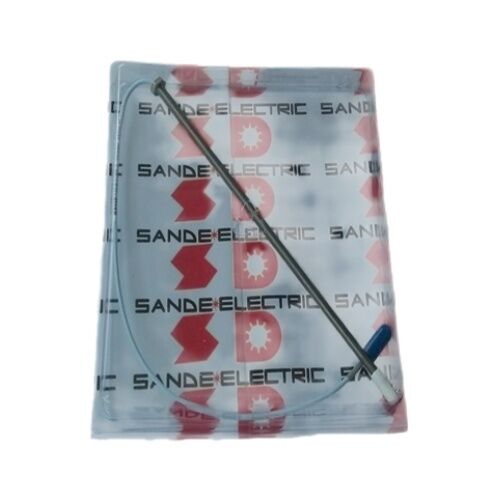
Bently Nevada 330901-00-05-02-00 | 3300 XL NSv Proximity Probe — 1/4-28 UNF, 0.5" Case, AISI304, ClickLoc, Standard Approvals
Overview
The Bently Nevada 330901-00-05-02-00 is the compact 0.5-inch case configuration of the 3300 XL NSv proximity probe series — an eddy current transducer for non-contact measurement of shaft radial displacement in rotating machinery.
The probe tip generates an electromagnetic field that is perturbed by the electrically conductive shaft surface passing nearby; that perturbation, converted to a voltage by the 3300 NSv proximeter, provides a continuous DC signal proportional to the gap between probe tip and shaft.
The 3300 XL NSv system is Bently Nevada's workhorse proximity transducer platform, used on turbines, compressors, pumps, motors, and other rotating machinery where shaft vibration and position monitoring is required for condition monitoring, protection, and process control.
The 330901 base model designates the standard 1/4-28 UNF threaded probe without armored cable — the configuration that fits most standard proximity probe ports machined into turbomachinery casings worldwide.
The compact 0.5-inch case length of the -00-05 configuration is specifically intended for installations where the depth of the mounting hole is limited — shallow probe ports in small machine housings, installations with restricted radial clearance around the probe body, or retrofit positions where the original equipment used a shorter probe design.
The 0.0-inch unthreaded section (00 prefix) means the threaded portion extends from the very tip of the probe, maximising engagement in shallow thread ports without wasting depth on an unthreaded section.
Key Specifications
| Parameter |
Value |
| Thread |
1/4-28 UNF (no armor) |
| Unthreaded Length |
0.0 inches |
| Case Length |
0.5 inches |
| Connector |
Mini coaxial ClickLoc (standard cable) |
| Case Material |
AISI 304 stainless steel |
| Tip Material |
PPS (polyphenylene sulfide) |
| Cable Impedance |
75 Ω coaxial |
| Cable Insulation |
FEP |
| Sensitivity |
200 mV/mil (7.87 V/mm) |
| Frequency Response |
DC to 10 kHz |
| Operating Temperature |
−52°C to +177°C |
| DC Resistance (cable) |
4.0 ± 0.5 Ω (0.5m) |
| Max Thread Engagement |
0.375 inches |
| Recommended Torque |
5.1 N·m (45 in·lb) |
| Compatible System |
3300 XL NSv |
| Approvals |
Standard (option 00) |
3300 XL NSv System Architecture
The 330901-00-05-02-00 probe is one element of a three-component proximity transducer system: the probe itself, an extension cable connecting probe to proximitor, and the 3300 XL NSv proximitor (conditioning module).
The probe generates the eddy current field, the extension cable carries the raw RF signal, and the proximitor converts the gap-dependent RF signal into a calibrated DC voltage output — typically −18V at the calibrated far gap and varying toward −1V as the shaft approaches the probe tip.
This distributed architecture separates the measurement point (probe) from the electronics (proximitor).
The probe contains no active electronics — only a wound coil and tuning network — which allows the probe to operate in the −52°C to +177°C range that would damage semiconductor circuits.
The proximitor mounts in a cooler, more accessible panel location, away from the thermal and vibration environment of the machine casing.
Bently Nevada's 3300 XL NSv system is backward compatible with 3300 XL extension cables and proximitors, making the 330901-00-05-02-00 directly interchangeable with earlier 330901 series probes in existing installations.
The ClickLoc mini coaxial connector (option 02) matches the standard 3300 XL cable connector, allowing probe replacement without modifying the field cable assembly.
Installation Mechanics
The 0.5-inch case length determines the physical probe depth from the machine casing surface to the probe tip. When threaded fully into a probe port with 1/4-28 UNF thread, the 0.5-inch case positions the probe tip 0.5 inches below the mounting surface — appropriate for shaft bore depths that match this dimension.
Unlike longer probe variants used for reaching shafts in deeply recessed locations, the 0.5-inch case is for measurements close to the casing surface.
Recommended installation torque is 5.1 N·m (45 in·lb), with an absolute maximum of 7.3 N·m (65 in·lb).
Exceeding maximum torque risks thread deformation or damage to the PPS probe tip, particularly important since the tip's PPS material — while chemically resistant and mechanically hard — will shear under excessive torsional loading.
The Viton O-ring seal at the probe body provides positive sealing against oil and process fluids at the probe port; inspect the O-ring condition before installation and replace if cracked or deformed.
The optimum working gap between probe tip and shaft for the 3300 NSv system is approximately 2mm (80 mils).
At this gap, the system operates near the centre of its linear range, providing maximum resolution and minimising sensitivity to gap errors from thermal expansion or shaft deflection.
The gap is set by adjusting the probe's axial position in the threaded port and verified by measuring the DC output voltage with the shaft stationary.
FAQ
Q1: What is the optimum working gap for the 330901-00-05-02-00, and how do I set it?
The 3300 NSv system is calibrated for approximately 2mm (80 mils) nominal gap. With the shaft stationary and the system energised, adjust the probe axially until the DC output voltage from the proximitor reads approximately −10V (the midpoint of the −18V to −2V linear range for the 3300 NSv system).
This positions the shaft at the centre of the probe's linear measurement range. Lock the probe in this position with a locking nut and confirm the gap is within specification using the proximitor's output voltage as the reference.
Q2: Can the 330901-00-05-02-00 be used without extension cables — directly connected to the proximitor?
The probe's ClickLoc mini coaxial connector (option 02) connects to the standard 3300 XL NSv extension cable, which then connects to the proximitor.
While physically possible to connect probe to proximitor without an extension cable in bench testing, the calibrated system is designed and characterised with specific cable impedances.
Using no extension cable, or a cable that doesn't match Bently Nevada's 3300 XL specifications, will affect the system sensitivity and linear range. Always use the correct Bently Nevada 3300 XL extension cable for field installations.
Q3: The approvals are listed as option 00 (standard) — does this preclude installation in hazardous areas?
Standard approvals (option 00) means this probe variant does not carry the additional ATEX, IECEx, or other hazardous area certifications that the option 05 variant provides. Installations in classified hazardous areas (explosive atmospheres, flammable gas or dust zones) require the agency-approved variant of the probe.
For non-hazardous machine rooms, standard option 00 is appropriate and covers general industrial use without restriction.
Q4: Is there a difference between the 330901 "NSv" and the older 330900 series probes?
The 3300 NSv (Non-metallic Sensing surface voltage) designation identifies the probe as part of Bently Nevada's newer series with improved linearity and extended temperature range compared to the earlier 3300 standard probes.
The 330901 NSv series uses the same 1/4-28 UNF thread and ClickLoc connectors as the 330900 series, making physical retrofitting straightforward, but the NSv system's proximitors and extension cables should be used with NSv probes to maintain calibration accuracy.
Mixing NSv probes with non-NSv proximitors may produce calibration offsets.
Q5: What is the maximum shaft surface speed this probe can accurately measure?
The 3300 XL NSv proximity system's DC to 10 kHz frequency response means it accurately captures vibration and displacement at frequencies up to 10 kHz — comfortably covering all mechanical vibration frequencies encountered in industrial turbomachinery from sub-synchronous to very high-order harmonics.
The probe itself has no mechanical speed limitation; it operates as long as the shaft surface is within the probe's linear range.
For machines operating above 10,000 RPM, the frequency content of vibration signals at higher orders may approach the system's bandwidth, but fundamental and lower-order harmonics remain fully within the measurement range.



 Your message must be between 20-3,000 characters!