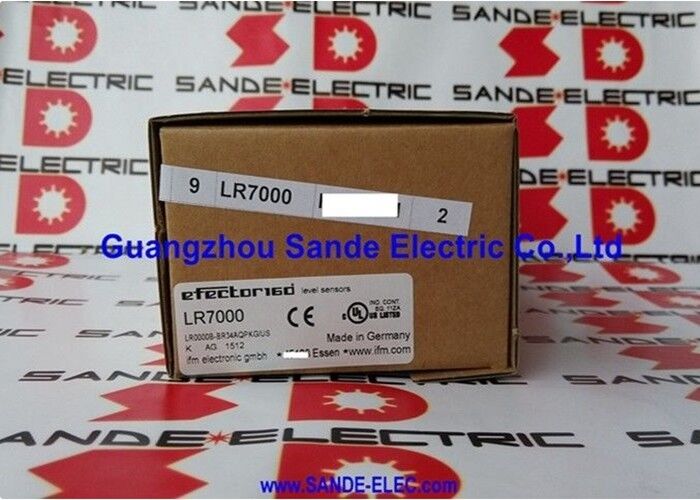
IFM Efector LR7000 | Guided Wave Radar Continuous Level Sensor — 18–30V DC, PNP, IP67, G¾", Probe up to 1600mm, 4-Digit Display
Overview
The IFM Efector LR7000 is a guided wave radar (GWR) level sensor covering continuous level measurement in tanks and containers holding water, oils, coolants, and similar liquids.
The system consists of a separate evaluation unit and a flexible probe that can be cut to the required length for the specific tank installation — anything from 100mm up to 1600mm — giving the installer a single sensor family that fits a wide range of tank geometries without stocking multiple fixed-length variants.
Guided wave radar is a measurement method well suited to the liquid types the LR7000 is designed for. Unlike ultrasonic sensors that can be disrupted by foam, vapour, or filling turbulence at the liquid surface, a guided wave radar sends its microwave pulse along a physical rod or cable probe that dips into the liquid.
The pulse travels along the probe, reflects off the liquid surface at the point of impedance change between air and liquid, and returns to the transceiver. Because the signal travels along the probe rather than through the air above the liquid, foam, condensation, and slow-moving vapour have negligible effect on the measurement.
The LR7000 evaluation unit's 4-digit alphanumeric LED display provides a constant readout of the measured level directly on the sensor body, eliminating the need to break into the control system to check actual tank level during commissioning or troubleshooting.
Both switching outputs are independently programmable — setpoints, reset points, and NO/NC polarity — through the front-panel buttons, with no external programming tools required for basic configuration.
Key Specifications
| Parameter |
Value |
| Measurement Type |
Guided wave radar (GWR) |
| Supply Voltage |
18–30V DC |
| Output Design |
PNP, 2 × programmable switching |
| Process Connection |
G¾" male |
| Probe Length |
100–1600mm (cuttable) |
| Current Consumption |
<80 mA |
| IP Rating |
IP67 |
| Ambient Temperature |
0°C to +60°C |
| Connector |
M12 |
| Reverse Polarity Protection |
Yes |
| Short-Circuit Protection |
Yes |
| Display |
4-digit alphanumeric LED |
Modular Design: Evaluation Unit + Probe
The LR7000's separation of evaluation electronics from the probe is an engineering choice that simplifies both installation and maintenance. The evaluation unit — containing the radar transceiver electronics, display, programming buttons, and M12 electrical connector — mounts above the tank at a convenient access point.
The probe extends down into the tank through the G¾" process connection.
Because probes can be cut to the exact length required for each tank, there is no dead zone at the bottom caused by a probe that is too long, and no reduction in measurement range because the probe ended too early.
The cut end is the reflection termination point; cutting is a deliberate part of the installation procedure, not a modification. IFM specifies the cutting procedure to ensure a clean end that does not create spurious reflections.
For applications where the tank dimensions change — a new tank replaces an older one, or the sensor is relocated — the probe can be trimmed or replaced without changing the evaluation unit.
This modularity reduces the total cost of adaptation in facilities where tank configurations are periodically revised.
Two Programmable Switching Outputs
The LR7000 provides two independently configurable switching outputs. In a typical tank level monitoring installation: output 1 triggers a "fill pump ON" signal when level drops below a minimum threshold (SP1), and output 2 triggers an "overflow warning" when level reaches a maximum (SP2).
Both outputs are programmable as NO or NC, allowing either active-high or active-low logic without rewiring.
The switching outputs connect directly to PLC digital input cards, relay modules, or process control indicators through the M12 connector.
With 250 mA output current capacity (per output for PNP switching), the LR7000 drives standard automation loads without amplifier interposing in most installations.
Application Fit: Water, Oils, Coolants
IFM positions the LR7000 specifically for water, oils, and coolants in industrial tank and container applications — the liquid types with the dielectric properties that guided wave radar handles most reliably.
Liquids with very low dielectric constants (below approximately 1.5) reduce the reflection amplitude at the liquid surface; water, cooling water, and most industrial oils are well above this threshold and produce strong reflections throughout the LR7000's probe length.
The G¾" process connection is the standard male thread used on industrial tank nozzles and sight-glass ports. A threaded nozzle in the tank top with a compatible G¾" female thread accepts the LR7000 directly, using PTFE tape or an appropriate thread sealant on the threads. Adapters are available from IFM for tanks with different connection standards.
FAQ
Q1: Does the LR7000 probe need to be recalibrated after cutting to length?
Cutting the probe to the required tank depth does not require recalibrating the sensor's radar circuitry.
The evaluation unit is programmed with the probe's installed length as a reference parameter, and the level measurement is calculated from the position of the reflection point relative to this reference.
After cutting and installation, enter the probe length and the minimum/maximum level setpoints through the front panel — the sensor's internal calibration is factory-set and does not need adjustment.
Q2: Can the LR7000 measure level in tanks with internal agitators or paddle mixers?
Guided wave radar is generally more resistant to agitation than ultrasonic level sensors, because the signal travels along the probe rather than through the air. However, direct mechanical contact between a rotating agitator blade and the probe must be avoided.
Position the probe in a zone of the tank that the agitator blades do not enter — typically at the tank wall opposite the agitator, or in a still-pipe or guide tube if the tank geometry creates unavoidable agitation throughout the vessel.
Q3: What process temperatures can the LR7000 probe withstand?
The ambient temperature specification of 0°C to +60°C refers to the temperature at the evaluation unit. The probe itself is rated for higher process temperatures — consult IFM's LR7000 technical data sheet for the specific maximum process temperature, which differs from the ambient rating. For elevated-temperature processes such as hot water systems, confirm the process temperature against the probe material specification before installation.
Q4: How are the two switching outputs configured, and can they share the same setpoint?
Each output has its own independent setpoint (SP1, SP2) and reset point (rP1, rP2), configurable in the programming menu through the front panel buttons. They can be set to the same value if needed, though the typical application uses distinct thresholds for different actions (e.g., fill start and overflow alarm).
Each output is independently programmable as NO or NC. IO-Link capable variants in the LR series additionally support remote parameterisation and process value transmission as analogue data.
Q5: Is the LR7000 compatible with IFM's IO-Link system for remote monitoring?
The base LR7000 provides switching outputs. IFM's LR series includes IO-Link variants that add IO-Link communication for real-time analogue level data transmission, remote parameterisation, and diagnostic access through an IO-Link master.
If continuous analogue level output rather than setpoint-based switching is required for the application, verify whether the specific LR7000 order code includes IO-Link capability, or consider an IO-Link variant from the LR series.


 Your message must be between 20-3,000 characters!