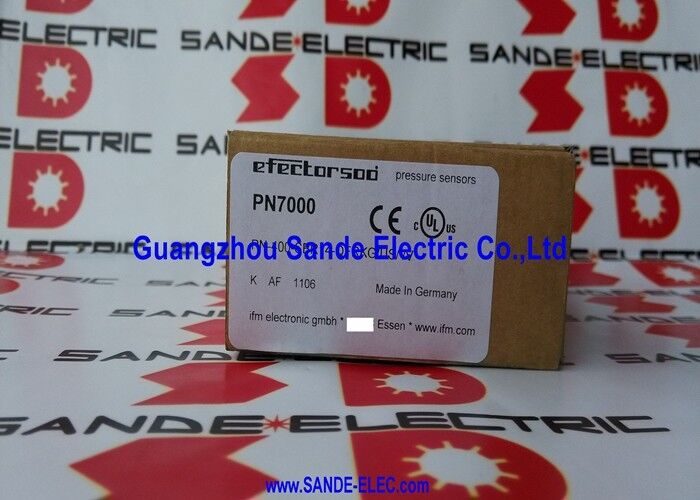
36VDC, PNP/NPN, G1/4 External, M12, IP67, ±0.25% Accuracy
Overview
The IFM PN7000 is a 0–400 bar electronic pressure sensor from IFM's PN7000 series — the high-pressure member of a family that covers from vacuum/low pneumatic (PN7004's −1 to 10 bar) up through the demanding hydraulic pressures required by presses, injection moulding machines, die casting equipment, and high-pressure hydraulic power units. With an integrated display, PNP/NPN configurable output, and G¼" external thread on a compact body, the PN7000 installs directly into standard hydraulic pressure ports without adapters.
Four hundred bar (5,800 psi) is more than adequate for virtually all industrial hydraulic systems. Standard high-pressure hydraulics in injection moulding typically reach 200–350 bar during the injection stroke; metal stamping presses often operate at similar levels; cold isostatic pressing goes higher, but the PN7000's 400 bar range covers the majority of production machine hydraulic circuits.
The sensor is not a precision process transmitter with 4–20mA output for analogue feedback — it is a condition monitoring and switching device, providing switching outputs for pressure high/low alarms, machine interlock, and process confirmation.
The 600 bar nominal pressure rating and 1,000 bar minimum burst pressure provide the mechanical safety margins appropriate for hydraulic duty.
Hydraulic systems generate pressure transients — rapid valve closure causes water-hammer-equivalent spikes, accumulator charging produces pressure peaks, and pressure relief valve response is not instantaneous. The PN7000's housing withstands these transients well above the normal operating range without diaphragm damage or zero shift.
Key Specifications
| Parameter |
Value |
| Measuring Range |
0–400 bar (0–40 MPa / 0–5,800 psi) |
| Nominal Pressure |
600 bar (60 MPa / 8,700 psi) |
| Burst Pressure |
1,000 bar (100 MPa / 14,500 psi) |
| Supply Voltage |
18–36V DC |
| Electrical Scheme |
DC PNP/NPN |
| Process Connection |
G¼" external (male) thread |
| Electrical Connection |
M12 connector |
| IP Rating |
IP67 |
| Accuracy (BFSL) |
<±0.25% (of full scale) |
| Accuracy (LS) |
<±0.5% (of full scale) |
| Operating Temperature |
−25°C to +80°C |
400 Bar, 1000 Bar Burst — Hydraulic Safety Architecture
The relationship between measurement range, nominal pressure, and burst pressure defines the sensor's safety architecture. Measurement range (0–400 bar) is where the sensor's output is accurate and calibrated.
Nominal pressure (600 bar) is the maximum static pressure the sensor withstands without damage or zero offset shift — it is the proof pressure, not the operating limit. Burst pressure (1,000 bar) is the catastrophic failure threshold — the pressure at which the sensor housing mechanically fails.
The 1,000 bar burst pressure is 2.5× the nominal pressure and 2.5× the measurement range — significant safety margin for a hydraulic application. High-pressure hydraulic systems can experience instantaneous pressure spikes substantially above their steady-state operating pressure during load rejection events and valve slam closures.
The PN7000's burst pressure ensures the sensor remains mechanically intact through these events without explosion or fluid injection risk.
Accuracy Specification — BFSL vs LS
The <±0.25% BFSL (Best Fit Straight Line) specification means any measured value deviates by less than ±0.25% of full scale (400 bar = ±1 bar) from the best-fit straight line through the sensor's calibration curve.
BFSL removes the effect of zero and span offset and represents the sensor's intrinsic non-linearity and hysteresis.
The <±0.5% LS (Least Squares) specification is slightly more conservative — it includes endpoint anchoring effects and represents the error a user would observe in an installation where the zero and span are not individually trimmed.
FAQ
Q1: Does the PN7000 have an analogue output, or only switching outputs?
The PN7000 is a switching pressure sensor — its outputs are PNP or NPN switching contacts that turn on or off at programmable setpoints, not a continuous analogue signal (such as 4–20mA or 0–10V). The display shows the current pressure value numerically, but this reading does not leave the sensor as a continuous analogue signal for a controller input.
If a continuous analogue pressure feedback signal is required for PID control or data logging, a different sensor with analogue output (such as a 4–20mA transmitter) is needed.
Q2: What does G¼" external thread mean — is this compatible with NPT fittings?
G¼" external thread is BSP (British Standard Pipe) parallel thread with a male thread on the sensor body. It is not compatible with NPT (National Pipe Taper) thread — BSP is parallel while NPT is tapered, and despite similar dimensions they are not interchangeable.
The hydraulic manifold or pipe fitting must have a female G¼" BSP thread port to accept the PN7000 directly. If the machine uses NPT threading (common in North American equipment), a BSP-to-NPT adapter is required.
Q3: How do I program the switching setpoints on the PN7000?
Setpoint programming is performed using the push buttons on the sensor body and the integrated display. IFM's standard parameter entry interface allows setpoint values to be entered in bar, psi, or MPa. The IFM PN7000 operating manual covers the full programming procedure.
No external tools, cables, or software are required for basic setpoint configuration; IO-Link interfaces are available on some PN7000 variants for network parameterisation.
Q4: Can the PN7000 be used with hydraulic oil, or is it limited to water-based fluids?
The PN7000 is designed for hydraulic duty including mineral oil, synthetic hydraulic fluids, and water-glycol hydraulic fluids. The ceramic measuring cell is chemically resistant to these media.
The sealing materials and housing should be verified against any unusual hydraulic fluid additives or synthetic fluid types that fall outside standard mineral oil composition — IFM's media compatibility documentation for the PN7000 provides guidance for specific fluids.
Q5: What is the IP67 rating in the context of hydraulic machine installation?
IP67 means the sensor is completely dust-tight and withstands temporary immersion to 1m depth. In hydraulic machine installation, this covers the oil mist, fluid splash, and incidental flooding that occurs around hydraulic manifolds and cylinder connections.
The M12 connector must be fully mated to maintain the IP67 rating at the cable entry. If the connector is left unconnected, the unsealed port reduces the IP rating and allows fluid ingress. Always mate the M12 connector before the sensor is exposed to fluids.


 Your message must be between 20-3,000 characters!