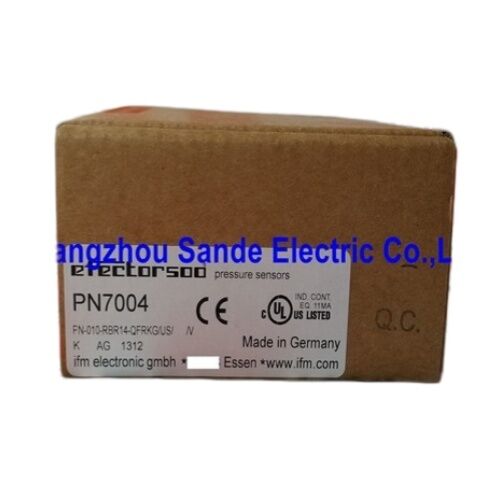
IFM PN7004 | Electronic Pressure Sensor — 0–10 bar, 18–36VDC, 2× PNP/NPN Outputs, G1/4 Internal, M12, IP65, 4-Digit Display
Overview
The IFM PN7004 is an electronic pressure sensor covering −1 to 10 bar, with two independently programmable switching outputs, an integrated 4-digit alphanumeric display, and a G¼" female (internal) thread process connection. Within IFM's PN7000 series, the PN7004 occupies the low-pressure end alongside the PN7000's 400 bar capability — these two sensors serve entirely different application spaces despite sharing the same housing platform and programming interface.
The −1 to 10 bar range is the domain of pneumatic systems and low-pressure processes.
Compressed air supplies for industrial machines typically operate at 6–8 bar; vacuum ejectors for suction grippers operate between 0 and −1 bar gauge; cooling water circuits run at 3–8 bar depending on system height and pump pressure.
The PN7004 handles all of these with a single measurement range, and the integrated display provides direct pressure readout at the sensing point without additional instrumentation.
Two programmable switching outputs are the PN7004's most practically valuable feature compared to simpler single-output pressure switches.
In any system that needs both a control setpoint and an alarm setpoint — a compressor that loads at 5 bar and alarms below 3 bar, a hydraulic circuit that enables a cycle at 60 bar and alarms above 80 bar — the PN7004 replaces two separate sensors with one.
Both setpoints monitor the same pressure connection; both connect independently to the PLC; both switch at their individually programmed threshold levels.
Key Specifications
| Parameter |
Value |
| Measuring Range |
−1 to 10 bar (−0.1 to 1.0 MPa) |
| Proof Pressure |
75 bar |
| Burst Pressure |
150 bar |
| Supply Voltage |
18–36V DC |
| Outputs |
2 × PNP or NPN switching |
| OUT1 Function |
Pressure switch |
| OUT2 Function |
Pressure switch or diagnostic |
| Display |
4-digit alphanumeric |
| Process Connection |
G¼" internal (female) thread |
| Electrical Connection |
M12 connector, 4-pin |
| IP Rating |
IP65 |
| Operating Temperature |
−25°C to +80°C |
−1 to 10 Bar — Vacuum Through Pneumatic
The measurement range beginning at −1 bar makes the PN7004 directly applicable to vacuum applications without requiring a separate sensor. Industrial vacuum systems for suction grippers, vacuum forming, and degassing applications operate between 0 and −0.95 bar gauge (approaching full vacuum).
The PN7004 covers this range at the lower boundary and the compressed air supply at the upper — a single sensor per pressure monitoring point for systems that use both vacuum and positive pressure at different points in their cycle.
The 10 bar upper range covers the full spectrum of pneumatic machine pressure. Standard industrial compressor delivery to pneumatic distribution is typically 6–8 bar; after pressure regulators and losses, point-of-use pressure is 4–6 bar; high-pressure pneumatic applications (some clamping cylinders, pneumatic presses) reach 8–10 bar.
The PN7004 handles all of these without exceeding its measurement range.
Overload Protection: 75 Bar Proof, 150 Bar Burst
Seventy-five bar proof pressure against a 10 bar measurement range is a 7.5:1 overload factor.
This is IFM's recognition that even low-pressure pneumatic and hydraulic systems experience transient pressure events substantially above their normal operating range — pump starts, valve slam, accumulator discharges, and hydraulic cylinder end-stop impacts all generate transients that may exceed the setpoint multiple times.
The 75 bar proof pressure ensures the PN7004's ceramic measuring cell survives these events without zero shift or permanent damage.
FAQ
Q1: What is the difference between PN7004 and PN7000, and how do I choose?
The PN7004 measures −1 to 10 bar with IP65 and G¼" internal (female) thread, intended for pneumatic systems, low-pressure hydraulics, and instrument air. The PN7000 measures 0–400 bar with IP67 and G¼" external (male) thread, for main hydraulic circuits in high-pressure machinery.
Both have the same 18–36V DC supply, PNP/NPN outputs, M12 connector, and integrated display. Select based on the measurement range: if your system operates below 10 bar, PN7004; above 10 bar, consider the PN7000 or a mid-range PN series variant.
Q2: Can OUT2 on the PN7004 function as a second independent pressure switch?
Yes. OUT2 is programmable either as a second independent switching output at a different setpoint from OUT1, or as a diagnostic output that signals the sensor's internal status. When configured as a second switching output, both outputs switch independently at their respective programmed setpoints, each with its own hysteresis setting.
This makes the PN7004 equivalent to two independent single-output pressure switches sharing one measurement point.
Q3: The G¼" connection is listed as internal thread — what hardware does the sensor connect to?
G¼" internal (female) thread means the sensor body contains a female socket into which a male G¼" BSP fitting is screwed. To install the PN7004, a male G¼" BSP nipple, adapter, or direct fitting from the machine's pressure line must mate with the sensor's socket.
Many hydraulic and pneumatic manifolds provide female G¼" ports — the PN7000 (male thread) would connect to these directly, but the PN7004 (female thread) requires a male-thread fitting or adapter. Verify the connection format at the machine's pressure tap before ordering.
Q4: The PN7004 replaces PB7024 and PN7024 — is this a direct drop-in replacement?
IFM lists the PN7004 as a replacement for these earlier models, with compatible measuring range, output type, and process connection. The programming interface and display differ from the older models.
The electrical and mechanical installation should be compatible in most cases. Check the M12 connector pin-out of the original installation against the PN7004's connector assignment before wiring.
Q5: Is IP65 adequate for hydraulic machine environments, or is IP67 required?
IP65 covers complete dust exclusion and protection against water jets from any direction — adequate for the oil mist, coolant splash, and incidental fluid exposure typical of hydraulic machine environments.
IP67 (temporary immersion) is needed when the sensor may be submerged or subjected to high-pressure fluid flooding.
For the majority of pneumatic and hydraulic panel installations where the sensor is inside a machine cabinet or on an accessible manifold, IP65 is sufficient.
For sensors mounted in sumps, trenches, or locations where fluid accumulation is possible, IP67 provides additional protection.


 Your message must be between 20-3,000 characters!