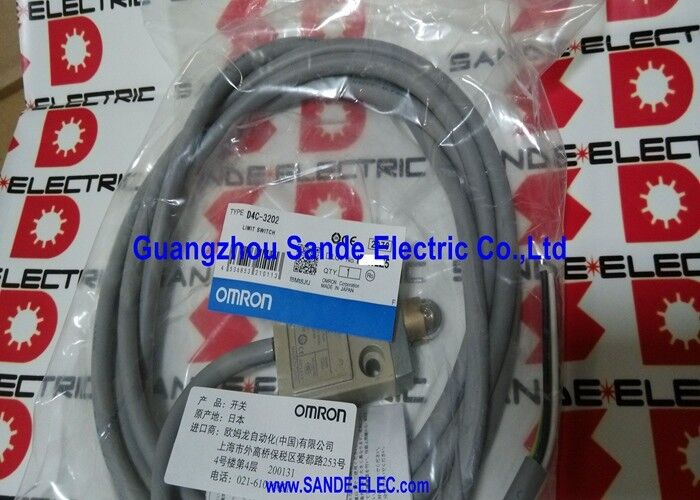
Omron D4C-3202 | Compact Enclosed Limit Switch — Roller Plunger / SPDT / 4A DC / IP67 Triple-Sealed / 3m VCTF Cable
Triple-Sealed IP67 — Three Barriers, Not One
IP67 on a limit switch requires sealing at three separate ingress points, because the housing has three potential paths for fluid entry. The D4C-3202 addresses each independently:
Plunger seal: A nitrile rubber packing seal and diaphragm that travels with the actuator throughout its full stroke — the plunger can operate at any point in its range without breaking the fluid barrier.
Switch chamber seal: A nitrile rubber cap over the contact assembly that isolates the contacts from any fluid that passes the plunger stage.
Cable entry seal: Encapsulating material that fills the gap between cable jacket and housing completely.
A switch that seals only two of three paths will fail in sustained coolant immersion even with an IP65 or IP66 rating. For machine tool applications where the switch body can pool in coolant at the bottom of a machining enclosure, the D4C-3202's three-stage construction is what maintains the IP67 rating in real operating conditions over the switch's service life.
Key Specifications
| Parameter |
Value |
| Actuator |
Roller plunger |
| Contacts |
SPDT (NO + NC) |
| Rating |
4A / 30V DC |
| Operating Force |
11.77 N |
| Release Force |
4.41 N |
| IP |
IP67 (triple-sealed) |
| Cable |
VCTF oil-resistant, 3 m |
| Inrush (NC) |
20 A max |
| Inrush (NO) |
10 A max |
| Mechanical Life |
10,000,000 ops |
| Housing |
Die-cast aluminium |
SPDT — One Switch Body, Two Wiring Options
The single-pole double-throw contact (1 NO + 1 NC on a common terminal) allows the D4C-3202 to serve two functions simultaneously from one switch body. The 4-core VCTF cable carries all three switch connections (common, NO, NC) plus shield/ground, enabling both a safety interlock function (NC contact, fail-safe logic) and a position confirmation signal (NO contact) to be wired from the same cable run without running two separate cables from the switch location.
Roller Plunger — Self-Releasing at 11.77 N
The roller at the plunger tip reduces lateral force from oblique cam approaches, protecting the plunger shaft and guide bearings from side-loading that would otherwise reduce actuator service life. The plunger self-releases under spring force when the cam moves away — unlike a roller lever actuator that can be held in the actuated position by a stationary cam, the plunger always returns to rest position when cam contact is removed.
The 11.77 N / 4.41 N operating and release force differential defines the switching hysteresis. The 10,000,000 mechanical operation rating suits high-cycle position confirmation applications running hundreds of cycles per hour across long production periods.
VCTF Cable — Oil Resistance That Lasts
Standard PVC cable degrades in sustained oil exposure as the plasticiser migrates into the surrounding oil, leaving the jacket brittle and eventually cracked. VCTF (Vinyl Cabtire flexible) compounds resist plasticiser migration, maintaining jacket flexibility through the machine's service life alongside cutting oils, hydraulic fluids, and water-based coolants.
FAQ
Q1: Can the D4C-3202 switch inductive loads such as solenoid valves directly?
For inductive DC loads, the 4A rating must be derated based on the load's L/R time constant. The 4A rating applies to resistive (non-inductive) loads at 30V DC. For solenoid coils or relay coils at significant currents, verify the load current against Omron's inductive load rating for the D4C series. For borderline cases, use an intermediate relay to protect the contacts.
Q2: What is the difference between D4C-3202 and D4C-2202?
Both are roller plunger, IP67, 3m VCTF cable D4C switches. The D4C-3202 is rated at 4A/30V DC — for DC 24V PLC-controlled machines. The D4C-2202 is rated at 5A/125V AC — for AC control circuits in older machine designs. Select based on the control circuit voltage.
Q3: Can D4C switches be gang-mounted for multi-position detection?
Yes. D4C plunger models are designed for gang mounting — multiple switches side by side with plungers on a common actuator rail, each switching independently. Up to 6 switches can be gang-mounted. Omron supplies mounting hardware for gang configurations used in multi-position detection arrays.
Q4: The operating force is 11.77 N. Does approach angle affect this?
The 11.77 N specification is the axial force required perpendicular to the plunger axis. When a cam approaches the roller at an oblique angle, the axial force component is reduced — requiring more total cam force to achieve the required 11.77 N axial component. The cam or dog must be designed to deliver sufficient axial force at all intended approach angles and operating speeds.
Q5: Does the red LED draw from the switch contacts?
Yes — the LED is powered from the NO contact in parallel with the connected load. It draws a small current when the switch is activated. For PLC input loads (5–15mA), the LED current is negligible. For loads near the 4A maximum, subtract the LED's parallel current from the available load current. Omron's D4C documentation specifies the LED current draw.


 Your message must be between 20-3,000 characters!