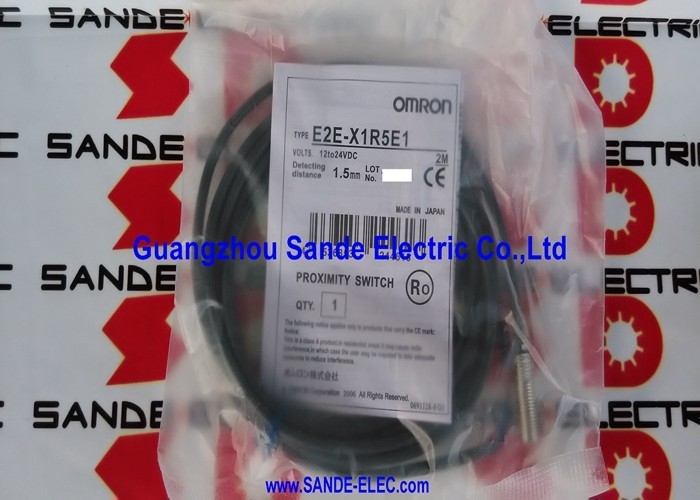
Omron Proximity Switch E2E-X1R5E1 E2EX1R5E1
Product Overview
The Omron E2E-X1R5E1 is a shielded M8 inductive proximity sensor delivering a 1.5mm nominal sensing distance with a 3-wire NPN normally open output on a 12-24V DC supply.
At 2kHz switching frequency, it sits at the fast end of the standard E2E shielded M8 range—ideal for applications where the detection rate exceeds what a lower-frequency sensor can reliably track, while maintaining the familiar E2E series reliability, IP67 oil-proof sealing, and flush-mount mechanical compatibility.
The 1.5mm sensing distance makes this sensor perfect for confirming that very small targets are precisely where they should be, or for detecting fine features (slots, holes, edges, pins, blades) on components where a longer sensing range would introduce ambiguity about which feature triggered the output.
Key Specifications
| Parameter |
Value |
| Sensing Distance |
1.5 mm (±10%) |
| Setting Distance |
0-1.2 mm |
| Differential Distance |
10% max of Sn |
| Housing |
M8 × 1mm, shielded |
| Output |
NPN, NO, 3-wire |
| Supply Voltage |
12-24V DC |
| Operating Range |
10-30V DC |
| Current Consumption |
13 mA max |
| Response Frequency |
2 kHz |
| Standard Target |
Iron 8 × 8 × 1 mm |
| IP Rating |
IP67 + oil-proof |
| Temperature Range |
−40°C to +85°C |
| Approvals |
CE, CCC |
High-Speed Sensing in Compact Housing
Two kilohertz means the E2E-X1R5E1 completes a full detection cycle—ON to OFF and back to ON—in 0.5 milliseconds. For high-speed applications where targets pass the sensor face rapidly, this switching speed determines the maximum target passing rate the sensor can reliably resolve.
A practical example: a 20-tooth gear rotating at 6,000 RPM generates 100 tooth-passing events per second (100 Hz). At 2kHz, the E2E-X1R5E1 handles this with a 20:1 safety margin. For most machine tool applications, 2kHz provides ample headroom for detection rates encountered in spindle rotation sensing, conveyor counting, and cam shaft position feedback.
Flush Mounting Capability
The shielded construction of the E2E-X1R5E1 focuses its electromagnetic sensing field forward from the sensing face, suppressing lateral field extension through internal shielding integrated into the M8 body.
This allows the sensor to be installed flush in a metal bracket—face level with the surrounding metal—without the surrounding metal absorbing the sensing field and reducing the 1.5mm range. For the M8 body size, flush mounting is particularly valuable in tight machine locations where the sensor's compact 8mm diameter is part of the design constraint.
Environmental Protection
IP67 covers complete dust exclusion and temporary immersion to 1 metre. Omron's additional "oil-proof" classification confirms that the sealing materials are qualified for sustained exposure to cutting oil and coolant, not just water.
The −40°C to +85°C operating temperature range accommodates both cold-start conditions in unheated facilities and the elevated ambient temperatures inside machine enclosures where coolant and spindle motor heat raise the local temperature above room ambient.
Frequently Asked Questions
Q1: The output is NPN—how does this connect to a PLC digital input?
NPN (sinking) output connection: brown wire to +24V DC, blue wire to supply common (0V), black wire (output) to PLC input terminal. The PLC input must be type-compatible with NPN sinking sensors—the input terminal expects to be pulled low (toward 0V) when the sensor activates. For PNP-input-only PLC cards, use the PNP variant of this sensor (E2E-X1R5F1) instead of adding interface adapters.
Q2: The sensing distance is 1.5mm—how is the setting distance (0-1.2mm) different?
The sensing distance (1.5mm) is the nominal distance at which the sensor switches reliably under ideal standard test conditions. The setting distance (0-1.2mm) is the practical working range—the gap at which the sensor can be configured to switch reliably in an actual installation, accounting for manufacturing tolerance, temperature effects, and voltage variation.
Q3: How does the E2E-X1R5E1 perform on stainless steel targets versus standard iron?
The 1.5mm sensing distance is rated for the standard iron test target. Stainless steel (non-magnetic) has a correction factor of approximately 0.6-0.8× for E2E shielded sensors, producing an effective sensing distance of 0.9-1.2mm. For stainless steel detection at 1.5mm range, verify the actual switching point with the specific stainless grade and target dimensions in the actual installation configuration.
Q4: The 3-wire design requires a separate supply wire—is the third wire a nuisance in confined spaces?
The third wire (typically brown, +24V supply) is the trade-off for the clean switching performance of 3-wire sensors: no minimum load current requirement, negligible off-state leakage, and rail-to-rail voltage swing on the output. In confined installations where pulling three conductors is problematic, a 2-wire DC variant of the E2E series (D-suffix models) reduces to two conductors at the cost of a minimum load current requirement and off-state leakage.
Q5: What causes the most common E2E sensor failures in machine tool environments, and how can they be prevented?
The most common failure modes are: cable damage from coolant accumulation in the cable entry (mitigated by routing cable upward from the sensor to create a drip loop), mechanical damage to the sensing face from direct contact with chips or workpieces (mitigated by correct sensing gap and mechanical guarding), and connector corrosion in connector-type variants (mitigated by ensuring the M12 connector is fully mated and sealed).


 Your message must be between 20-3,000 characters!