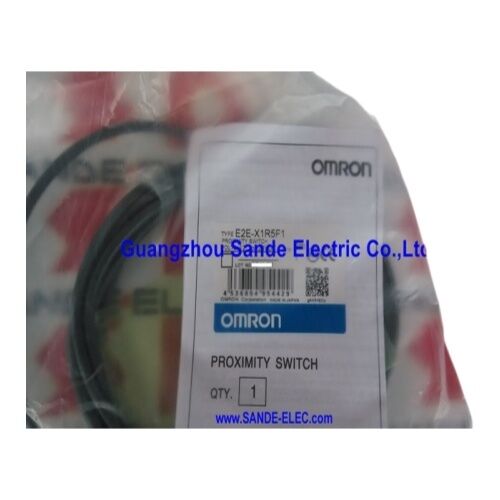
OMRON Proximity Switch Sensor E2E-X1R5F1 E2EX1R5F1
Product Overview
The Omron E2E-X1R5F1 is a shielded M8 inductive proximity sensor in the E2E series, producing a PNP sourcing output on a 3-wire circuit. Its 1.5mm sensing distance, 2kHz switching frequency, and stainless steel housing combine in a package that threads into an M8 hole to handle the fastest, tightest detection tasks in the E2E standard range.
The 2kHz performance specification sets this model apart from most M8 sensors. A single switching cycle takes 0.5ms — fast enough to reliably count teeth on small gears spinning at high speed, detect holes in rotating discs at several thousand RPM, or capture individual slots on encoder discs where slower sensors would merge detections into continuous output.
The stainless steel housing provides material durability for applications where M8 sensors are typically deployed — tight fixture cavities, inside tooling assemblies, and detection points inside machine working zones where coolant, chips, and incidental mechanical contact are normal conditions.
Key Specifications
| Parameter |
Value |
| Sensing Distance |
1.5 mm (±10%) |
| Setting Distance |
0-1.2 mm |
| Housing |
M8 × 1mm, shielded, stainless steel |
| Output |
PNP, NO, 3-wire |
| Supply Voltage |
12-24V DC (10-40V operating) |
| Current Consumption |
13 mA max |
| Switching Capacity |
0-200 mA |
| Response Frequency |
2 kHz |
| Standard Target |
Iron 8 × 8 × 1 mm |
| IP Rating |
IP67 |
| Operating Temperature |
−40°C to +85°C |
| Housing Material |
SUS (stainless steel) |
| Protection |
Surge, short-circuit, reverse polarity |
Shielded M8 Design Features
Shielded construction focuses the electromagnetic field directly forward from the sensing face, allowing flush installation in metal brackets with no reduction in the 1.5mm sensing distance. The surrounding metal does not absorb the forward-projected field, enabling recessed installation in protective metalwork without compromising detection.
The M8 thread and lock nut provide fine axial adjustment after initial mounting, allowing precise gap setting before the lock nut is tightened. For detecting features smaller than the standard 8mm target, actual switching distance should be measured with the specific target to confirm reliable detection.
Performance Characteristics
At 2kHz average response frequency, the E2E-X1R5F1 handles up to 2,000 detection cycles per second. For reliable detection with safety margin, actual detection rates should be kept within 50-70% of the 2kHz maximum (approximately 1,000-1,400 events per second).
The 10-40V operating range extends beyond typical 10-30V ranges, accommodating 24V systems with generous regulation tolerance and occasional 36V nominal industrial supplies encountered in retrofit installations.
Frequently Asked Questions
Q1: What is the difference between the E2E-X1R5F1 (PNP) and the E2E-X1R5E1 (NPN)?
Both are M8 shielded 3-wire sensors with identical physical construction, 1.5mm sensing distance, 2kHz frequency, and IP67 protection. The F1 suffix indicates PNP (sourcing) output, while E1 indicates NPN (sinking) output. Select F1/PNP for PNP-input PLC cards (European standard) and E1/NPN for NPN-input cards (Japanese/East Asian standard).
Q2: The part is listed as Obsolete — can I still source it, and is there a direct replacement?
Obsolete status means Omron has discontinued manufacturing, but surplus and refurbished stock remain available. Omron's current equivalent in the E2E series is the E2EW or E2ER series with equivalent M8 shielded PNP specifications. Verify cable color coding, connector type, and supply voltage requirements before substitution.
Q3: The switching capacity is listed as 0-200mA. Is there a minimum current requirement?
Unlike 2-wire sensors, the E2E-X1R5F1's 3-wire PNP output has no minimum load current requirement. Zero load current (open-circuit output) is permissible. The 200mA maximum is the absolute upper limit; sustained operation near this limit should be avoided in continuously energized applications.
Q4: What does the −40°C to +85°C temperature range mean for hot machine environments?
This range represents the ambient temperature the sensor body can withstand while meeting sensing specifications. At the upper end, 85°C refers to cabinet air temperature at the sensor location — not surface temperature of mounting brackets or workpieces. Verify actual ambient temperature against this limit in heated environments.
Q5: The standard sensing object is 8×8×1mm iron — what happens with smaller targets?
Smaller targets present less surface area to the sensor's electromagnetic field, reducing flux returned to the coil and effectively reducing sensing distance. For small targets, always measure the actual switching point with the specific target and set the working gap well within the measured switching distance.



 Your message must be between 20-3,000 characters!