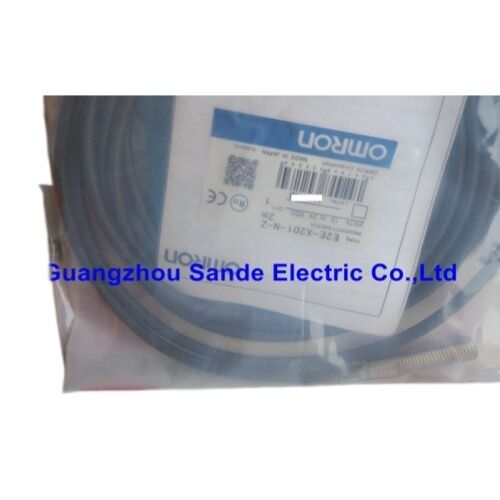
Omron E2E-X2D1-N-Z | Inductive Proximity Sensor — M8, 2mm, NPN 2-Wire NO, 10–30VDC, 1.5kHz, Stainless Steel, IP67
Overview
The Omron E2E-X2D1-N-Z is a shielded M8 inductive proximity sensor with a stainless steel housing body, 2mm sensing distance, and NPN 2-wire normally open output on cable leads.
Its 1.5kHz switching frequency — the specification that stands out most immediately — places it in a performance category above standard M8 sensors, making it the appropriate choice when the detection rate exceeds what a conventional proximity sensor can track.
Small, fast, and stainless.
Those three characteristics collectively define the application space this sensor occupies.
The M8 × 1mm thread fits holes that an M12 or M18 sensor cannot enter — tight fixture locations, narrow guide rails, small robotic tooling, instrument panels with limited clearance. The stainless steel body resists the corrosive and abrasive environments where smaller sensors are frequently deployed.
And 1.5kHz gives 0.67ms per switching cycle — the response speed needed when the machine's cycle rate would outpace a slower sensor's ability to track individual events.
The 2-wire NPN circuit carries the design simplicity of two-wire connection into the M8 category: two conductors to the sensor, connected in series with the load between the positive supply and the return.
No separate power supply conductor. The LED indicator provides visual confirmation of the output state at the sensor body — a commissioning and troubleshooting aid that helps confirm detection without needing a multimeter at the load.
Key Specifications
| Parameter |
Value |
| Sensing Distance |
2 mm |
| Housing |
M8 × 1mm, shielded, stainless steel |
| Output |
NPN, NO, 2-wire |
| Supply Voltage |
10–30V DC |
| Response Frequency |
1.5 kHz |
| Termination |
Cable leads (Z) |
| IP Rating |
IP67 |
| Indicator |
LED |
| Operating Temperature |
−25°C to +70°C |
Stainless Steel at M8 — Built for Demanding Small-Space Installations
Stainless steel housing is not universal in the M8 sensor category — brass with nickel plating is more common, and some M8 sensors use plastic bodies.
The stainless steel body on the E2E-X2D1-N-Z addresses the environments where M8 sensors are most likely to be installed: inside tooling and fixtures that are handled frequently, in spray-heavy coolant zones, in food-adjacent equipment where cleaning regimes are aggressive, and in applications where the sensor body may be contacted by passing workpieces or tooling changes.
The stainless body holds its surface condition under sustained chemical exposure and mechanical contact that would visibly degrade a plated brass housing over months of service. This matters not just cosmetically but functionally: a corroded or pitted housing surface at the sensing face area can affect the electromagnetic field uniformity and, over extreme cases of degradation, the sensing distance.
Stainless steel housing maintains dimensional and surface integrity through the sensor's service life with minimal maintenance.
IP67 protection at M8 is consistent with the sensor's use cases — the 2mm sensing distance means the sensor is always installed very close to the target, typically inside the machine's working zone where coolant, chips, and cleaning fluid exposure is realistic.
1.5kHz — The Frequency Case
Standard M8 inductive sensors typically switch at 200–800Hz. The E2E-X2D1-N-Z's 1.5kHz rate — a full switching cycle every 0.67ms — enables reliable detection in applications that lower-frequency sensors cannot serve. Two examples make this concrete.
On a rotary indexing table with 48 indexing positions running at 20 indexes per second, the sensor detecting each index position must switch 20 times per second — 20Hz, trivially within any sensor's capability.
But if the same machine is used to detect individual teeth on a 200-tooth encoder disc on the index drive shaft, the tooth-passing rate at full speed is 200 × (table RPM).
At 100 RPM of the drive shaft, that is 20,000 tooth events per minute — 333 events per second, or 333Hz. At 200 RPM, it doubles to 667Hz. The E2E-X2D1-N-Z's 1.5kHz handles 667Hz tooth detection with a 2× safety margin and covers drive shaft speeds up to 450 RPM at 200 teeth before approaching the sensor's limit.
The second case is small part counting on high-speed conveyors, where individual components pass the sensor face at rates measured in hundreds per second.
Here the combination of 2mm sensing distance — implying a very small sensing spot that captures each small component cleanly without overlap — and 1.5kHz switching frequency gives reliable individual part counts at throughput rates that standard sensors would merge into a continuous ON signal.
FAQ
Q1: The output is "NPN 2-wire" — how does this wire to a PLC input?
Two-wire NPN: connect the sensor's positive wire to the DC supply positive, and the sensor's negative (output) wire in series with the PLC input to the supply common. When a target is detected, the sensor conducts through the load (PLC input to common).
The sensor will have a small off-state leakage current flowing through the PLC input even when no target is present — confirm that this leakage is below the PLC input's turn-on threshold to prevent false outputs. If leakage causes a false ON, add a parallel resistor across the PLC input (typically 5.6–10kΩ) to shunt the leakage current below threshold.
Q2: Is 2mm sensing distance sufficient for practical machine applications, or is this too short?
Two millimetres is designed for detection scenarios where the sensor must be installed in very tight mechanical clearance and the target passes reliably within 1–1.5mm of the sensor face.
Typical uses include detecting small metallic parts in fixtures, confirming the presence of pins, screws, or inserts in assembly pallets, and detecting thin metal features (slots, edges, holes) on rotating components.
The very short sensing distance is a feature, not a limitation — it gives sharp on/off transitions with minimal hysteresis and predictable detection boundaries in tight mechanical arrangements.
Q3: Does the M8 stainless steel housing require any special mounting tools?
Standard M8 × 1mm metric hex nuts and lock nuts are used — the same tool size as any M8 fastener. Stainless steel lock nuts are recommended to match the housing corrosion resistance and avoid galvanic issues at the thread interface in wet environments.
Tighten the lock nuts to finger-tight plus approximately 1/4 turn with a spanner — excessive torque on M8 stainless threads risks galling. Apply anti-seize compound to the threads in stainless-to-stainless installations to prevent thread galling during future removal.
Q4: At 1.5kHz switching frequency, what is the maximum speed of a metallic target that this sensor can reliably detect?
The maximum detection rate depends on both frequency and target size. At 1.5kHz, the minimum detectable pulse width is approximately 0.33ms. For a target to be detected reliably, it must remain within the sensing field for at least one full switching cycle.
A 2mm target passing the sensor face at 1 m/s occupies the field for approximately 2ms — well within the 0.67ms cycle time. At 10 m/s, the 2mm target occupies the field for 0.2ms, which is shorter than one cycle — the sensor may miss it.
For small fast-moving targets, verify the target size and velocity combination against the sensor's response time specification before committing to the installation.
Q5: Can the E2E-X2D1-N-Z be installed in a stainless steel bracket without reducing its sensing distance?
As a shielded sensor, the E2E-X2D1-N-Z can be mounted flush in a metal bracket — including stainless steel — without the surrounding metal reducing the 2mm sensing distance. The internal shielding confines the field to the forward-facing direction.
Ensure the lock nut clamps the sensor firmly enough that vibration during machine operation cannot loosen the axial position, as even 0.5mm of sensor movement at 2mm nominal sensing distance represents a 25% change in the detection gap.



 Your message must be between 20-3,000 characters!