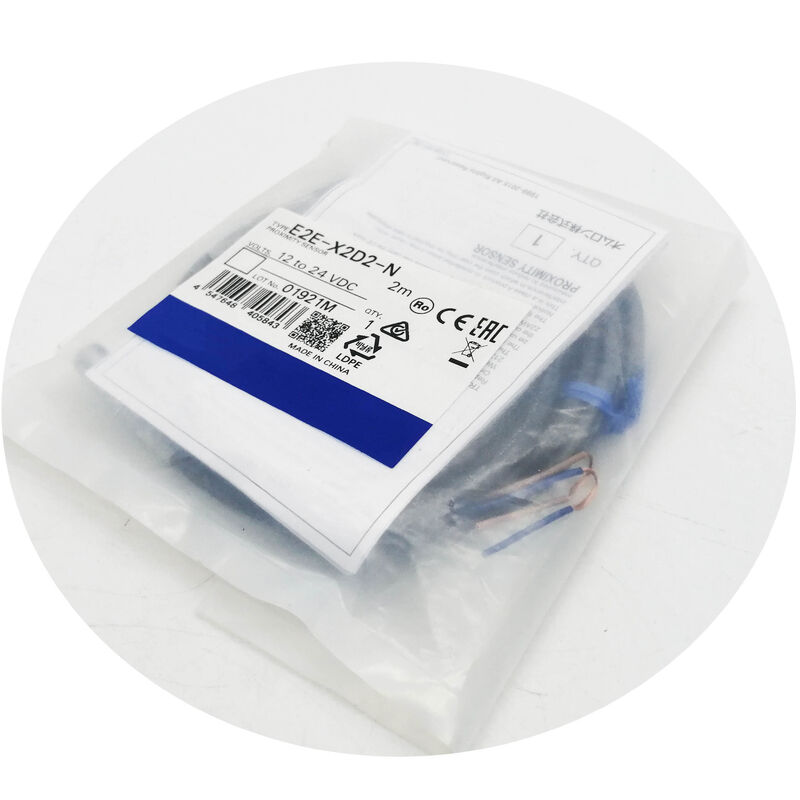
Omron E2E-X2D2-N | Inductive Proximity Sensor — M8 Shielded, 2mm NC, DC 2-Wire, 10–30VDC, 1.5kHz, Stainless Steel, IP67 Oil-Proof, 2m Cable
Overview
The Omron E2E-X2D2-N is the normally closed variant of the E2E M8 shielded 2mm DC 2-wire sensor — the physical twin of the E2E-X2D1-N in every respect except the output state logic.
Where the D1 variant opens its circuit when no target is present and closes it when a target is detected, the D2 conducts when idle and opens when the target approaches.
That reversal — NC instead of NO — changes nothing about the sensor's physical construction, sensing distance, housing material, or installation footprint, but it fundamentally changes how the sensor integrates into a control circuit.
NC sensors carry an inherent fail-safe characteristic that NO sensors do not. In a normally closed circuit, a sensor failure — cable break, connector fault, power loss — produces the same signal as "target detected": the circuit opens.
For safety interlocks and machine guard monitoring, this is the desirable behaviour: any fault condition causes the machine to see an open circuit, which the control logic treats as a guard-open or unsafe condition and responds to by stopping the machine.
A normally open circuit, by contrast, fails to the opposite state — an open circuit that the machine might interpret as "no target present, safe to continue."
In machine tool practice, the E2E-X2D2-N is appropriate wherever the absence of a target must produce an active (energised) output signal: guard-closed confirmation, fixture-unclamped detection, door-fully-retracted verification, and chip conveyor-running confirmation where the output being energised is the normal condition and a de-energised output signals an anomaly.
Key Specifications
| Parameter |
Value |
| Sensing Distance |
2 mm (±10%) |
| Setting Distance |
0–1.6 mm |
| Housing |
M8 × 1mm, shielded, SUS303 stainless steel |
| Output |
DC 2-wire, NC, with polarity |
| Supply Voltage |
12–24V DC |
| Operating Range |
10–30V DC |
| Switching Capacity |
3–100 mA |
| Leakage Current |
0.8 mA max |
| Response Frequency |
1.5 kHz |
| Cable |
2m oil-resistant PVC |
| IP Rating |
IP67 + oil-proof |
| Housing Material |
SUS303 stainless steel |
| Standards |
EN60947-1, EN60947-5-2, CE |
NC vs NO — The Control Logic Decision
Choosing between NC and NO is a control design decision before it is a sensor selection decision. The question to ask is: what physical state should produce an active (energised) output?
If the answer is "target present = output ON" — standard position confirmation, part-present verification, end-of-stroke detection — use the NO variant (E2E-X2D1-N). The circuit is normally open; target detection closes it and energises the load.
If the answer is "target absent = output ON" — door closed monitoring, guard presence confirmation, safe-to-operate interlock — use the NC variant (E2E-X2D2-N). The circuit is normally conducting; target detection opens it and de-energises the load, which the PLC program interprets as a condition change.
In the NC configuration, the sensor does its detection work in reverse: when the guard or door is in the safe (closed/present) position, the target (mounted on the door/guard) is in the sensing field, the E2E-X2D2-N's output is open, and the PLC input reads OFF.
This seems counterintuitive but is the standard safety circuit approach — the PLC program confirms safety by expecting the input to be OFF, and any condition that opens the circuit (including cable fault) produces the same OFF reading.
Stainless Steel Housing in Machine Tool Environments
The SUS303 stainless steel housing of the E2E-X2D2-N resists the combined chemical attack of alkaline water-based cutting coolants (which attack brass), neat cutting oils, hydraulic fluid contamination, and the cleaning agents used in machine maintenance.
Brass housings with nickel plating tolerate short-term exposure well but can develop pitting corrosion in long-term coolant immersion — particularly with high-concentration alkaline coolants.
Stainless steel eliminates this failure mode, which matters in sensor installations that are expected to run continuously for years without replacement.
The PBT (polybutylene terephthalate) thermoplastic sensing face provides additional chemical resistance for the sensor's most exposed surface — the face that is directly aimed at the target and receives the highest fluid contact.
PBT maintains its dimensional stability and surface smoothness in oils and coolants that would swell or degrade softer plastics, preserving the sensing face geometry that determines the sensor's air gap accuracy over its service life.
FAQ
Q1: In the NC configuration, what does the PLC input read when the E2E-X2D2-N is installed and powered but no target is in range?
When powered with no target in the sensing field, the E2E-X2D2-N output transistor conducts — current flows through the load (PLC input) and the input reads ON (logic 1, assuming positive logic).
When a target enters the 2mm sensing field, the output opens — current drops to the 0.8 mA leakage level and the PLC input reads OFF (logic 0). This is the NC output behaviour: conducting at idle, opens on detection.
Q2: The E2E-X2D2-N has NC output — does it matter which wire is positive and which is negative in installation?
Yes, it matters. The DC 2-wire circuit is polarised — the sensor has defined positive and negative terminals despite having only two wires.
Reversing the connections prevents normal operation. Omron's standard wire colour coding for DC 2-wire sensors is: brown wire = supply positive (connect to +24V DC), blue wire = load/output (connect in series with load to supply common).
The surge suppressor protection prevents permanent damage from brief polarity reversal, but correct wiring is required for operation.
Q3: Can the E2E-X2D2-N sense through a thin non-ferrous metal cover to detect a ferrous target behind it?
The E2E-X2D2-N's sensing field penetrates non-metallic materials (plastic covers, glass, paint) with minimal effect.
Non-ferrous metal sheets between the sensor and target are more complex: thin aluminium or brass sheets reduce the field somewhat but may allow the ferrous target to still be detected if the combined gap (sheet thickness + air gap to target) remains within the effective sensing range.
Thick non-ferrous metal shields absorb the field more significantly.
Testing with the specific materials in the actual installation is the only reliable way to confirm detection capability through an intermediate non-ferrous layer.
Q4: At 1.5kHz frequency, what is the fastest target motion the E2E-X2D2-N can reliably track?
At 1.5kHz switching frequency, each ON-OFF-ON cycle takes 0.67ms. For reliable tracking, a target must remain within the sensing field for at least one full cycle.
A 2mm target passing at 3 m/s crosses the sensor's sensing zone in approximately 0.67ms — right at the sensor's tracking limit.
For reliable detection, the target should either be larger than 2mm or move more slowly than 3 m/s.
For counting applications with fast-moving targets, the target transit time must be calculated against this frequency limit with a safety margin.
Q5: Is there any setting or calibration required after installing the E2E-X2D2-N?
No calibration is required. The E2E-X2D2-N is factory-calibrated for its 2mm sensing distance.
Installation involves threading the sensor into an M8 hole at the correct sensing gap (within the 0–1.6mm setting distance), securing with the lock nuts, connecting the two wires, and verifying correct operation by confirming the output state changes when a ferrous target enters and exits the sensing field.
The LED indicator confirms output state at the sensor body. No potentiometer, teach button, or software parameter is required for standard operation.



 Your message must be between 20-3,000 characters!