logo
Guangzhou Sande Electric Co.,Ltd.
Email Sales01@sande-elec.com TEL: 86--18620505228
Home > Products > Industrial Automation Sensors >
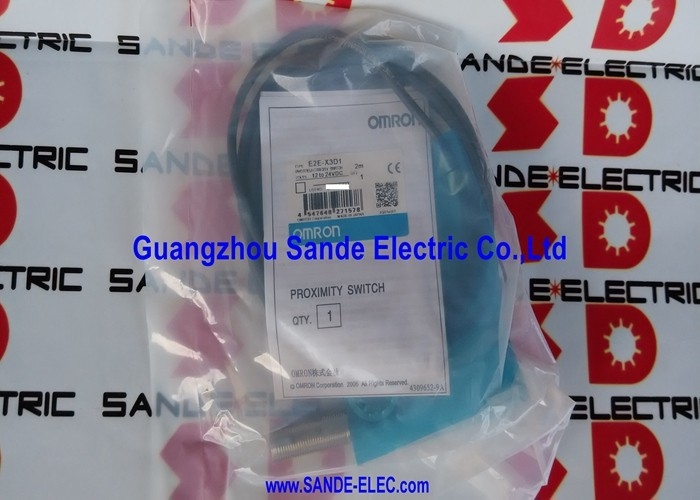
Proximity Switch E2E-X3D1 E2EX3D1
  • Proximity Switch   E2E-X3D1  E2EX3D1

Proximity Switch E2E-X3D1 E2EX3D1

Place of Origin japan
Brand Name OMRON
Certification CE ROHS
Model Number E2E-X3D1
Product Details
Condition:
New Factory Seal(NFS)
Item No.:
E2E-X3D1
Origin:
Japan
Highlight: 

proximity industrial automation sensors

,

proximity smc pneumatic rotary actuator

,

switch industrial automation sensors

Payment & Shipping Terms
Minimum Order Quantity
1 pcs
Packaging Details
original packing
Delivery Time
0-3 days
Payment Terms
T/T,PayPal,Western Union
Supply Ability
100 pcs/day
Product Description

Omron E2E-X3D1 | Inductive Proximity Sensor — M12 Shielded, 3mm NO, DC 2-Wire, 10–30VDC, 1kHz, Nickel-Plated Brass, IP67 Oil-Proof


Overview

The Omron E2E-X3D1 is an M12 shielded inductive proximity sensor with a 3mm sensing distance and DC 2-wire normally open output. Stepping up from the M8 body to M12 brings two advantages: the larger thread provides more secure mechanical mounting in high-vibration machine environments, and the larger sensing face area generates a stronger electromagnetic field — which is why the E2E-X3D1 achieves 3mm sensing from a shielded M12 body when an M8 shielded sensor of the same type reaches only 2mm.

The 3mm sensing distance and 0–2.4mm setting range give the installer more working clearance between the sensor face and the target than smaller M8 sensors allow.

This additional tolerance absorbs misalignment during target approach, mechanical wear in the actuating mechanism, and thermal expansion of the structural components that hold the sensor and target — all of which change the effective gap over the machine's operating cycle.

Where an M8 sensor set at 1.5mm might approach its operating limit as the machine heats up and structures expand, the E2E-X3D1 set at 2mm sits comfortably within its 2.4mm setting range across the full thermal range.

Available in multiple connection variants — pre-wired 2m or 5m oil-resistant PVC cable (E2E-X3D1-N), M12 connector (E2E-X3D1-M1), or M12 IEC-arrangement connector (E2E-X3D1-M1G) — the E2E-X3D1 fits the machine wiring standard of the installation without adapter hardware.


Key Specifications

Parameter Value
Sensing Distance 3 mm (±10%)
Setting Distance 0–2.4 mm
Housing M12 × 1mm, shielded
Output DC 2-wire, NO, with polarity
Supply Voltage 12–24V DC
Operating Range 10–30V DC
Switching Capacity 3–100 mA
Leakage Current 0.8 mA max
Response Frequency 1 kHz
Standard Target Iron 12 × 12 × 1 mm
IP Rating IP67 + oil-proof
Housing Material Nickel-plated brass
Indicators Red LED (output) + Green LED (setting range)
Standards EN60947-1, EN60947-5-2, CE

Dual LED Indicators — Red Output + Green Setting Range

The E2E-X3D1 features two LED indicators that serve distinct commissioning and operational functions, a step up from the single-LED designs found on smaller M8 sensors.

The red LED mirrors the output state: it illuminates when the output is conducting (target detected, circuit active) and extinguishes when the output is open (no target). During production monitoring, the red LED provides continuous visual confirmation of each detection event — particularly useful for verifying that a conveyor is counting parts correctly or that a cylinder is reaching its end position on every cycle.

The green LED is the setting range indicator: it illuminates when the target is within the 0–2.4mm setting range — the zone where detection is reliable and stable. During installation, with the machine set up and the target at its intended position, the green LED should illuminate steadily.

If the green LED flickers or fails to illuminate when the target is at the intended position, the sensor is operating near or outside its reliable setting range and the gap needs adjustment. This indicator eliminates the need for a separate multimeter or diagnostic screen during initial setup.


M12 Body — Greater Sensing Distance, Stronger Mounting

The M12 thread standard is the dominant mechanical format for industrial proximity sensors in European and global machine design.

The larger thread cross-section (12mm diameter versus 8mm for M8) provides greater torque capacity in the lock nut, reducing the risk of the sensor rotating under vibration. 

In applications on rotating machine tables, high-cycle presses, or equipment subject to continuous mechanical vibration, the M12 thread maintains sensor position far more reliably than M8 over extended service periods.

Nickel-plated brass is the standard housing material for M12 E2E sensors.

The nickel plating provides corrosion resistance against the cutting coolants and oils encountered in machine tool environments, while the underlying brass provides good machinability and dimensional accuracy for the precision thread.

For applications requiring maximum corrosion resistance — particularly aggressive coolants or washdown environments — stainless steel housing variants of the E2E M12 series are available.


Applications and Connection Options

Three millimetres of sensing distance in an M12 shielded body is the specification that covers the largest share of general machine tool position sensing: end-of-travel on pneumatic cylinders, part-present confirmation in fixtures, pallet location detection on conveyor systems, and safety guard monitoring.

The wider sensing range of M12 sensors (relative to M8) also makes them appropriate for detecting targets with surface variation — cast or formed parts where the presented surface is not perfectly flat or consistent, requiring a sensing range that maintains reliable detection across the surface variation.

Connection variants allow the same E2E-X3D1 sensing specification to be installed with the wiring standard of the machine: the pre-wired N 2M variant routes directly to a terminal strip without any field connectors; the M1 and M1G connector variants mate with Omron's M12 field cable assemblies, allowing the sensor to be replaced without disturbing the machine's wiring harness.


FAQ

Q1: What is the difference between the E2E-X3D1 (M12) and E2E-X2D1 (M8) in a practical application?

Both are shielded DC 2-wire NO sensors with similar circuit characteristics. The key differences are physical size (M12 vs M8), sensing distance (3mm vs 2mm), response frequency (1kHz vs 1.5kHz), and standard target size (12×12mm vs 8×8mm).

Choose M8 for tight installation spaces or where only a small target is being detected. Choose M12 for higher sensing distance, better mounting stability in vibration-prone locations, or when detecting larger target features.

The M12 body also accommodates a dual-LED indicator not available on the M8 variant.


Q2: The setting distance is 0–2.4mm on a 3mm rated sensor — why is the setting range less than the nominal sensing distance?

Omron rates the nominal sensing distance at 3mm as the distance at which the sensor reliably detects the standard test target under defined laboratory conditions.

The setting range (0–2.4mm, approximately 80% of nominal) is the practical working zone that accounts for real-world variables: manufacturing tolerance (±10% of Sn), temperature effects (±10% over −25°C to +70°C), voltage variation (±1% over the rated voltage range), and target surface variation.

Setting within the 0–2.4mm range provides margin against all these variables simultaneously, ensuring reliable switching across the full range of operating conditions.


Q3: The standard target is 12 × 12 × 1mm iron — what if the actual target material is stainless steel?

Stainless steel (non-magnetic austenitic grades such as 304 or 316) has a correction factor of approximately 0.6–0.75× for E2E shielded sensors. For the E2E-X3D1, this translates to an effective sensing distance of approximately 1.8–2.25mm for a 316 stainless target of the same size as the standard iron test plate.

Set the installation gap within the calculated effective range for stainless, and verify the actual switching point before finalising the mechanical mounting.

Magnetic stainless grades (such as 430) behave closer to iron and may produce distances near the nominal rating.


Q4: Can multiple E2E-X3D1 sensors be mounted side by side without interfering with each other?

Mutual interference between shielded inductive sensors is possible when two sensors are mounted facing each other with their sensing fields overlapping, or when mounted side by side at very close spacing.

Omron specifies minimum face-to-face and side-by-side distances for the E2E M12 series to prevent mutual interference.

For standard-frequency models at side-by-side spacing, the minimum separation is typically in the range of 30–40mm between sensor faces.

For applications requiring closer spacing, different-frequency variants (the E2E-X3D15 series) allow adjacent sensors to operate at different oscillation frequencies, enabling much closer installation.


Q5: The E2E-X3D1 is listed without a specific cable suffix — what connection options are available?

The E2E-X3D1 designates the sensor core specification (3mm, shielded, M12, DC 2-wire, NO). Connection variants include: E2E-X3D1-N 2M or 5M (pre-wired oil-resistant PVC cable, bare end leads, 2 or 5 metres); E2E-X3D1-M1 (M12 pre-wired connector, standard pin arrangement); E2E-X3D1-M1G (M12 connector, IEC pin arrangement).

All variants provide identical sensing performance — the connection type is the only difference. Select based on the machine's existing M12 cable infrastructure or whether a direct-wire installation without field connectors is preferred.

Contact Us at Any Time

+86 18620505228
10/F,Jia Yue Building, Chebei Road,Tianhe district,Guangzhou,China
Send your inquiry directly to us