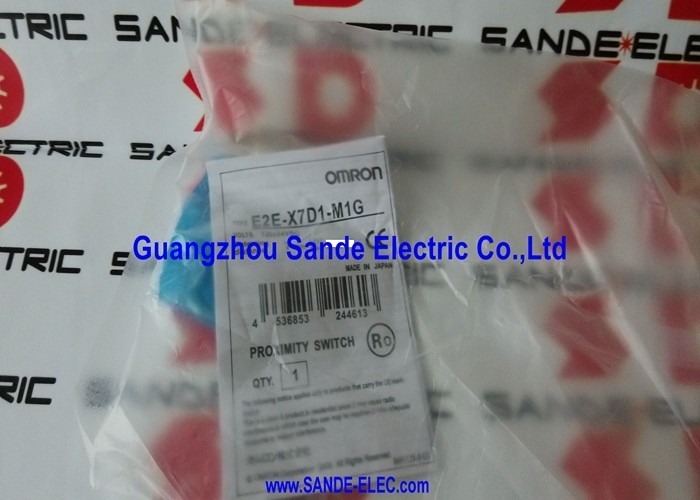
Omron E2E-X7D1-M1G | M18 Shielded Inductive Proximity Sensor — 7mm / DC 2-Wire / IP67 + IP69K / M12
Part Number: E2E-X7D1-M1G
Manufacturer: Omron (Japan)
Product Type: Inductive Proximity Sensor — M18 Shielded
Sensing Distance: 7 mm (±10%)
Setting Distance: 0–5.6 mm
Built for Washdown Environments
Standard industrial proximity sensors handle machine coolant and incidental splashing. The E2E-X7D1-M1G goes further. The dual IP67/IP69K rating and stainless steel body make it a direct choice for food processing, beverage production, pharmaceutical manufacturing, and industrial washing systems — anywhere that sensors must survive hot-water high-pressure cleaning without removal or protection.
IP67 and IP69K are different tests, not a single one. IP67 covers temporary immersion to one metre for 30 minutes — the baseline for wet machine environments. IP69K is the IEC 60529 high-pressure, high-temperature jet test: 80°C minimum water temperature, high pressure, directed from 10–15 cm at multiple angles. A sensor rated IP67 only does not necessarily survive IP69K conditions. The E2E-X7D1-M1G has been qualified against both independently, making it suitable for CIP (clean-in-place) and SIP (steam-in-place) cycles that are standard in regulated food and pharma facilities.
The M12 IEC connector supports this environment practically. In washdown areas, sensors need to be replaceable without accessing terminal strips. The M12 connection disconnects in a quarter-turn, letting maintenance swap a sensor without touching the fixed cable run. When mated with an M12 cable assembly also rated to IP69K, the full sensor assembly maintains its protection rating.
7mm Sensing Distance and 38mm Thread — Why Both Matter
The step from M12 body to M18 more than doubles the sensing distance — from 3mm to 7mm. In food processing and pharmaceutical equipment made from stainless steel, that 7mm gap accommodates fabrication tolerances in welded frames, thermal expansion between cold start and operating temperature, and the clearance needed to avoid contact between sensor face and target under vibration loading.
The 0–5.6mm setting distance gives a stable working zone. The switching point varies less than 10% across the −25°C to +70°C operating range — useful in plants where temperature cycles from ambient to hot washdown to process temperature are routine.
The 38mm thread length (versus the 30mm typical of standard M18 sensors) allows secure installation through thick-wall stainless steel machine frames. More thread engagement means better pull-out resistance and a more stable mechanical installation against cyclic loads.
Key Specifications
| Parameter |
Value |
| Sensing Distance |
7 mm (±10%) |
| Setting Distance |
0–5.6 mm |
| Output |
DC 2-wire NO, polarised |
| Supply |
12–24V DC |
| Switching |
3–100 mA |
| Response |
500 Hz |
| Connection |
M12 IEC |
| Thread |
M18 × 1 mm, stainless |
| Overall Length |
53 mm / Thread 38 mm |
| IP |
IP67 + IP69K |
| Temperature |
−25°C to +70°C |
FAQ
Q1: What cleaning agents are compatible with the E2E-X7D1-M1G?
The stainless housing and PBT sensing face resist alkaline CIP chemicals (caustic soda, sodium hypochlorite), phosphoric acid cleaners, and quaternary ammonium compounds — the standard food and beverage cleaning agents. For aggressive acids such as nitric acid in dairy CIP, or specialised solvents, verify compatibility of the sensing face material against the specific agent and concentration before committing to an installation.
Q2: At 500Hz, is this sensor suitable for counting applications on production lines?
At 500Hz, the sensor resolves 500 ON/OFF cycles per second. For conveyor counting — bottles, cans, packages — at up to 100 items per second, this gives a 5:1 safety margin. For very high-speed lines where items pass at several hundred per second, verify that the item's transit time exceeds the sensor's minimum detection period. Higher-frequency E2E variants are available for demanding counting applications.
Q3: Does the M12 connector maintain IP69K protection during washdown?
Only when mated with an M12 cable connector also rated to IP69K. An unmated connector should be protected with an IP69K-rated blanking plug. The sensor connector alone cannot maintain its rating without the correct mating connector fully installed and locked.
Q4: Why is the 38mm thread length significant?
Standard M18 E2E sensors have approximately 30mm thread length. The extra 8mm on the E2E-X7D1-M1G suits thick-wall stainless steel equipment frames common in sanitary applications. Greater thread engagement improves pull-out resistance and distributes clamping force across more thread turns for a more stable installation.
Q5: Does the 7mm sensing distance apply to stainless steel targets?
The 7mm figure is rated for iron (the standard test material). For austenitic stainless steel (grades 304/316), apply a correction factor of approximately 0.6–0.75× — effective sensing distance of roughly 4.2–5.25mm. For aluminium or titanium, correction is approximately 0.3–0.4×. Confirm actual switching distance with the intended target material in the specific installation before finalising the mechanical design.



 Your message must be between 20-3,000 characters!