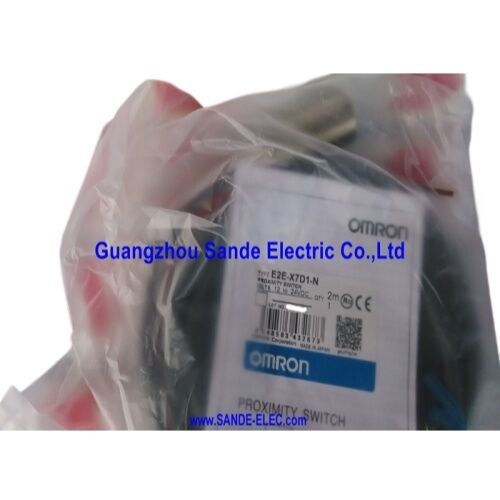
Omron E2E-X7D1-N | Inductive Proximity Sensor — M18, 7mm, DC 2-Wire NO, 10–30VDC, 500Hz, IP67, Shielded
Overview
The Omron E2E-X7D1-N is a shielded M18 inductive proximity sensor wired as a DC 2-wire device — no separate power supply conductor, just two wires connecting the sensor into the load circuit between the DC positive supply and the load.
It detects ferrous metal targets at up to 7mm and switches a 3–100mA load at up to 500Hz, with 0.8mA leakage in the off state and IP67 protection against both dust ingress and temporary immersion.
The DC 2-wire circuit is structurally the same as a mechanical switch wired in series with its load: one wire to supply positive, one wire to the load, load to supply return.
When a target is present, the sensor's internal circuit conducts and current flows through the load.
When the target is absent, the circuit is open — apart from the 0.8mA leakage that flows through the load even in the off state. The two-wire topology requires no external power supply wire and simplifies panel wiring in machines where every conductor counts, while the polarised design prevents damage from reversed supply connections.
Two status LEDs — a red operation indicator that shows the current output state and a green setting indicator that confirms the target is within the usable setting range — provide commissioning feedback that two-wire sensors of older generations did not offer.
The green LED is particularly useful during setup: it illuminates when the target distance is within the 0–5.6mm setting range, confirming that the installation gap is both within sensing range and within the zone where stable, bounce-free switching is reliable.
Key Specifications
| Parameter |
Value |
| Sensing Distance |
7 mm (−10% to +10%) |
| Setting Distance |
0–5.6 mm |
| Housing |
M18 × 1mm, shielded |
| Output |
DC 2-wire, NO, with polarity |
| Supply Voltage |
12–24V DC (10–30V operating) |
| Switching Capacity |
3–100 mA |
| Leakage Current |
0.8 mA max |
| Response Frequency |
500 Hz |
| Standard Target |
Iron 18 × 18 × 1 mm |
| IP Rating |
IP67 + oil-proof |
| Housing Material |
Nickel-plated brass / PBT |
| Operating Temperature |
−25°C to +70°C |
| Indicators |
Red (output state) + Green (setting range) |
| Protection |
Surge suppressor, short-circuit protection |
| Approvals |
CE, EN60947-1, EN60947-5-2 |
Shielded at M18 — Flush Mounting with 7mm Sensing
Shielded (flush-mountable) inductive sensors contain the electromagnetic sensing field within the sensor body's forward projection, suppressing sideways field extension through integral shielding built into the housing. The E2E-X7D1-N can be mounted with its face flush to a metal bracket surface, surrounded by metal on all sides, without the surrounding metal absorbing the forward sensing field and reducing detection range.
Seven millimetres of sensing distance from a shielded M18 design is a well-balanced specification.
M18 shielded sensors in the standard E2E class typically achieve 5–7mm; the 7mm rating of the X7D variant is toward the upper end of what shielded M18 construction provides.
In bracket-flush installations the full 7mm gap between the sensor face and the target's nearest approach point is available, with the setting range of 0–5.6mm providing the working zone where detection is stable.
The nickel-plated brass housing is a mechanical specification choice as well as a material one: nickel plating protects the underlying brass from the corrosive effects of cutting oil, coolant, and the alkaline cleaning agents used in machine wash-down cycles, while the brass body provides the thermal conductivity needed to dissipate the small heat generated by the sensor's oscillator circuit in continuous operation.
DC 2-Wire Output — Leakage Current and Load Selection
The 0.8mA maximum leakage current through the E2E-X7D1-N's off-state output is the specification that most directly affects load selection. This current flows through the connected load even when no target is present. For most PLC input cards — which draw 5–20mA for a logic 1 and have a clear threshold above 2mA — 0.8mA is well below the turn-on threshold and causes no false triggering.
Where false outputs from leakage become a concern, a bypass resistor across the load (PLC input or relay coil) shunts the leakage current and prevents false activation. The resistor value should be calculated to keep the voltage drop across the load below its turn-on threshold when 0.8mA flows through the parallel combination.
Typically 5.6kΩ to 10kΩ resistors accomplish this for standard 24V PLC inputs without measurably affecting the sensor's behaviour when the output is actively conducting.
The 3mA minimum load current is equally important: the sensor's internal output circuit requires at least 3mA flowing through it to maintain stable switching.
Loads that draw less than 3mA — very high-impedance PLC inputs on some modern controllers — may not provide sufficient current for stable operation, resulting in intermittent or unreliable output switching.
FAQ
Q1: What is the difference between the E2E-X7D1-N (2-wire DC) and a 3-wire NPN version of the same sensor?
The 2-wire DC version (this sensor) connects in series with the load — two wires total, no separate supply conductor. The load must handle the off-state leakage current of 0.8mA, and the minimum load current is 3mA.
The 3-wire NPN version (e.g., E2E-X7ME1) uses a separate supply wire, a common wire, and an output wire — the output transistor switches the load to common with no minimum load current requirement and negligible leakage.
Choose the 2-wire version for simple two-conductor replacement of mechanical limit switches; choose the 3-wire version for sensitive loads (low-impedance PLC inputs, logic gate inputs) that cannot tolerate leakage or require minimum-current-free switching.
Q2: The sensor has two LEDs — what does each one indicate?
The red LED reflects the current output state: lit when the output is conducting (target detected, NO output ON), off when no target is present.
The green LED is a setting range indicator: it illuminates when the target is within the 0–5.6mm setting range — confirming that the installed gap is suitable for stable switching. During setup, the green LED should be ON when the target is at the intended detection position and OFF when the target is absent or beyond the sensing range. If the green LED is OFF when the target is at the intended position, the gap exceeds the 5.6mm setting limit.
Q3: Can the E2E-X7D1-N sense stainless steel or aluminium targets?
Yes, with reduced effective sensing distance. Stainless steel (non-magnetic grade) produces approximately 60–75% of the iron sensing distance — roughly 4.2–5.25mm.
Aluminium produces approximately 35–45% — approximately 2.5–3.2mm. Copper is the least responsive, typically under 2mm effective distance.
For non-ferrous targets, measure the actual switching distance with the specific material at installation conditions and set the gap within the measured effective range with a safety margin.
Q4: What does "with polarity" mean for the DC 2-wire output?
"With polarity" means the sensor has a defined positive and negative supply terminal — the two wires are not interchangeable. Reversing the supply connections will prevent normal operation; however, the reverse polarity surge suppressor in the protection circuit prevents damage from brief polarity reversal during installation.
Standard Omron 2-wire cable colours: brown = positive supply connection, blue = negative supply connection (to load return). Always verify wiring from the product's label or data sheet.
Q5: Is the E2E-X7D1-N appropriate for mounting in an aluminium bracket?
Yes. As a shielded sensor, the E2E-X7D1-N can be mounted flush in both steel and aluminium brackets.
The shielding inside the sensor body focuses the field forward and prevents the surrounding bracket material from reducing the sensing range — whether the bracket is ferrous steel or non-ferrous aluminium.
This contrasts with unshielded sensors, which are affected by any metal within their specified minimum side and rear clearances regardless of material type.



 Your message must be between 20-3,000 characters!