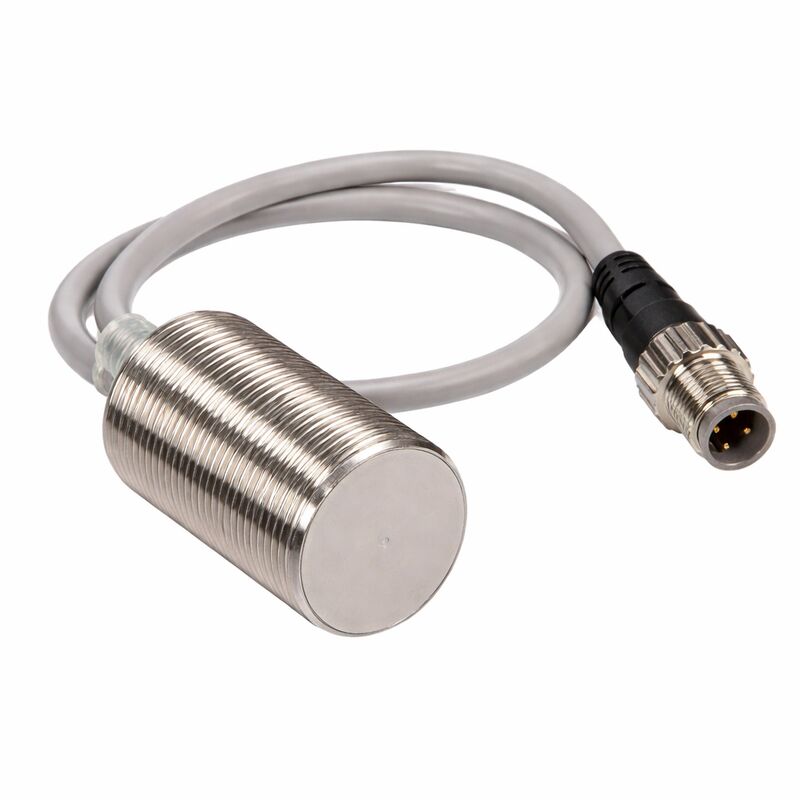
Omron E2E-X10D1-M1G M30 Shielded Proximity Sensor
Overview
The Omron E2E-X10D1-M1G is an M30 inductive proximity sensor designed for reliable metal detection in industrial machinery that needs a straightforward DC 2-wire interface and a connector-based installation format.
Within the E2E family, this specification set aligns with a shielded, embeddable, normally open configuration with a 10 mm sensing distance, making it a practical choice for conveyors, machine frames, tooling stations, and automated handling equipment where robust cylindrical sensors are preferred.
A key strength of this model is its balance between mechanical simplicity and industrial durability.
The M30 threaded body gives it a familiar mounting format for panel builders and OEMs, while the DC 2-wire polarized design helps simplify wiring in control systems that rely on standard proximity sensor inputs.
For applications that need a flush-mounted sensor in a metal bracket or machine wall, the shielded construction is especially useful because it supports more predictable installation in tight metal surroundings.
From an operating standpoint, the 10 mm sensing class is well suited to repeatable ferrous-metal detection where the target position is stable and the machine cycle depends on clean switching behavior.
The E2E platform is also known for IP67 protection, oil-resistant construction, and an ambient operating range down to -25 °C and up to +70 °C, which makes this sensor a strong fit for day-to-day factory environments rather than light-duty bench applications.
Key Specifications
| Parameter |
Value |
| Model |
E2E-X10D1-M1G |
| Sensor Type |
Inductive proximity sensor |
| Housing Size |
M30 |
| Mounting Style |
Shielded / embeddable / flush mount |
| Power Source |
DC 2-wire, polarized |
| Output |
Normally open (NO) |
| Sensing Distance |
10 mm |
| Setting Distance |
0 to 8 mm |
| Response Frequency |
400 Hz max. |
| Connection |
M12 connector |
| Supply Voltage |
10 to 30 VDC |
| Nominal Voltage |
12 to 24 VDC |
| Housing Material |
Nickel-plated brass |
| Sensing Surface |
Thermoplastic P.B.T. |
| Protection Rating |
IP67 |
| Ambient Temperature |
-25 to +70 °C |
Shielded M30 Format — Better for Metal Mounting
The shielded M30 format is one of the most practical reasons to choose this model.
In real machine construction, sensors are often mounted directly into steel brackets, aluminum plates, or compact machine housings, and a shielded design helps keep the sensing field concentrated at the front face.
That makes the installation more predictable and reduces the risk of surrounding metal affecting the switching point.
For builders and maintenance teams, this matters because a sensor that is easy to embed cleanly into a machine frame is often more valuable than one with similar electrical data but less installation flexibility.
In compact industrial layouts, the combination of M30 body size and flush-mount capability can simplify both original assembly and later replacement work.
DC 2-Wire Wiring — Useful in Standard Control Circuits
A DC 2-wire proximity sensor is often selected when the goal is straightforward integration into established control circuits.
In practical use, it can reduce wiring complexity compared with some 3-wire arrangements, especially in equipment where the input architecture already expects 2-wire field devices. The normally open output is also a familiar choice for general presence detection, stop confirmation, and machine sequencing.
The connector-based M12 format adds another practical advantage: it can make replacement faster and cleaner than a permanently wired sensor in applications where access is limited or downtime matters.
That is one reason connectorized E2E models remain useful in OEM equipment and field service alike.
FAQ
Q1: What kind of applications is E2E-X10D1-M1G best suited for?
It is best suited for general industrial metal detection in conveyors, machine tools, fixtures, transfer mechanisms, and automated handling stations.
The 10 mm sensing class and M30 body make it especially useful where the target position is stable and the machine needs a robust cylindrical sensor with straightforward installation.
Q2: Why is the shielded flush-mount design important?
A shielded flush-mount design helps the sensor operate more predictably when installed in metal brackets or machine frames.
In practical engineering terms, that means easier integration, less unwanted side influence from nearby metal, and more reliable switching behavior in compact equipment layouts.
Q3: What are the main electrical points engineers should check before installation?
The most important checks are the DC 2-wire interface, the normally open output logic, the operating voltage range of 10 to 30 VDC, and the control input compatibility of the receiving device.
Because 2-wire sensors behave differently from 3-wire models in some circuits, the engineer should also confirm load behavior and panel-side input expectations before installation.
Q4: Is this sensor suitable for demanding factory environments?
Yes. The E2E family is published with IP67 protection and an ambient operating range from -25 °C to +70 °C, and the body uses industrial materials suited to regular exposure to oil-resistant machine environments.
That makes this model appropriate for daily industrial duty when installed correctly.
Q5: What should buyers verify before ordering a replacement?
Buyers should confirm the exact model marking, M30 body size, shielded mounting requirement, connector style, and the expected sensing distance in the machine.
For replacement work, matching the mechanical format and wiring method is just as important as matching the part number.



 Your message must be between 20-3,000 characters!