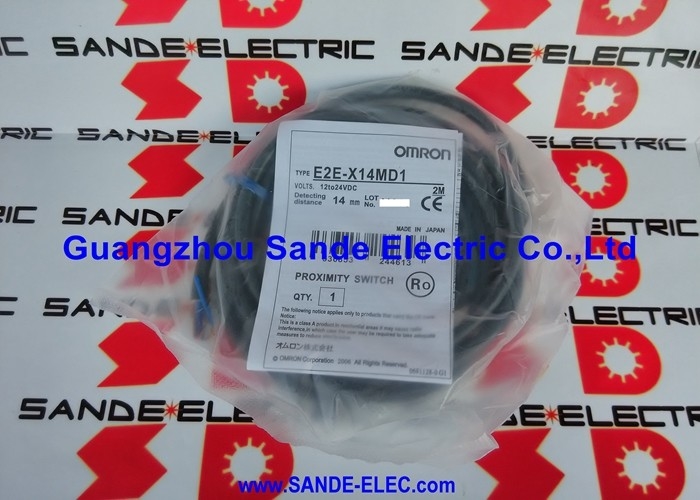
Omron E2E-X14MD1 M18 Standard Proximity Sensor
Overview
The Omron E2E-X14MD1 is an M18 inductive proximity sensor designed for standard industrial sensing tasks where a longer M18 sensing distance is useful without moving up to a larger M30 body.
Within the E2E family, the 14 mm class is associated with an unshielded cylindrical design, DC 2-wire operation, and normally open switching, which makes this model well suited to machine detection tasks that need more installation tolerance than shorter-range M18 sensors typically provide.
This model is a practical choice for equipment builders who want a familiar threaded barrel sensor with clean integration into PLC or control-circuit inputs.
The E2E platform supports oil-resistant cable options, stable sensing of ferrous metal targets, and IP67 protection, which helps the sensor remain useful in everyday industrial environments such as conveyors, packaging equipment, assembly tooling, and parts-transfer stations.
Because it is an unshielded M18 type, the E2E-X14MD1 is often favored where the machine can allow a little more open space around the sensing face and the designer wants the advantage of a longer nominal sensing distance.
In practice, that can make setup easier in applications where mechanical tolerance, bracket variation, or part approach distance would be too tight for a shorter-range flush-mount device.
Key Specifications
| Parameter |
Value |
| Model |
E2E-X14MD1 |
| Sensor Type |
Inductive proximity sensor |
| Housing Size |
M18 |
| Mounting Style |
Unshielded |
| Power Source |
DC 2-wire |
| Output |
Normally open (NO) |
| Sensing Distance |
14 mm |
| Setting Distance |
0 to 11.2 mm |
| Differential Distance |
10% max. of sensing distance |
| Standard Sensing Object |
Iron 30 × 30 × 1 mm |
| Response Frequency |
400 Hz |
| Supply Voltage |
12 to 24 VDC |
| Operating Voltage Range |
10 to 30 VDC |
| Protection Rating |
IP67 |
| Ambient Temperature |
-25 to +70 °C |
| Cable Version |
Pre-wired model |
14 mm M18 Sensing — More Installation Margin
One of the strongest practical points of E2E-X14MD1 is the 14 mm sensing distance in an M18 form factor. In real machine design, that gives the installer more margin for bracket tolerance, part approach variation, and minor mechanical offset than shorter-range M18 sensors.
That can make commissioning easier and reduce nuisance adjustments during maintenance.
This does not mean it is a better sensor for every job, but it does mean it is a useful option when the sensing target is not perfectly controlled or when a little extra stand-off distance helps the machine design.
For OEMs and retrofit teams, that added installation margin is often a real operational advantage.
Unshielded Design — Best Used with Proper Clearance
Because this model is unshielded, it should be installed with appropriate spacing from surrounding metal around the sensing face. In practice, that is normal for longer-range cylindrical proximity sensors: the wider sensing field helps achieve the range, but it also means the mounting geometry matters more than with a flush-mount shielded design.
When used in a suitable mechanical layout, the unshielded design can work very well in standard automation equipment.
It gives the machine builder a useful sensing envelope without forcing a larger sensor size or a more complex detection method.
FAQ
Q1: What kind of applications is E2E-X14MD1 best suited for?
It is best suited for general machine detection tasks where an M18 sensor is preferred but a longer sensing distance is needed.
Common examples include part presence confirmation, stop-position sensing, bracket-mounted machine logic, and transfer or conveyor detection in industrial automation equipment.
Q2: Why would an engineer choose a 14 mm unshielded M18 sensor?
The main reason is installation margin. A 14 mm sensing distance in an M18 package can make setup easier where the target does not pass very close to the sensor face or where bracket tolerances and product variation leave less room for a short-range device.
Q3: What should users know about the unshielded design before installation?
An unshielded sensor needs proper clearance around the sensing face because nearby metal can affect performance.
In engineering practice, this means the mounting arrangement should be checked early, especially if the sensor will be recessed into a metal structure or installed near other conductive parts.
Q4: Is E2E-X14MD1 suitable for regular industrial environments?
Yes. The E2E family is published with IP67 protection, industrial temperature capability, and oil-resistant construction features, which makes it suitable for routine factory use when installed within its intended application limits.
Q5: What should buyers verify before ordering?
Buyers should check the exact model number, the required sensing distance, the mounting clearance for an unshielded sensor, the wiring concept, and the cable style used on the machine. For replacement work, confirming those physical and electrical details is usually the safest path.


 Your message must be between 20-3,000 characters!