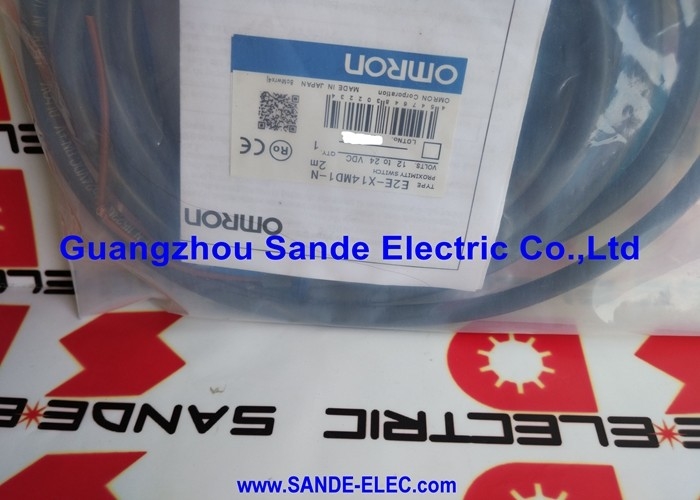
Omron E2E-X14MD1-N M18 Proximity Sensor
Overview
The Omron E2E-X14MD1-N is best positioned as an M18 inductive proximity sensor for standard industrial metal detection where a 14 mm sensing distance and DC 2-wire normally open output are required.
Public product listings identify it as an E2E-series proximity sensor with a 14 mm measuring range, pre-cable connection method, and IP67 protection, while Omron’s E2E family documentation supports the same core operating class for M18 14 mm unshielded DC 2-wire NO models.
In practical automation work, this kind of sensor is selected for stable presence detection, stop-point confirmation, and machine sequence logic where a threaded cylindrical body and a longer M18 sensing distance are desirable.
The DC 2-wire format makes it especially suitable for control systems that are already built around standard two-wire sensor wiring and do not need more complex field-device interfaces.
The strength of this model is not in complexity, but in familiarity and reliability. For maintenance teams and OEM builders, an E2E-series M18 sensor is often chosen because it is easy to integrate, simple to understand, and well matched to everyday factory use.
That makes E2E-X14MD1-N a sensible choice for installed-machine support, replacement demand, and general automation detection tasks.
Key Specifications
| Parameter |
Value |
| Model |
E2E-X14MD1-N |
| Sensor Type |
Inductive proximity sensor |
| Housing Size |
M18 |
| Mounting Style |
Unshielded |
| Power Source |
DC 2-wire |
| Output |
Normally open (NO) |
| Sensing Distance |
14 mm |
| Setting Distance |
0 to 11.2 mm |
| Response Frequency |
400 Hz |
| Connection Method |
Pre-cable |
| Cable Length |
2 m |
| Supply Voltage |
12 to 24 VDC |
| Protection Rating |
IP67 |
| Operating Temperature |
-25 to +70 °C |
Pre-Cable Construction — Practical for Direct Replacement
A pre-cable version is often preferred in machines where the original sensor was directly wired into the harness rather than connected through a field plug.
In those situations, keeping the same connection style can make replacement more straightforward and avoid introducing new adapter points into the wiring path.
That is one reason pre-cabled E2E models remain common in repair and support scenarios.
From a maintenance standpoint, this can also help preserve the original machine layout.
When the goal is quick restoration with minimal rewiring change, a pre-cabled sensor is often more convenient than reworking the installation for a connectorized alternative.
M18 14 mm Detection — Useful for General Automation
Like the broader 14 mm E2E-X14 class, this model is a good fit for general automation tasks that need more range than a short flush sensor provides but still want the familiarity of an M18 threaded body.
That makes it useful for conveyors, parts handling, machine brackets, and general industrial sensing where stable ferrous-metal detection is required.
Because it is part of the E2E proximity sensor family, it also benefits from the platform’s established industrial profile: two-wire DC operation, IP67 environmental protection, and a design language that is familiar to control engineers and maintenance personnel.
FAQ
Q1: What kind of applications is E2E-X14MD1-N best suited for?
It is best suited for standard industrial detection tasks such as part presence sensing, machine stop confirmation, and sequence control where an M18 cylindrical sensor with a 14 mm sensing distance is appropriate. Its pre-cabled form also makes it practical for direct replacement in installed machinery.
Q2: What is the benefit of the pre-cable connection style?
A pre-cable design is often easier to use in machines that already route the sensor lead directly into a cabinet or harness.
It can simplify replacement, reduce connector-related changes, and help the repair stay closer to the original installation concept.
Q3: Is this model the same sensing class as other E2E-X14MD1 versions?
Yes, publicly available information places it in the same 14 mm M18 DC 2-wire normally open E2E sensing class.
For replacement work, however, buyers should still verify the exact suffix and connection style because that part of the model affects installation compatibility.
Q4: What should engineers check before using it as a replacement?
They should verify the exact part suffix, the cable length, the mounting clearance for the unshielded sensing head, the expected sensing distance, and the compatibility of the receiving control input.
These checks are especially important when replacing a field-installed sensor in an older machine.
Q5: Is E2E-X14MD1-N suitable for harsh industrial environments?
Yes, within normal operating limits. Public specifications list IP67 protection, and the E2E family is intended for industrial proximity sensing with oil-resistant and factory-suitable construction features.
That makes it appropriate for routine industrial use when installed correctly.



 Your message must be between 20-3,000 characters!