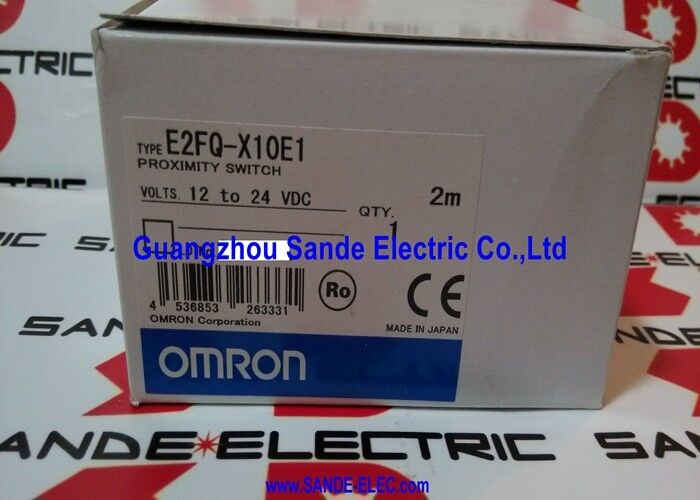
Omron E2FQ-X10E1 M30 Chemical-Resistant Proximity Sensor
Overview
The Omron E2FQ-X10E1 is a chemical-resistant inductive proximity sensor built for industrial environments where standard cylindrical sensors may be exposed to aggressive cleaning agents, splashing process fluids, or chemically demanding operating conditions.
It combines an M30 threaded body, shielded flush-mount design, DC 3-wire NPN output, and a 10 mm sensing distance, making it a practical choice for machine builders and maintenance teams that need stable metal detection with stronger environmental resistance.
In day-to-day use, this model is especially suitable for machinery where the sensor is mounted directly into metal structures and expected to perform reliably over long service cycles.
The shielded design helps keep the sensing field concentrated at the front face, which supports more predictable installation in compact brackets, housings, and stainless or plated machine frames.
That makes it well suited to process equipment, packaging machinery, washdown-prone installations, and industrial systems where chemical resistance is a real engineering requirement rather than a nice-to-have feature.
Another strength of the E2FQ-X10E1 is that it stays simple electrically. The DC 3-wire NPN normally open output is familiar to many control engineers, and the 2 m pre-wired cable keeps installation straightforward in cabinets and field wiring routes where direct cable entry is preferred over a connectorized interface.
For buyers supporting installed equipment, this combination of chemical resistance, proven cylindrical mounting, and standard control logic makes the model easy to specify with confidence.
Key Specifications
| Parameter |
Value |
| Model |
E2FQ-X10E1 |
| Sensor Type |
Inductive proximity sensor |
| Housing Size |
M30 |
| Type |
Cylindrical threaded, shielded |
| Mounting Style |
Flush / embeddable |
| Power Source |
DC 3-wire |
| Output Type |
NPN |
| Operation Mode |
NO |
| Sensing Distance |
10 mm ±10% |
| Setting Distance |
0 to 8 mm |
| Differential Distance |
10% max. of sensing distance |
| Standard Sensing Object |
Iron 30 × 30 × 1 mm |
| Response Frequency |
400 Hz |
| Supply Voltage |
12 to 24 VDC |
| Operating Voltage Range |
10 to 30 VDC |
| Current Consumption |
17 mA max. |
| Switching Capacity |
200 mA max. |
| Residual Voltage |
2 V max. |
| Connection Method |
Pre-wired, 2 m |
| Protection Rating |
IP67 |
| Ambient Temperature |
-25 to +70 °C |
| Case / Sensing Surface |
Fluororesin |
Chemical-Resistant Construction — Built for Harsh Service
The most important reason to choose this model is its chemical-resistant fluororesin construction. In practical industrial service, that matters when the sensor is installed near detergents, process liquids, frequent washdown, or environments where conventional sensor housings may degrade over time.
A sensor that can tolerate the application environment without forcing extra covers or relocation can reduce maintenance work and improve long-term reliability.
This construction also supports better consistency in equipment where the sensing point must remain fixed.
If a sensor has to be mounted exactly where the process demands it, environmental resistance becomes a performance factor, not just a durability feature. That is why the E2FQ line is especially useful in process-oriented machines and cleaning-intensive installations.
M30 Shielded Format — Easy to Integrate, Easy to Replace
The M30 threaded body and shielded sensing arrangement give this model a very practical mechanical profile.
It can be mounted in standard threaded holes or brackets, and because it is flush-mountable, it is easier to integrate neatly into metal machine structures than an unshielded long-range design. For OEM builders, that simplifies layout. For maintenance teams, it makes replacement cleaner because the physical format is familiar and predictable.
The pre-wired 2 m cable adds another practical advantage.
In many machines, direct cable routing is still the most reliable approach, especially where vibration, fluid exposure, or enclosure access make plug connections less attractive. That makes the E2FQ-X10E1 a strong fit for both new machine builds and exact replacement work.
FAQ
Q1: What kind of applications is E2FQ-X10E1 best suited for?
It is best suited for industrial metal detection in environments where chemical resistance is important, such as process machinery, washdown-prone equipment, packaging systems, and installations exposed to cleaning fluids or aggressive media. Its M30 shielded form also makes it practical in machine structures that require flush mounting.
Q2: Why is the fluororesin housing important in real use?
The fluororesin case and sensing surface improve resistance to harsh operating conditions compared with more conventional materials.
In practice, this helps the sensor maintain service life and installation flexibility in machines where chemical exposure would otherwise limit where a standard sensor could be mounted.
Q3: What should engineers check before installation?
They should confirm the DC 3-wire NPN interface, the 10 to 30 VDC operating range, the expected load current, and the mechanical mounting conditions.
Because this is a shielded flush-mount sensor, it is especially suitable where the machine design requires close metal mounting around the body.
Q4: Is this model suitable for harsh industrial environments?
Yes. Omron publishes IP67 protection, oil-proof characteristics, and an operating temperature range of -25 to +70 °C.
Combined with the chemical-resistant body materials, that gives the sensor a strong industrial profile for demanding service conditions.
Q5: What should buyers verify before ordering a replacement?
Buyers should confirm the full part number, the M30 body size, the shielded mounting requirement, the DC 3-wire NPN NO output logic, and the 2 m cable format.
For replacement work, matching both the sensing distance and the environmental specification is just as important as matching the model number.


 Your message must be between 20-3,000 characters!