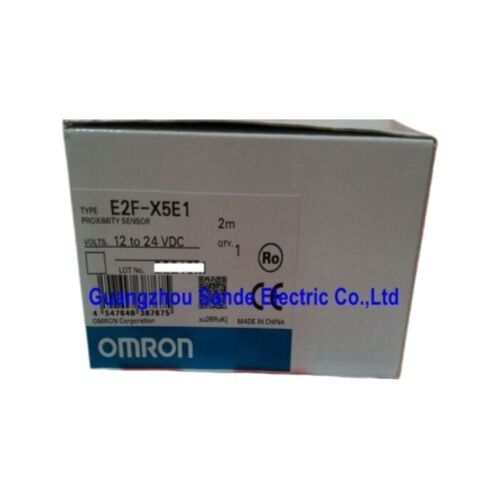
M18 Shielded Inductive Proximity Sensor, DC 3-Wire, NPN, NO
This M18 shielded inductive proximity sensor is designed for reliable short-range metal detection in industrial automation systems. Built in a cylindrical threaded housing, it is a practical choice for machines that require stable position sensing, object confirmation, and repeatable switching performance in compact mounting spaces.
With a rated sensing distance of 5 mm, this sensor is well suited for detecting ferrous metal targets in equipment such as conveyors, packaging machines, assembly stations, transfer units, and general factory automation lines.
The shielded design helps support controlled installation in metal surroundings, making it easier to integrate into machinery where space is limited and sensing consistency matters.
The DC 3-wire configuration and NPN normally open output make it compatible with many standard control systems used in industrial equipment.
It operates on 12 to 24 VDC, with an allowable operating range of 10 to 30 VDC, giving engineers flexibility in panel design and field installation.
A maximum switching capacity of 200 mA allows the sensor to handle common control input requirements with dependable output behavior.
For day-to-day industrial use, this model offers a balanced combination of compact size, stable detection, and straightforward wiring.
The red detection indicator gives operators and maintenance personnel clear visual feedback during commissioning and troubleshooting. With a response frequency of 600 Hz, it is fast enough for many routine automation tasks where repeatable sensing is more important than excessive complexity.
This sensor is a solid option for OEM machine builders, maintenance teams, and industrial buyers looking for an M18 inductive sensor that delivers dependable metal detection, easy installation, and practical control compatibility.
Technical Data
| Item |
Specification |
| Sensing Head Size |
M18 |
| Type |
Cylinder type, threaded, shielded |
| Power Source |
DC 3-wire models |
| Sensing Distance |
5 mm ±10% |
| Setting Distance |
0 to 4 mm |
| Differential Distance |
Max. 10% of sensing distance |
| Sensing Object |
Ferrous metal |
| Standard Sensing Object |
Iron 18 × 18 × 1 mm |
| Response Frequency |
600 Hz |
| Power Supply Voltage |
12 to 24 VDC, ripple (p-p) 10% max. |
| Operating Voltage Range |
10 to 30 VDC |
| Current Consumption |
17 mA max. |
| Output Type |
NPN |
| Operation Mode |
NO |
| Switching Capacity |
200 mA max. |
| Residual Voltage |
2 V max. (at 200 mA load, cable length 2 m) |
| Indicator |
Red detection indicator |
FAQ
Q1: What materials can this sensor detect, and does the target material affect performance?
This sensor is primarily designed for detecting ferrous metal targets, which provide the most stable and predictable sensing performance. It can also detect non-ferrous metals, but the effective sensing distance usually becomes shorter because different metals interact with the sensing field differently.
For best results in industrial use, the target material, target size, and mounting distance should all be considered during selection and installation.
Q2: What kinds of industrial applications is this sensor suitable for?
This sensor is well suited for short-range metal detection tasks in automation equipment, including part presence verification, stop-position sensing, cylinder position confirmation, indexing control, and transfer line monitoring.
Its M18 threaded body and shielded construction make it especially practical for machinery where mounting space is limited and reliable repeat detection is required. It is commonly used in conveyors, packaging systems, assembly fixtures, and general-purpose factory automation equipment.
Q3: What is the advantage of a shielded M18 inductive sensor in machine design?
A shielded sensor is easier to install in metal brackets or tight machine structures because the sensing field is more concentrated at the front face. This helps reduce unwanted influence from surrounding metal and makes installation more predictable in compact equipment layouts.
For machine builders and maintenance engineers, that means easier mechanical integration, cleaner mounting, and more stable sensing behavior when the installation is done within the recommended distance range.
Q4: What should users know about the NPN normally open output before wiring it into a control system?
This model uses an NPN normally open output, which means the output switches when the target is detected and is intended for control systems that accept NPN-type signal logic. Before installation, the user should confirm PLC input compatibility, supply voltage range, and load current requirements.
The switching capacity is up to 200 mA, so it is suitable for many standard control inputs, but system designers should still verify the electrical characteristics of the receiving device to ensure stable long-term operation.
Q5: What factors are most important for achieving stable sensing performance in real use?
Stable performance depends on several practical factors: the target material should ideally be ferrous metal, the target size should be close to or larger than the standard sensing object, and the mounting distance should remain within the usable setting range of 0 to 4 mm.
Engineers should also pay attention to wiring quality, power supply stability, and the mechanical repeatability of the moving part being detected. In production environments, correct installation usually matters just as much as the sensor specification itself.


 Your message must be between 20-3,000 characters!