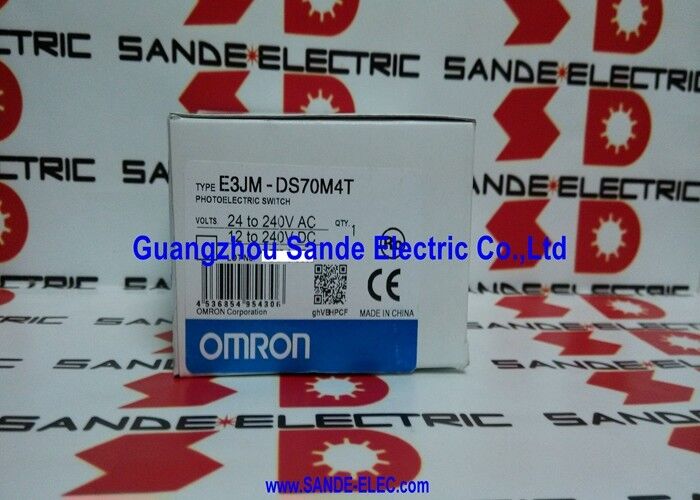
Omron E3JM-DS70M4T | Diffuse-Reflective Photoelectric Sensor — 700mm / Relay SPDT / 100–240VAC / 24–240VDC / IP66
Wide Supply, Relay Output — The Retrofit Advantage
Most photoelectric sensors ask you to match your power supply to the sensor. The E3JM-DS70M4T works the other way — it accepts both 100–240V AC and 24–240V DC, letting it fit the existing panel power standard without wiring changes. In retrofit and maintenance work, that single specification eliminates a class of compatibility problems that would otherwise require adding a power conversion stage or redesigning the panel feed for the new sensor position.
The relay SPDT output adds to this compatibility advantage. Older machine control systems — relay logic panels, mixed AC/DC interlocks, alarm circuits built around contact inputs — are directly compatible with a relay-output sensor. There is no transistor signal to adapt, no pull-up resistor to calculate, no input threshold to verify against the PLC's input card specification.
The relay contact either opens or closes, in the same way the machine's original designers expected.
Diffuse-reflective detection means no separate reflector or receiver is needed — the sensor head mounts on one side, detects the target's return signal, and switches. For applications where opposite mounting is impractical, or where the target area does not allow a through-beam or retroreflective arrangement, diffuse is the right sensing method.
Timer Functions — Built Into the Sensor
The selectable ON-delay, OFF-delay, and one-shot delay (0.1–5 seconds each) allow the sensor to manage output timing directly. On a conveyor where brief product gaps should not switch the output, an OFF-delay holds the output stable across those gaps.
On packaging equipment where a confirmation signal needs to persist for a defined period after detection, an ON-delay or one-shot creates that window without a separate timer relay in the circuit. Single-turn sensitivity adjustment sets the threshold at installation for the actual target and background conditions.
Key Specifications
| Parameter |
Value |
| Sensing Distance |
700 mm (white 200×200mm target) |
| Light Source |
IR LED, 940 nm |
| Supply |
100–240V AC / 24–240V DC |
| Output |
Relay SPDT, 250VAC 3A max |
| Operation Mode |
L-ON / D-ON selectable |
| Response Time |
30 ms max |
| Timer |
ON / OFF / One-shot, 0.1–5 s |
| Sensitivity |
Single-turn adjustment |
| IP Rating |
IP66 |
| Connection |
Terminal block |
FAQ
Q1: What applications suit the E3JM-DS70M4T best?
Conveyor and transfer equipment, packaging machines, part handling lines, gate presence monitoring, and retrofit projects in mixed-voltage control environments — anywhere that needs 700mm diffuse detection with a contact-style relay output and flexible power supply.
Q2: Why is the wide supply voltage range important?
It avoids the need to match the sensor to a specific supply voltage. A single E3JM-DS70M4T covers both 24V DC control circuits and 100–240V AC power schemes — useful when stocking a replacement sensor that must fit multiple machine types, or when replacing a sensor in a legacy panel without a dedicated low-voltage supply at the sensing point.
Q3: What is the practical advantage of relay output over transistor output?
A relay contact is universally compatible with the connected load — it switches any voltage within its rating (up to 250VAC 3A) regardless of the control circuit's logic level. No input threshold matching, no pull-up configuration, no PNP/NPN type selection. For machines with contact-based interlocks, alarm inputs, or relay logic, this simplifies integration directly.
Q4: How do the timer functions help in a real installation?
ON-delay prevents premature output switching when a target appears briefly. OFF-delay holds the output ON through short absences — preventing nuisance switching when a product briefly leaves the sensing zone. One-shot produces a fixed-duration output pulse regardless of how long the target stays in range. Each timer function addresses a specific machine timing requirement without adding a separate timer relay to the panel.
Q5: What should be verified before ordering a replacement E3JM-DS70M4T?
Confirm: sensing distance needed for the actual target and background, supply voltage at the installation point, whether a relay output is correct for the connected input, connection method (terminal block), IP66 suitability for the environment, and whether any timer function is being used in the current installation so it can be matched on the replacement.



 Your message must be between 20-3,000 characters!