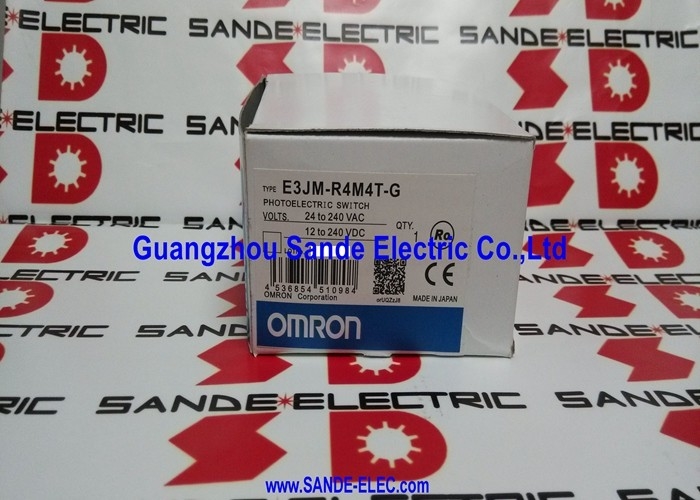
Omron E3JM-R4M4T-G Retro-Reflective Photoelectric Sensor
Overview
The Omron E3JM-R4M4T-G is a square-type retro-reflective photoelectric sensor built for industrial detection tasks that need long sensing distance, relay output, and wide-range AC/DC power compatibility in one housing.
With M.S.R. function, polarized red light, and a 4 m sensing distance when used with the specified reflector, this model is especially well suited to conveyors, gate monitoring, packaging lines, and general object detection where stable sensing must be maintained in practical plant conditions.
One of the strongest advantages of this model is its electrical flexibility. Because it supports both 100 to 240 VAC and 24 to 240 VDC, it can be integrated into a wide range of control panels without forcing a redesign around a narrow supply standard.
In retrofit work, that matters a great deal: a sensor that matches the existing power architecture and still provides a relay contact can simplify replacement, reduce wiring changes, and shorten downtime during service.
This model also offers practical machine-level functions beyond basic detection.
Omron lists selectable Light-ON / Dark-ON operation, timer selection from ON-delay, OFF-delay, or one-shot delay, and a response time of 30 ms max.
That combination makes the E3JM-R4M4T-G useful not only as a sensing device, but also as a flexible control component that can help shape signal behavior directly at the field level.
Key Specifications
| Parameter |
Value |
| Model |
E3JM-R4M4T-G |
| Shape |
Square type |
| Sensing Method |
Retro-reflective with M.S.R. function |
| Sensing Distance |
4 m (when using E39-R1) |
| Standard Sensing Object |
Opaque, 75 mm dia. min. |
| Directional Angle |
1 to 5° |
| Light Source |
Red LED (660 nm) |
| Power Supply Voltage |
100 to 240 VAC ±10%, 50/60 Hz |
|
24 to 240 VDC ±10% |
| Power Consumption |
2 W max. |
| Control Output |
Relay output (SPDT) |
| Relay Rating |
250 VAC 3 A max.; 5 VDC 10 mA min. |
| Operation Mode |
Light-ON / Dark-ON selectable |
| Response Time |
Operate or reset: 30 ms max. |
| Timer Function |
ON-delay / OFF-delay / One-shot delay |
| Timer Range |
0.1 to 5 s |
| Connection Method |
Terminal block |
| Conduit |
PG13.5 |
Relay Output and Wide Supply Range
The relay output is one of the most practical reasons to choose this model. In many industrial systems, especially older machines, a contact-style output is easier to integrate than a transistor signal.
It fits naturally into relay logic, interlock loops, and control circuits that expect a switched contact rather than a low-voltage electronic output. That makes the E3JM-R4M4T-G particularly useful in maintenance-oriented projects and mixed-generation automation systems.
The wide AC/DC power range adds another layer of usefulness.
Instead of being limited to one plant standard, the sensor can work across both AC and DC control environments, which reduces application risk and helps the same model fit a broader range of equipment. For buyers managing spare parts across different machine platforms, that flexibility can be a real operational advantage.
M.S.R. Function and Timer Support
The retro-reflective sensing method with M.S.R. function is valuable in applications where reflective backgrounds or shiny surfaces might otherwise complicate detection. In practical use, it helps the sensor stay focused on the intended target and reflector arrangement rather than reacting too easily to unwanted optical conditions.
This improves reliability in conveyor and transfer applications where detection consistency matters more than raw speed alone.
The built-in timer functions make the model more versatile than a basic beam sensor. ON-delay, OFF-delay, and one-shot delay can help suppress nuisance switching, hold signals long enough for control logic to register them, or create cleaner timing behavior without extra timer relays.
That reduces panel complexity and gives the installer more direct control over how the sensor behaves in the field.
FAQ
Q1: What kind of applications is E3JM-R4M4T-G best suited for?
It is best suited for industrial object detection where a retro-reflective sensor offers a good balance of range, installation simplicity, and reliable switching.
Typical applications include conveyors, transfer stations, machine entrances, pallet or box detection, and general automation tasks where a 4 m sensing span is useful.
Q2: Why is the relay output important in real machine systems?
Relay output is especially useful in systems that rely on contact-based control logic or where the receiving circuit is not designed for transistor outputs.
In practice, it can simplify replacement work, reduce interface concerns, and make the sensor easier to integrate into legacy equipment and mixed-voltage panels.
Q3: What is the practical benefit of the wide AC/DC power range?
The wide supply range makes the model easier to apply across different plant standards.
It can be used in both AC and DC-powered environments, which is a strong advantage when one sensor family needs to support multiple machine platforms or when a service team wants to minimize stock variation.
Q4: How useful are the built-in timer functions?
They are very useful in real automation work. ON-delay, OFF-delay, and one-shot delay allow the sensor to shape its own output behavior, which can help smooth control logic, reduce chatter, or create a pulse-style response without adding a separate timing relay in the cabinet.
Q5: What should buyers verify before ordering a replacement?
Buyers should confirm the sensing method, reflector arrangement, required power range, relay-output requirement, conduit style, and whether the machine depends on timer-enabled behavior. In retrofit work, those details are just as important as the base model number.


 Your message must be between 20-3,000 characters!