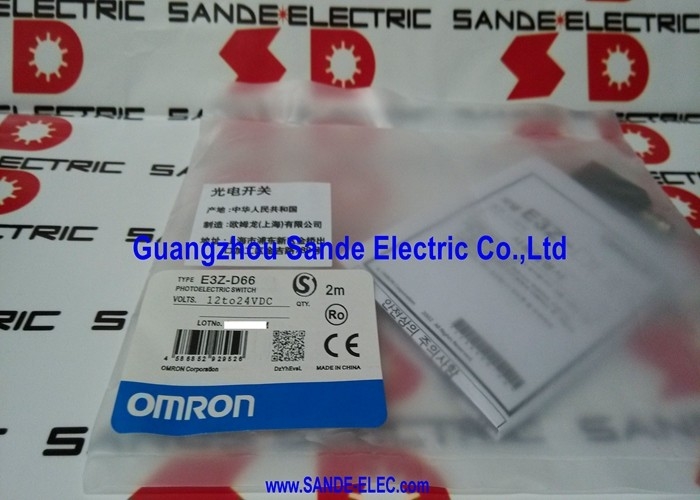
Omron E3Z-D66 Diffuse-Reflective Photoelectric Sensor
Overview
The Omron E3Z-D66 is a compact diffuse-reflective photoelectric sensor designed for general industrial detection where fast switching, small body size, and straightforward integration are more important than long sensing distance.
Its square body, 100 mm sensing distance on a white paper target, and NPN open-collector output make it a practical fit for packaging equipment, assembly stations, transfer points, and compact conveyor sections where reliable object detection is needed in a limited installation space.
This model is especially useful when a machine builder wants a self-contained sensor with built-in amplifier rather than a separate amplifier and fiber head arrangement.
The E3Z-D66 combines the sensing optics and output stage in one compact housing, which simplifies installation and reduces the number of components in the field.
For everyday automation work, that often means quicker setup, easier replacement, and cleaner wiring.
Its electrical profile is also well matched to modern control systems.
The sensor operates from 12 to 24 VDC, uses an NPN open-collector output, supports selectable Light-ON/Dark-ON operation, and responds within 1 ms.
Those features make it suitable for machines that need dependable switching without complicated parameter setting, while the protective circuits add practical durability for day-to-day factory service.
Key Specifications
| Parameter |
Value |
| Model |
E3Z-D66 |
| Shape |
Square type |
| Sensing Method |
Diffuse-reflective |
| Sensing Distance |
100 mm |
| Differential Distance |
20% max. of sensing distance |
| Light Source |
Infrared LED (860 nm) |
| Power Supply Voltage |
12 to 24 VDC ±10% |
| Current Consumption |
30 mA max. |
| Control Output |
NPN open collector |
| Max. Load Voltage |
26.4 VDC |
| Max. Load Current |
100 mA |
| Residual Voltage |
1 V max. / 2 V max. depending on load |
| Operation Mode |
Light-ON / Dark-ON selectable |
| Protective Circuit |
Short-circuit, output reverse polarity, supply reverse polarity |
| Response Time |
1 ms max. |
| Connection Method |
M8 connector |
Built-In Amplifier Simplicity
One of the most practical advantages of the E3Z-D66 is that it is a built-in amplifier type.
This means the installer does not have to separately manage a sensing head and an amplifier module, which can reduce wiring complexity and speed up replacement work.
In equipment where the sensor position is accessible and a self-contained body fits the layout, that simpler architecture is often the best choice.
Diffuse Sensing for General Automation
Diffuse-reflective sensing works well in a wide range of general-purpose applications because it does not require a separate reflector or receiver.
That makes the E3Z-D66 easy to apply in short-range object detection tasks such as carton presence, part verification, tray sensing, and machine sequence confirmation.
In many compact industrial systems, that practical installation advantage matters just as much as the sensing specification itself.
FAQ
Q1: What kind of applications is E3Z-D66 best suited for?
It is best suited for short-range object detection in compact automation equipment. Typical applications include packaging lines, assembly fixtures, small conveyors, and transfer mechanisms where a self-contained photoelectric sensor is easier to mount and wire than a separate amplifier system.
Q2: Why would an engineer choose a diffuse-reflective model instead of a through-beam type?
A diffuse-reflective sensor simplifies installation because it does not need a separate receiver or reflector.
In practice, that can reduce hardware count and make the sensing point easier to integrate, especially when the target passes close to the sensor and the required detection distance is modest.
Q3: Is the 1 ms response time suitable for production equipment?
Yes. A 1 ms response is fast enough for many common industrial detection tasks, including part confirmation and sequence control in compact machinery.
It supports stable switching without forcing the designer into a more specialized high-speed optical platform.
Q4: What should users know about the selectable Light-ON / Dark-ON mode?
This feature gives the installer more flexibility in matching the sensor output to the machine logic.
Instead of redesigning the control program around one fixed output style, the engineer can select the behavior that best fits the application and the receiving input circuit.
Q5: What should buyers verify before ordering?
Buyers should confirm the sensing method, required sensing distance, output type, connector format, and supply voltage.
For replacement work, it is also important to check whether the original machine uses a connector version or a pre-wired version of the same sensing class.


 Your message must be between 20-3,000 characters!