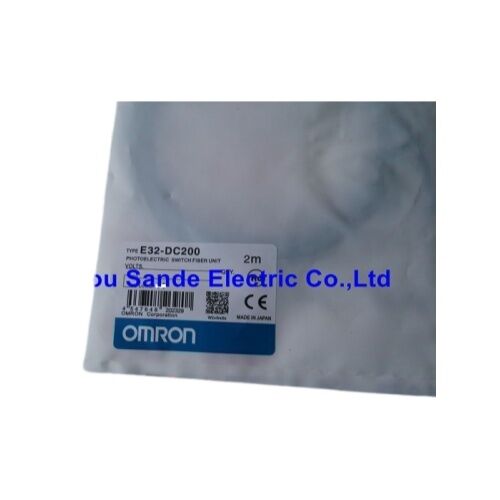
Omron E32-DC200 | Diffuse-Reflective Fiber Optic Sensor Head — M6, 900mm, SUS304, IP67, 2m Fiber, −40°C to +70°C
Overview
The Omron E32-DC200 is a diffuse-reflective fiber optic sensor head from Omron's E32-D series — the sensing end of a two-part detection system that separates where detection happens from where signal processing happens.
The M6 × 0.75mm threaded tip houses the SUS304 stainless steel sensing end, and the 2-metre plastic optical fiber carries light signals back to a separately mounted amplifier unit that generates the switching output.
Nothing electronic lives in the M6 tip itself; all the heat-generating circuitry stays at the amplifier, in the control panel, away from the detection point.
That separation is the whole point of fiber optic sensing.
The E32-DC200 can be threaded into places where no conventional photoelectric sensor would survive or fit — inside welding fixtures, adjacent to heated platens, inside injection moulding tooling, in cavities too small for any standard sensor body.
The M6 thread fits holes smaller than a pencil diameter, and the SUS304 sensing end withstands the heat, steam, cutting fluid, and mechanical contact typical of tight machine locations. IP67 protection at the sensing end covers immersion exposure that the fiber's installation position may encounter.
The diffuse-reflective mode means the E32-DC200 both emits and receives light from the same end.
There is no reflector to install, no opposing fiber on the other side of the detection gap — the sensor emits light toward the target and detects what bounces back.
This simplifies installation significantly when access to only one side of the detection point is available, and it makes the E32-DC200 appropriate for detecting the presence or absence of individual components, parts on conveyors, labels on packaging, and surface features on moving workpieces.
Key Specifications
| Parameter |
Value |
| Operation Mode |
Diffuse-reflective |
| Sensing Range |
900mm (E3NX-FA / ST mode), 600mm (E3X-HD / ST mode) |
| Housing Thread |
M6 × 0.75mm cylindrical |
| Sensing End Material |
SUS304 stainless steel |
| Fiber Material |
Plastic optical fiber |
| Fiber Sheath |
Polyethylene |
| Fiber Length |
2 metres |
| Min. Bending Radius |
R25mm |
| IP Rating |
IP67 |
| Operating Temperature |
−40°C to +70°C |
| Compatible Amplifiers |
E3X-HD series, E3X-NA series, E3X-SD series, E3NX-FA series |
SUS304 Sensing End — Why Material Matters at the Detection Point
The SUS304 stainless steel tip of the E32-DC200 is not incidental — it is the specification detail that determines where this sensor head can physically be installed. SUS304 is an austenitic stainless steel grade that resists corrosion in the presence of cutting oils, coolant, steam, and mild chemical exposure typical in machining and manufacturing environments.
It does not corrode or pit under the cycle of wetting and drying that accompanies coolant-flooded machine tool operations.
Where a sensor tip in bare brass would oxidise, darken, and require periodic cleaning to maintain optical performance, the SUS304 tip maintains its surface condition with minimal maintenance.
The mechanical hardness of SUS304 also makes the tip resistant to incidental contact — the light scratching and minor impacts that occur when tooling or workpieces pass close to the sensor in tight installations.
These events happen in real production environments regardless of how carefully the sensor is positioned during setup, and SUS304 endures them without deforming the sensing face in a way that misaligns the optical exit.
900mm Sensing Range and Amplifier Dependence
The stated 900mm sensing range is not an intrinsic property of the E32-DC200 fiber head alone — it is the range achieved when the fiber head is connected to the E3NX-FA amplifier running in Standard (ST) mode against white paper under controlled test conditions. With the E3X-HD amplifier in the same mode, the same fiber head achieves 600mm to the same target.
The difference comes from the amplifier's light emitting power and receiver sensitivity, not from the fiber unit itself.
In practice, the working detection distance for a specific application will depend on the target's reflectivity, surface colour, and texture. Dark or non-reflective surfaces return less light than the white paper standard, reducing the effective range below the published figures.
Highly reflective surfaces — polished metals, mirror-finish packaging — return so much light that the amplifier's sensitivity may need reducing to avoid false triggers from specular reflection.
The amplifier's sensitivity adjustment, available on all compatible amplifiers in the E3X and E3NX-FA series, handles both cases.
The R25mm minimum bending radius of the 2-metre fiber cable is the installation constraint to respect during routing.
Bending tighter than 25mm radius at any point along the fiber's length risks cracking the plastic optical fibers inside the sheath, increasing attenuation and reducing the transmitted light level — equivalent to reducing the effective sensing range without any change in target or amplifier settings.
FAQ
Q1: The E32-DC200 lists sensing distances for E3NX-FA and E3X-HD amplifiers — can it also work with the E3X-NA and E3X-SD series?
Yes. The E3X-NA, E3X-SD, and E3X-HD series are all listed as compatible amplifiers.
The sensing range will vary depending on the amplifier's emitted power and the operating mode selected. E3NX-FA amplifiers achieve the maximum stated range of 900mm; E3X-NA and E3X-SD amplifiers will produce somewhat shorter effective ranges.
Select the amplifier based on the required sensing distance, response speed, and any additional features (digital display, communication output) needed for the application.
Q2: The fiber is plastic, not glass — does this limit temperature resistance at the sensing end?
The plastic fiber's operating temperature range (−40°C to +70°C) refers to the fiber cable, not the SUS304 sensing end. The sensing end itself tolerates higher ambient temperatures at the tip than the fiber cable can.
If the sensing point is in a high-temperature environment (oven, heated platen, close to a heating element), ensure that the temperature the fiber cable encounters along its routing — particularly near the sensing end — stays within the −40°C to +70°C cable specification.
If the tip location is hotter, the fiber must be routed away from the heat source before it reaches the higher-temperature zone.
Q3: What is the difference between diffuse-reflective and retro-reflective mode, and when would I choose each?
Diffuse-reflective (this sensor) emits and detects from the same end, detecting light scattered back by the target itself. Retro-reflective uses a separate reflector on the opposite side, with the sensor detecting whether the beam to the reflector is interrupted.
Diffuse is simpler to install where only one access point exists, but its detection is sensitive to target reflectivity — dark or transparent targets return little light. Retro-reflective gives more consistent detection independent of target colour or finish, but requires mounting a reflector opposite the sensor.
Choose diffuse for solid opaque target detection in single-access locations; consider retro-reflective when target colour or transparency varies.
Q4: Can the E32-DC200 fiber be shortened if 2 metres is more than the installation requires?
Cutting the fiber shortens it but also requires re-terminating the cut end at the amplifier.
Omron fiber amplifiers accept a stripped plastic fiber tip that is inserted into the amplifier's fiber port — the end can be cut clean with the appropriate fiber cutter (Omron recommends using their fiber cutter tool for a clean, perpendicular face) and re-inserted.
Cutting does not reduce the sensing range significantly over short reductions in length, since signal attenuation per metre of plastic fiber is low. However, the fiber should not be shortened to less than the minimum required to reach from the sensing point to the amplifier with the R25mm bending radius respected along the route.
Q5: How does the M6 × 0.75mm thread affect mounting, and what bracket do I need?
The M6 × 0.75mm is a standard metric thread that accepts M6 hex lock nuts — typically provided with the E32-DC200. The sensor threads through a 6mm mounting hole and is secured by tightening the lock nut against the back of the bracket.
Two lock nuts allow axial position adjustment along the bracket before final locking — one nut from the front face of the bracket and one from the rear. Omron and third-party suppliers offer purpose-made mounting brackets for the M6 E32 series; alternatively, any steel or aluminium panel with a drilled and tapped M6 hole serves the same function.



 Your message must be between 20-3,000 characters!