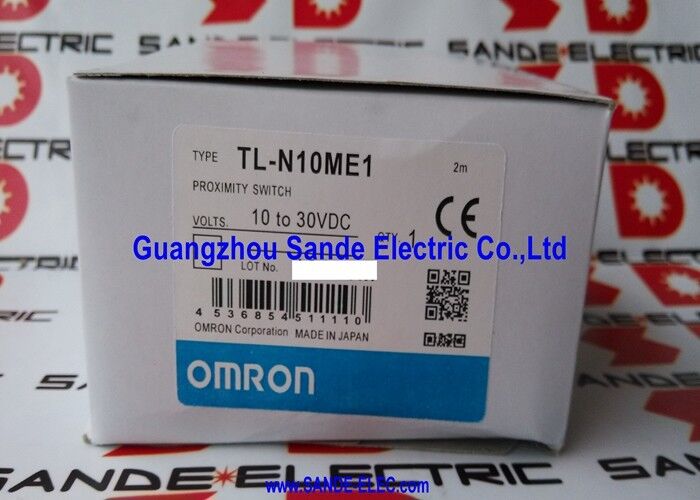
Omron TL-N10ME1 Rectangular Inductive Proximity Sensor
Overview
The Omron TL-N10ME1 is a rectangular inductive proximity sensor intended for machine builders and maintenance teams that prefer a square-body form instead of a cylindrical threaded sensor.
Its unshielded design, 10 mm sensing distance, DC 3-wire NPN normally open output, and rectangular 30 mm class housing make it a practical choice for brackets, flat-surface machine mounting, transfer equipment, and industrial mechanisms where a cuboid sensor body is easier to position than a threaded barrel type.
This model is especially useful in machines where the sensor must be aligned to a flat mechanical surface and remain easy to replace.
The TL-N family is built around that style of installation, and the TL-N10ME1 combines a straightforward electrical interface with a larger rectangular sensing head that provides a practical 10 mm sensing distance for ferrous targets.
In real automation work, that can make setup easier where a little extra stand-off distance helps absorb normal bracket or part-position variation.
The electrical characteristics are also well matched to standard industrial control systems.
The model operates from 10 to 30 VDC, uses a DC 3-wire NPN NO output, switches up to 500 Hz, and includes reverse-polarity protection and a surge suppressor.
That combination gives it a strong, practical profile for conveyors, general machine detection, stop-position sensing, and repeated metal-target detection in everyday factory environments.
Key Specifications
| Parameter |
Value |
| Model |
TL-N10ME1 |
| Sensing Head Size |
30 mm × 30.5 mm × 52.5 mm |
| Type |
Square type, unshielded |
| Power Source |
DC 3-wire |
| Sensing Distance |
10 mm ±10% |
| Setting Distance |
0 to 8 mm |
| Differential Distance |
15% max. of sensing distance |
| Sensing Object |
Ferrous metal |
| Standard Sensing Object |
Iron 40 × 40 × 1 mm |
| Response Frequency |
500 Hz |
| Power Supply Voltage |
12 to 24 VDC |
| Operating Voltage Range |
10 to 30 VDC |
| Current Consumption |
8 mA max. at 12 VDC / 15 mA max. at 24 VDC |
| Control Output |
NPN |
| Operation Mode |
NO |
| Indicator |
Red detection indicator |
| Protective Circuit |
Reverse polarity protection, surge suppressor |
| Ambient Temperature |
-25 to +70 °C |
| Cable Length |
2 m |
Rectangular Body for Flat-Surface Installation
The rectangular housing is one of the main reasons engineers choose this model. In many machines, a square-body sensor is easier to mount against a flat bracket or side plate than a cylindrical threaded type, especially when the installation already has a fixed flat surface and the designer wants a simple screw-on mounting arrangement.
This can make both original installation and later replacement more convenient.
Unshielded 10 mm Detection
An unshielded 10 mm sensing class gives the TL-N10ME1 a useful operating margin for general metal detection.
That added range can help in machines where the target approach is not extremely tight or where small mechanical tolerances need to be absorbed without moving to a larger sensor family.
As with other unshielded sensors, the surrounding metal and mounting geometry should still be considered during installation for the best long-term stability.
FAQ
Q1: What kind of applications is TL-N10ME1 best suited for?
It is best suited for general industrial metal detection where a rectangular body is easier to mount than a cylindrical sensor.
Typical uses include conveyor sensing, machine stop confirmation, bracket-mounted detection, and position monitoring in automation equipment.
Q2: Why would an engineer choose a rectangular proximity sensor instead of a threaded barrel type?
The main reason is mounting convenience. A rectangular sensor can be easier to install on flat machine surfaces or brackets, and in many practical machine designs that mechanical advantage outweighs the flexibility of a cylindrical threaded body.
Q3: What does the unshielded design mean in practical use?
It means the sensing field extends more broadly than a flush-mount shielded type, which helps achieve the 10 mm range.
In practical terms, the installer should leave proper clearance around the sensing face and consider surrounding metal during mounting to maintain stable detection.
Q4: Is TL-N10ME1 suitable for standard factory environments?
Yes. Its published operating range, IP67-class family profile, and built-in protection features make it suitable for routine industrial use.
It is designed as a practical standard proximity sensor rather than a light-duty general-purpose detector.
Q5: What should buyers verify before ordering a replacement?
Buyers should confirm the exact model suffix, cable length, rectangular body size, sensing distance, and NPN NO DC 3-wire output format.
For replacement work, matching the mechanical mounting style is just as important as matching the electrical specification.



 Your message must be between 20-3,000 characters!