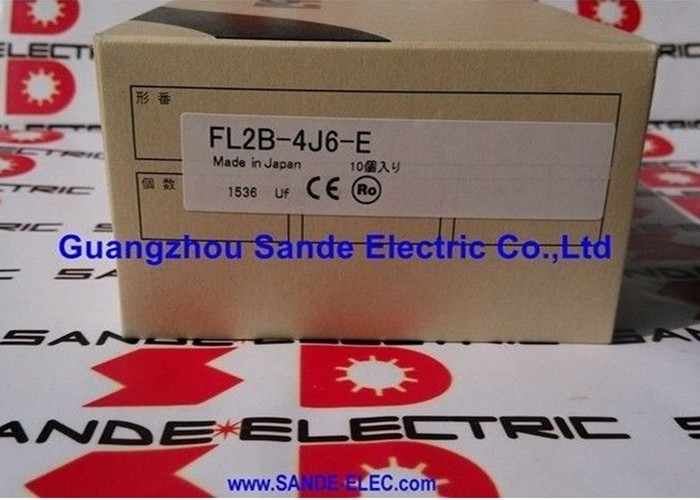
FL2B-4J6-E Rectangular Inductive Proximity Sensor
Overview
The FL2B-4J6-E is a compact rectangular inductive proximity sensor designed for industrial metal detection where a square body, screw-terminal connection, and 2-wire DC output are more practical than a cylindrical threaded sensor.
Its published data identifies it as a non-flush, normally open, 2-wire DC inductive sensor with a rated sensing distance of 4.4 mm, which makes it well suited to equipment builders and maintenance teams working with panel-integrated or bracket-mounted sensing points.
This model is especially useful in machinery where installation space or mounting geometry favors a flat, rectangular sensor body. In those situations, a square sensor can often be easier to align against machine surfaces and fixed brackets than a barrel-style proximity switch.
The FL2B-4J6-E also uses screw terminals rather than a molded cable or circular connector, which can be an advantage in control systems where the installer wants a terminal-compartment style connection for maintenance or retrofit work.
From an electrical standpoint, the sensor is intended for straightforward industrial use.
The published data shows a 10 to 30 VDC operating range, 800 Hz switching frequency, maximum operating current of 4 to 100 mA, and reverse-polarity tolerance with pulsing short-circuit protection.
That combination makes it suitable for stable, repetitive metal detection in control circuits where simple and dependable switching behavior is more important than advanced signal processing.
Key Specifications
| Parameter |
Value |
| Model |
FL2B-4J6-E |
| Sensor Type |
Inductive proximity sensor |
| Body Style |
Rectangular |
| Installation |
Non-flush |
| Switching Function |
Normally open (NO) |
| Output Type |
DC 2-wire |
| Rated Operating Distance |
4.4 mm |
| Assured Operating Distance |
0 ... 3.1 mm |
| Operating Voltage |
10 ... 30 VDC |
| Switching Frequency |
800 Hz |
| Hysteresis |
0.05 mm max. |
| Operating Current |
4 ... 100 mA |
| Off-State Current |
1 mA max. |
| Voltage Drop |
3.3 V max. |
| Connection Type |
Screw terminals |
| Housing Material |
PBT |
| Sensing Face |
PBT |
| Protection Rating |
IP67 |
| Ambient Temperature |
-25 ... +70 °C |
Rectangular Housing and Terminal-Compartment Practicality
The rectangular body is one of the key practical strengths of this model. In real machine assemblies, a square sensor can be easier to mount against flat hardware and side brackets, especially where the installer needs controlled alignment without using threaded barrel holes.
This makes the FL2B-4J6-E a useful option in compact mechanisms, fixture detection, and older equipment layouts where the original mounting concept already favors a rectangular sensor housing.
The screw-terminal format is equally practical in certain environments.
For replacement and retrofit work, terminal-compartment wiring can simplify servicing because the installer can access the wiring directly without replacing an entire cable or adapting to a different connector standard. In legacy industrial systems, that can make the replacement path cleaner and more reliable.
2-Wire DC Operation in Real Control Circuits
A 2-wire DC inductive sensor is often chosen when the control system expects a simple field device with minimal wiring complexity.
In practice, the FL2B-4J6-E fits applications where a normally open proximity switch must interface directly with a standard DC control circuit while maintaining good switching speed and predictable sensing behavior. Its 800 Hz switching frequency gives it enough responsiveness for many repetitive industrial detection tasks.
Because it is a 2-wire design, engineers should still treat load behavior and voltage drop carefully during system selection.
That does not make the model difficult to use, but it does mean the receiving circuit should be considered as part of the application, especially in retrofit projects where the original load conditions may need to be preserved.
FAQ
Q1: What kind of applications is FL2B-4J6-E best suited for?
It is best suited for short-range metal detection in industrial equipment where a rectangular body and screw-terminal wiring are preferred.
Typical uses include bracket-mounted machine sensing, position confirmation, fixture detection, and replacement work in control systems built around 2-wire DC field devices.
Q2: Why would an engineer choose a rectangular inductive sensor instead of a cylindrical one?
The main reason is mechanical fit. A rectangular housing can be easier to mount on flat machine surfaces or inside fixed bracket layouts.
In practical machine design, that can simplify alignment and replacement, especially in older or custom-built equipment.
Q3: What is the practical value of the screw-terminal connection?
Screw terminals can make field wiring and service work more direct, especially in legacy equipment or panel-adjacent installations.
Instead of changing a complete cable or adapting to a connector standard, the installer can work directly in the terminal compartment and keep the original wiring concept intact.
Q4: Is this sensor suitable for demanding industrial environments?
Yes. Its published data includes IP67 protection, PBT housing materials, reverse-polarity tolerance, and pulsing short-circuit protection.
Those features support everyday factory use where contamination, vibration, and repeated switching are part of normal operating conditions.
Q5: What should buyers verify before ordering a replacement?
Buyers should confirm the body shape, sensing distance, 2-wire DC normally open output logic, screw-terminal format, and the available mounting clearance.
For replacement work, both the mechanical format and the electrical load conditions should be checked before ordering.


 Your message must be between 20-3,000 characters!