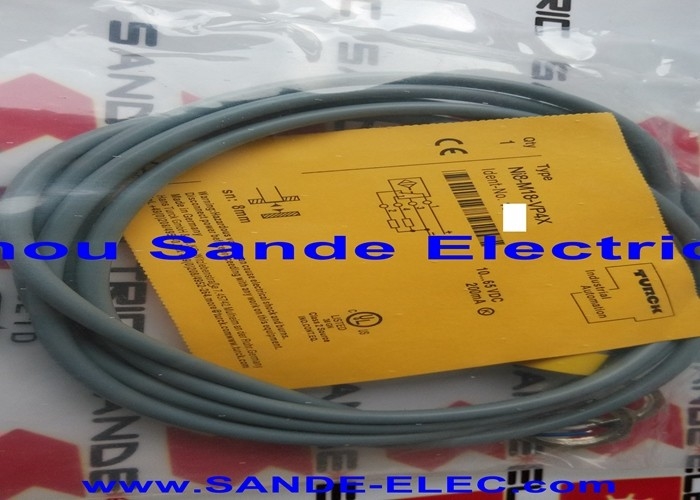
Turck NI8-M18-VP4X-H1141 M18 Inductive Sensor
Overview
The NI8-M18-VP4X-H1141 is an M18 inductive proximity sensor designed for industrial metal detection where a threaded cylindrical body, connectorized wiring, and a PNP changeover output are required.
Turck’s published data identifies it as a threaded-barrel M18 × 1 inductive sensor with a 4-wire complementary PNP output, M12 connector, and operating voltage from 10 to 65 VDC, which makes it a versatile choice for machine builders, control engineers, and maintenance teams working across different DC control standards.
One of the more practical strengths of this model is its electrical flexibility.
A wide 10 to 65 VDC operating range and PNP changeover output allow the sensor to fit a broader range of control environments than a narrow-voltage basic proximity switch.
In real automation work, that can simplify spare-parts planning and make the model easier to use in machines with different supply schemes or interface requirements.
Mechanically, the NI8-M18-VP4X-H1141 uses a chrome-plated brass housing, M18 threaded format, and M12 male connector, which gives it a familiar industrial profile for installation and replacement.
Combined with a 0.5 kHz switching frequency, reverse-polarity and wire-break protection, and an ambient operating range of -25 to +70 °C, it is clearly intended for robust factory use rather than light-duty sensing.
Key Specifications
| Parameter |
Value |
| Model |
NI8-M18-VP4X-H1141 |
| Sensor Type |
Inductive sensor |
| Design |
Threaded barrel, M18 × 1 |
| Housing Material |
Chrome-plated brass |
| Active Area Material |
PA12-GF30 |
| Output Function |
4-wire, complementary contact, PNP |
| Operating Voltage |
10 ... 65 VDC |
| Ripple |
≤ 10% UBmax |
| Rated Operating Current |
≤ 200 mA |
| No-Load Current |
≤ 15 mA |
| Residual Current |
≤ 0.1 mA |
| Voltage Drop at Ie |
≤ 1.8 V |
| Switching Frequency |
0.5 kHz |
| Connection Type |
M12 × 1 male connector |
| Ambient Temperature |
-25 ... +70 °C |
| Protection Functions |
Short-circuit, wire-break, reverse polarity |
| Length |
52 mm |
Wide-Range DC Operation and PNP Output
A major reason to choose this model is its wide DC operating range. Many proximity sensors are limited to a much narrower voltage band, but the NI8-M18-VP4X-H1141 can operate from 10 to 65 VDC.
In practical terms, that makes it useful in equipment where DC standards vary, where replacement flexibility matters, or where the machine design already uses a broader DC supply architecture.
The PNP complementary output adds further value because it gives the control designer more flexibility than a simple single-state output. In real applications, that can help when the machine logic needs more adaptable signal handling or when the sensor must fit an interface scheme that expects a changeover-style output structure.
M18 Threaded Format for Industrial Service
The M18 threaded housing keeps this model easy to integrate into standard industrial brackets and mounting holes. That matters because proximity sensor replacement is often driven by installation compatibility just as much as by electrical specification.
A familiar M18 body and M12 connector make the NI8-M18-VP4X-H1141 practical both for OEM use and for field replacement in existing equipment.
Its protective features also support real industrial service. Published data lists short-circuit protection, complete wire-break and reverse-polarity protection, and an operating temperature range up to +70 °C.
Those are exactly the kinds of characteristics that matter in factory environments where sensors must keep working reliably under routine electrical and mechanical stress.
FAQ
Q1: What kind of applications is NI8-M18-VP4X-H1141 best suited for?
It is best suited for general industrial metal detection where an M18 threaded sensor with connectorized installation and flexible DC supply capability is needed.
Typical uses include machine position sensing, part presence detection, transfer mechanisms, and replacement work in DC-powered control systems.
Q2: Why is the 10 to 65 VDC range important in real use?
The wide DC range gives the sensor more application flexibility than many standard proximity switches. In practice, that can make it easier to use across different machine platforms, reduce spare-parts variation, and support retrofit work where the control supply may not match a narrow low-voltage-only device.
Q3: What is the practical benefit of the PNP complementary output?
A complementary PNP output gives the control system more flexible signal options than a simple single-state output.
That can help the engineer match the sensor more easily to the receiving logic and support applications where output-state choice matters in the machine sequence.
Q4: Is this sensor suitable for demanding factory environments?
Yes. Its published specifications include chrome-plated brass housing, M12 connector, short-circuit protection, wire-break and reverse-polarity protection, and operation from -25 to +70 °C. These are all characteristics associated with industrial-duty service.
Q5: What should buyers verify before ordering a replacement?
Buyers should confirm the output type, supply range, M18 threaded format, connector style, and required control logic.
For replacement work, it is also important to check whether the original system depends on a complementary PNP output rather than a simpler single-output proximity sensor.



 Your message must be between 20-3,000 characters!