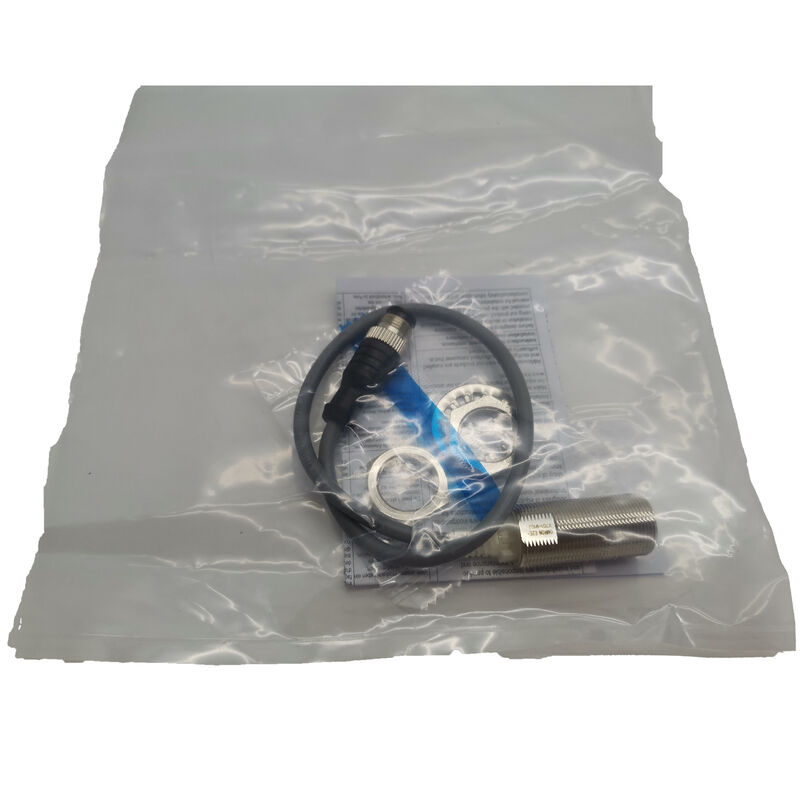
Omron E2EQ-X7D1-M1GJ | Spatter-Resistant Inductive Proximity Sensor — M18 Fluororesin Coated, 7mm NO, DC 2-Wire, 500Hz, IP67, M12 Pigtail Connector
Overview
The Omron E2EQ-X7D1-M1GJ is a spatter-resistant inductive proximity sensor — the E2EQ series variant of the standard M18 E2E design, differentiated by the fluororesin coating applied to the sensing surface and housing face. That coating is the reason this sensor exists.
In robotic and manual arc welding applications, hot metal droplets thrown from the weld pool land on everything within several metres of the arc: fixtures, tooling, wiring, and sensors. On a conventional sensor with a bare brass or stainless steel face, these droplets cool and solidify, bonding to the surface.
Once the layer of accumulated spatter is thick enough, it disrupts the sensor's electromagnetic field and causes detection failure — or the spatter removal process scratches the sensing surface and changes the gap. On a fluororesin-coated surface, solidified droplets find no grip.
The coating's non-stick characteristic allows spatter to be wiped or tapped away cleanly, the underlying surface undamaged, and detection performance unchanged.
The sensor carries all the standard E2E specifications for the M18 7mm shielded configuration: DC 2-wire NO output, 10–30V operating range, 500Hz switching frequency, dual LED indicators, and IP67 oil-proof sealing.
The 0.3m pigtail with M12 IEC connector is the connection format that allows the sensor to be replaced without entering the machine wiring — disconnect the M12 at the pigtail end, thread the replacement into the mounting hole, reconnect, done.
In welding cells where sensors are consumed by spatter accumulation on a schedule and replacement speed affects cell uptime, this connector arrangement is a practical maintenance feature.
Key Specifications
| Parameter |
Value |
| Sensing Distance |
7 mm (±10%) |
| Setting Distance |
0–5.6 mm |
| Housing |
M18 × 1mm, shielded, nickel-plated brass |
| Sensing Surface |
Fluororesin (spatter-resistant) coating |
| Output |
DC 2-wire, NO, polarised |
| Supply Voltage |
12–24V DC |
| Operating Range |
10–30V DC |
| Switching Capacity |
3–100 mA |
| Leakage Current |
0.8 mA max |
| Response Frequency |
500 Hz |
| Connection |
0.3m pigtail + M12 IEC connector |
| IP Rating |
IP67 + oil-proof |
| Indicators |
Red LED (output) + Green LED (range) |
| Standards |
EN60947-1, EN60947-5-2, CE |
Fluororesin Coating — The Spatter Problem Solved in the Material
Arc welding generates spatter when molten metal is expelled from the weld pool — a consequence of arc instability, incorrect wire feed speed, or the base metal's chemical composition. Even in optimised welding processes, some spatter production is unavoidable.
The question for machine designers is not whether spatter will land on the sensor, but what will happen when it does.
Fluororesin polymers (chemically similar to PTFE) have surface energy so low that molten metal droplets cannot wet the surface — they arrive, cool, and sit on the coating without forming a metallurgical or mechanical bond. The result is spatter that brushes off rather than accumulates.
Omron's E2EQ series applies this coating to the sensing face and the nose of the sensor body — the areas that face the weld zone and receive the highest droplet flux during welding cycles.
Standard proximity sensors in welding environments typically require daily or shift-by-shift spatter removal to maintain reliable detection. The E2EQ-X7D1-M1GJ extends this interval significantly, reducing both the maintenance burden and the risk of sensing face damage during cleaning.
It does not make the sensor immune to heavy sustained spatter accumulation — in extremely spatter-intensive processes, regular light cleaning is still good practice — but the effort is dramatically reduced compared to non-coated alternatives.
M12 Pigtail Connection — Fast Replacement in Welding Cells
The 0.3m pigtail cable exits the sensor body and terminates in an M12 IEC-arranged field connector. In the machine, a mating M12 cable runs from the control panel or junction box and plugs into this connector.
The sensor installation consists of threading the sensor into its mounting hole, locking with the M12 nut, and mating the M12 connector — a two-minute operation that can be performed by a maintenance technician without electrical tools or panel access.
When the sensor eventually requires replacement, the process reverses in the same two minutes.
The fixed machine cable stays in place; only the sensor pigtail unit is exchanged.
This matters in automated welding cells where replacement of a failed sensor during shift changeover is the target, and where accessing terminal strips inside a locked electrical enclosure during a production window is not an option.
Dual LED Indicators in a Welding Environment
The red output LED and green setting-range LED on the E2EQ-X7D1-M1GJ provide the same commissioning and operational confirmation as other dual-indicator E2E sensors.
In welding cell environments, where the sensor is typically mounted close to the weld fixture, the LED visibility allows a technician standing at the cell door to confirm the sensor is detecting correctly without entering the cell or checking a PLC diagnostic screen. The red LED's ON/OFF state mirrors each fixture close and open cycle; a missing flash at the expected point in the cycle indicates a detection problem while the cell is still running.
FAQ
Q1: How does the fluororesin coating affect the sensor's sensing distance?
The fluororesin coating is applied as a thin layer over the sensing face — its thickness does not measurably change the 7mm nominal sensing distance.
The coating is electrically transparent at the frequencies used by the inductive sensing circuit, so target detection performance is identical to the uncoated E2E-X7D1 variant.
The 0–5.6mm setting distance remains the valid installation range. No adjustment to the sensing gap is required when substituting the E2EQ for the standard E2E.
Q2: Can spatter accumulation fully block the E2EQ-X7D1-M1GJ's sensing capability?
A thin layer of solidified spatter on a fluororesin surface does not significantly affect sensing because: (a) metal spatter conducts the inductive field and may even extend the field slightly; and (b) the accumulated layer remains loosely bonded and can be cleared with a light wipe between cycles.
Very heavy accumulation over many cycles without any cleaning can eventually reduce field penetration to the target — the green setting-range LED going off or flickering during the fixture cycle is the practical indicator that the sensor face needs clearing.
Q3: Is the M12 connector on the E2EQ-X7D1-M1GJ rated for the welding cell environment?
The M12 connector is IP67-rated when mated. In welding cells, the connector should be positioned away from the direct spatter zone — the 0.3m pigtail provides some routing distance to accomplish this.
The connector body is typically not fluororesin coated, so heavy spatter accumulation on an exposed connector can cause sealing degradation over time. Route the pigtail so the M12 connector sits behind a shield or in a protected cable routing channel where possible.
Q4: What is the standard sensing object for this sensor, and why is it smaller than the M18 body diameter?
The standard sensing object (18 × 18 × 1mm iron plate) is defined to match the effective sensing field area of the M18 shielded sensor.
The sensing field projects from the sensing face in a cone whose effective diameter at the nominal sensing distance (7mm) is approximately 18mm — matching the standard target dimensions. Smaller targets produce proportionally shorter effective sensing distances; larger targets produce results close to the rated 7mm.
For targets smaller than the standard, test the actual switching point in the installation.
Q5: Can the E2EQ-X7D1-M1GJ replace the E2E-X7D1-M1GJ directly in an existing installation?
Yes. The E2EQ and E2E variants of the X7D1-M1GJ share the same M18 × 1mm body dimensions, sensing distance, DC 2-wire NO output, M12 IEC connector pigtail, 500Hz frequency, and IP67 protection. The only physical difference is the fluororesin coating on the E2EQ.
No wiring, PLC parameter, or mechanical gap adjustment is required when substituting one for the other. Use the E2EQ in welding environments; the E2E in non-welding applications where the spatter-resistance coating is not required.


 Your message must be between 20-3,000 characters!