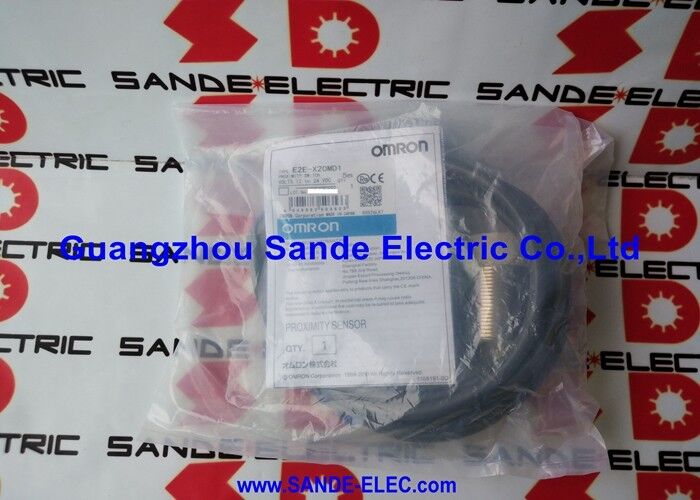
Omron E2E-X20MD1 | Inductive Proximity Sensor — M30 Unshielded, 20mm NO, DC 2-Wire, 10–30VDC, 100Hz, Dual LED, IP67, Oil-Resistant Cable
Overview
The Omron E2E-X20MD1 is the longest-range standard model in the E2E series' M30 unshielded line, delivering 20mm of inductive sensing distance from an M30 body with DC 2-wire normally open output.
Twenty millimetres is not an arbitrary figure — it represents the practical maximum for an unshielded inductive sensor in the standard M30 format, achieved by maximising the oscillating field volume without the restriction of internal shielding.
The logic behind selecting a 20mm sensor instead of a smaller-range M18 or M12 device usually comes down to one of three installation realities: the target cannot be reliably positioned within a shorter gap due to machine tolerance accumulation; the target surface is irregular (cast surfaces, rough forgings, stamped edges) and may vary in its presented distance; or the sensor must be mounted at a fixed distance from a moving target that swings or oscillates during the machine cycle. In all three cases, the 16mm setting distance of the E2E-X20MD1 provides a wide enough stable detection zone to accommodate the variation without sensing failures.
Being an M30 unshielded sensor, installation requires the familiar non-flush mounting protocol: the sensor face must protrude from its mounting hole, with the surrounding metal structure sitting behind the active sensing zone rather than level with it.
This is the trade-off that makes 20mm achievable from an M30 housing — the unrestricted field extends in all directions, which demands a metal-free zone around the sensor tip but delivers the range that flush-mounted shielded sensors of the same body size cannot match.
Key Specifications
| Parameter |
Value |
| Sensing Distance |
20 mm (±10%) |
| Setting Distance |
0–16 mm |
| Standard Target |
Iron 54 × 54 × 1 mm |
| Housing |
M30 × 1.5mm, unshielded, nickel-plated brass |
| Output |
DC 2-wire, NO, polarised |
| Supply Voltage |
12–24V DC |
| Operating Range |
10–30V DC |
| Switching Capacity |
3–100 mA |
| Leakage Current |
0.8 mA max |
| Response Frequency |
100 Hz |
| IP Rating |
IP67 |
| Indicators |
Red + Green LED |
| Standards |
EN60947-1, EN60947-5-2, CE |
20mm Sensing — The M30 Unshielded Ceiling
The progression from shielded to unshielded construction in Omron's M30 E2E line is consistent: the shielded M30 achieves 10mm of sensing distance (E2E-X10D1); the unshielded variant doubles it to 20mm (E2E-X20MD1).
The unshielded field's extended range is the result of allowing the oscillator coil to radiate its field in all directions rather than confining it to a forward cone — the total available field energy reaches the target at greater distances, but the field also extends sideways, requiring the installation to isolate the sensor from lateral metal.
For the standard 54 × 54 × 1mm iron test plate, the 20mm distance is measured axially — the plate approaching straight toward the sensor face. In practice, most machine targets approach from a fixed angle and present a consistent area to the sensor.
Where the target is significantly smaller than 54 × 54mm, effective sensing distance is reduced proportionally.
Targets larger than the standard plate do not extend the sensing distance significantly beyond the rated 20mm, as the field's geometry limits the maximum detectable range regardless of target area.
100Hz Response — Appropriate for Large-Format Sensing
The 100Hz switching frequency of the E2E-X20MD1 is lower than smaller E2E models and is directly related to the sensor's larger oscillator circuit.
At M30 body size with a 20mm sensing field, the oscillator operates at lower frequencies to support the larger coil geometry — higher-frequency oscillation in a large coil produces field characteristics that reduce sensing range rather than improving it.
One hundred Hz provides 100 detection cycles per second — adequate for virtually all presence/absence applications where the target is a large machine component moving at moderate industrial speeds.
The only applications where 100Hz may fall short are high-speed counting of large targets passing rapidly past a fixed sensor point, such as bottles on high-speed filling lines or objects on high-speed conveyors at spacings that require detection at rates above 50 per second.
For such applications, assess whether the 100Hz limit is compatible with the required detection rate before selecting the sensor.
Large Standard Target Area and Non-Ferrous Corrections
The 54 × 54mm standard test target is sized to ensure the characterised sensing field is fully illuminated during the test — a consequence of the wide field geometry of the unshielded M30 coil.
For real-world targets smaller than 54mm square, the rule of thumb is that effective range scales approximately with the square root of the target area ratio. A 27 × 27mm target (one-quarter of the standard area) produces approximately half the rated range — approximately 10mm for an iron target.
For non-ferrous targets: aluminium approximately 0.3–0.4× of iron range (6–8mm), brass approximately 0.4–0.5× (8–10mm), stainless steel 0.6–0.75× (12–15mm).
These are approximations for flat plate targets of standard test dimensions; actual values depend on alloy, target thickness, and approach geometry. Always verify switching distance empirically with the specific target in the intended installation before committing to the mechanical design.
FAQ
Q1: What is the required metal-free zone around the E2E-X20MD1 sensor tip?
Omron specifies the metal-free zone for unshielded M30 sensors in the E2E installation guide. The sensor must protrude from its mounting hole, with the mounting metal face set back from the sensing face by at least one body diameter (30mm) on each side.
The bore through the mounting plate should not exceed the housing diameter and should have no metallic material within the specified zone of the sensing tip.
Violating this zone reduces sensing distance and can cause the sensor to detect the surrounding metalwork rather than the intended target.
Q2: At 100Hz, how fast can a target move through the sensing field and still be reliably detected?
At 100Hz, one detection cycle takes 10ms. For reliable detection, the target must enter and remain in the sensing field for at least one full cycle — 10ms. At a target speed of 1 m/s, a target occupies any given 10mm zone for 10ms, just meeting the minimum.
At higher speeds or with smaller targets, the transit time through the active field may be shorter than one cycle, resulting in missed detections.
Calculate transit time = target length in direction of travel ÷ approach speed, and confirm this exceeds 10ms with a safety margin.
Q3: Can the E2E-X20MD1 be used as a zero-speed or standstill detector?
Yes. The sensor detects the presence or absence of a large ferrous target statically — it does not require target motion to operate.
For zero-speed detection, the sensor is positioned to detect a target mounted on the rotating shaft or moving component.
When motion stops, the target either remains in the sensing field (if stopped in the detection zone) or exits it. The control logic determines which state represents "standstill" depending on the installation geometry.
Q4: Is the E2E-X20MD1 available with a connector termination instead of a pre-wired cable?
Yes. The E2E-X20MD1-M1G is the M12 IEC-connector version of the same sensor, providing a field-disconnectable interface for installations where sensor replacement without cable disruption is preferred. The E2E-X20MD1-M1 is the M12 connector version with the standard (non-IEC) pin arrangement.
All variants carry identical sensing specifications; the connection method is the only difference.
Q5: How should the E2E-X20MD1 be mounted if the target approaches at an angle rather than straight-on?
Axial approach (target moves directly toward and away from the sensing face) produces the rated 20mm distance.
Off-axis approach — target moving parallel to the sensor face, or on a curved path — results in a shorter effective switching distance because the target enters and exits the field's strongest zone at an angle.
For conveyor-style applications where a target passes in front of a side-mounted sensor, the switching distance depends on the approach angle and target dimensions.
Empirical testing with the actual target and motion profile is the most reliable way to determine the effective switching position in non-axial installations.



 Your message must be between 20-3,000 characters!