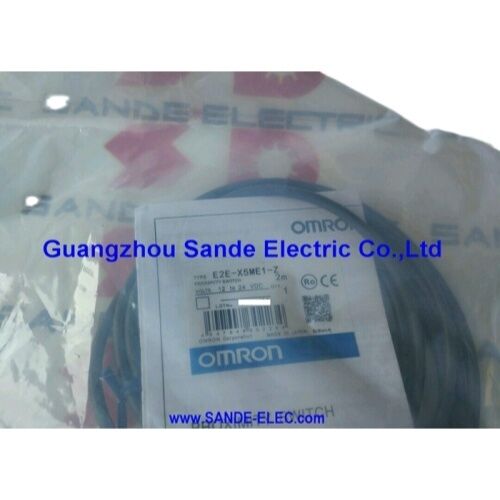
Omron E2E-X5ME1-Z | Inductive Proximity Sensor — M12, 5mm, NPN NO, 12–24VDC, Unshielded, IP67, 2m Cable
Overview
The Omron E2E-X5ME1-Z is a standard 3-wire NPN inductive proximity sensor from Omron's E2E series, specified for a 5mm sensing distance on an M12 cylindrical housing with a 2-metre pre-wired oil-resistant cable.
Unshielded construction extends the electromagnetic sensing field beyond the M12 body's face, giving the 5mm detection range from a 12mm diameter sensor — appropriate for close-clearance detection in tight machine locations where an M18 or M30 body would not physically fit.
The Z suffix confirms this is the cable-output variant with oil-resistant PVC jacket — the industrial field-installation standard for machine tool environments where coolant and cutting oil exposure is routine.
The NPN (sinking) output is the standard for Japanese and East Asian machine design and for PLC input cards wired to sink current from NPN sensor outputs.
Omron built the E2E series around the premise that proximity sensors should be reliable enough to effectively disappear into the machine — present throughout the production life without requiring attention.
The protection circuits (surge suppressor, short-circuit protection, reverse polarity protection) and the IP67 sealing deliver on that premise by eliminating the failure modes that most often take basic sensors offline: transient voltage spikes from inductive switching, brief output short circuits during installation, reversed supply wires, and coolant ingress.
Key Specifications
| Parameter |
Value |
| Sensing Distance |
5 mm (−10% to +10%) |
| Setting Distance |
0–4 mm |
| Housing |
M12 × 1mm, unshielded |
| Output |
NPN, NO (sinking) |
| Supply Voltage |
12–24V DC |
| Operating Voltage |
10–40V DC |
| Current Consumption |
13 mA max |
| Switching Capacity |
0–200 mA |
| Response Frequency |
400 Hz |
| Connection |
2m oil-resistant PVC cable |
| Standard Target |
Iron 15 × 15 × 1 mm |
| IP Rating |
IP67 |
| Temperature Range |
−40°C to +85°C |
| Protection |
Surge, short-circuit, reverse polarity |
| Approvals |
CE, CCC |
Unshielded M12 — 5mm from a Compact Body
The M12 form factor makes the E2E-X5ME1-Z physically one of the smallest cylindrical inductive sensors in standard production.
Its 12mm body diameter, combined with the unshielded field geometry that projects sensing energy beyond the face, achieves 5mm detection in a sensor that threads into a space smaller than a standard bolt head.
That compactness directly serves applications in tight machine locations: fixture detection points between clamping jaws, presence verification inside tooling assemblies, part confirmation in pallets with closely spaced pockets, and edge detection on guide rails where larger sensor bodies would physically contact the target.
Every millimetre of body diameter saved in tight spaces is a degree of freedom recovered in the mechanical design.
The unshielded construction means, as with any non-flush sensor, that surrounding metal must be kept at the specified minimum distance from the sensing face and body sides. The E2E series mounting guidelines specify the required clearances — respecting these distances is the most common commissioning step that prevents reduced sensing range in otherwise correct installations.
−40°C to +85°C — Range That Covers Real Industrial Conditions
The E2E-X5ME1-Z's operating temperature range of −40°C to +85°C is wider than many proximity sensors in this class. At the cold end, −40°C covers outdoor installations, unheated storage facilities, food processing cold rooms, and any position on a machine in an unheated building during winter startup.
At the hot end, +85°C accommodates sensors near heat-generating process equipment, in cabinets with restricted airflow, or close to oven and dryer enclosures.
One temperature-related note: sensing distance varies slightly with temperature (±10% of the rated 5mm across −25°C to +70°C; ±15% across the full −40°C to +85°C range).
The setting distance — where the actual trigger point is configured during installation — should be set within the 0–4mm range specified, which provides adequate margin against the worst-case temperature-induced distance variation.
FAQ
Q1: What is the difference between the E2E-X5ME1-Z and the E2E-X5ME1-M1?
Both are M12 NPN NO inductive sensors with 5mm sensing distance and identical electrical specifications. The Z suffix identifies the pre-wired 2-metre cable model with standard straight cable exit.
The M1 suffix identifies the M12 connector model — a separate plug connector on the sensor body that mates with a field-installed M12 cable. Choose the Z (cable) version for permanent installations where the cable routing is fixed and easy; choose the M1 (connector) version for applications where the sensor may need periodic replacement without disturbing the field wiring.
Q2: The output type is NPN — how does this affect PLC wiring?
NPN (sinking) output means the sensor sinks current through the connected load to common when the output is active. Correct wiring: the PLC input is connected between the sensor's output wire (typically black in the standard 3-wire colour code) and the positive supply, with the common wire to negative supply.
The PLC input card must be NPN-compatible — designed to receive sinking signals. PNP-only input cards require a PNP-output sensor variant (E2E-X5ME2-Z or equivalent); connecting an NPN sensor to a PNP-only input produces no output response.
Q3: Short-circuit protection — does this mean I don't need an output fuse?
Short-circuit protection in the E2E means the sensor survives a brief direct short of the output wire to common or supply during installation without being permanently damaged. It does not replace appropriate overcurrent protection in the overall circuit design.
For installations driving multiple loads or where the supply loop includes other sensors sharing the same circuit, external fusing or current limiting appropriate to the circuit design is still good practice.
Q4: The sensing distance is 5mm — what is the actual detection gap I should set?
The setting distance is 0–4mm. This is the range within which the sensor reliably switches ON — 80% of the 5mm nominal sensing distance. Setting the actual gap at 2–3mm (60% of nominal) provides margin against temperature effects, target surface variation, and slight vibration or mechanical wear over time.
A sensor set at exactly 4mm (the limit of the setting range) operates close to the stability boundary and may exhibit intermittent switching under adverse conditions.
Q5: What metals does the E2E-X5ME1-Z detect, and does material type affect the sensing distance?
The sensor detects all electrically conductive metals. For standard iron/mild steel (the rated target material), sensing distance is 5mm. For stainless steel, the effective distance is typically 3–4mm. Aluminium and brass produce approximately 2mm effective distance.
Copper is the least responsive, typically 1.5mm or less. Always measure the actual switching point with the specific target material in the installation conditions when the target is not standard iron.



 Your message must be between 20-3,000 characters!