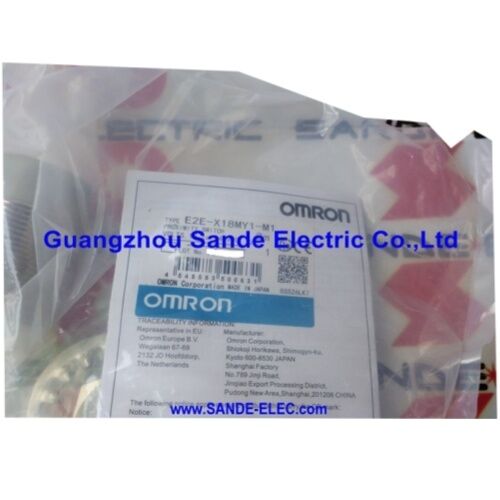
Omron E2E-X18MY1-M1 | Inductive Proximity Sensor — M30, Unshielded, 18mm, AC 2-Wire NO, M12 Connector, IP67
Overview
The Omron E2E-X18MY1-M1 is an M30 unshielded inductive proximity sensor in the E2E series, configured for AC 2-wire operation on supplies from 24 to 240V AC, with an 18mm sensing distance to ferrous metal targets and a normally open output on an M12 plug connector.
It detects the presence of metallic objects without physical contact, making it appropriate for position detection, end-of-travel confirmation, and object counting on machines and conveyor systems where the sensed target is iron or steel within the 18mm detection range.
The unshielded construction is the defining mechanical characteristic for this model.
An unshielded inductive proximity sensor extends its electromagnetic field beyond the sensing face in a wider cone pattern than a shielded (flush-mount) design, which is why the 18mm sensing distance is achievable from a 30mm body — the generous field projection trades the ability to mount flush in a metal bracket for the longer detection range.
Mounting an unshielded sensor flush in a metal bracket would severely reduce its sensing distance by allowing the surrounding metal to absorb the sensor's electromagnetic field; unshielded sensors require the clearance around the sensing face specified in Omron's mounting guidelines to operate at their rated distance.
The AC 2-wire circuit is the simplest possible wiring: the sensor connects in series with the load (PLC input, relay coil, indicator lamp) between line and neutral, passing current through the load when the output switches on and drawing only the 1.7mA leakage current through the load when off.
Two wires, no separate power supply conductor — the same circuit architecture that legacy mechanical limit switches used, which makes the E2E-X18MY1-M1 a natural drop-in upgrade for older limit switch installations without rewiring the control circuit.
Key Specifications
| Parameter |
Value |
| Sensing Distance |
18 mm (−10% to +10%) |
| Setting Distance |
0 to 14 mm |
| Housing |
M30 × 1.5mm, unshielded |
| Supply Voltage |
24–240V AC |
| Operating Voltage Range |
20–264V AC |
| Output |
AC 2-wire, NO |
| Switching Capacity |
5–300 mA |
| Leakage Current |
1.7 mA max |
| Response Frequency |
25 Hz |
| Sensing Object |
Ferrous metal (sensitivity reduced for non-ferrous) |
| Standard Object |
Iron, 54 × 54 × 1 mm |
| Connection |
M12 connector (M1 suffix) |
| IP Rating |
IP67 + oil-proof |
| Temperature Range |
−40°C to +85°C |
| Housing Material |
Nickel-plated brass / PBT sensing face |
| Approvals |
CE, CCC |
18mm Sensing Distance — Unshielded M30 in Practice
Eighteen millimetres is the nominal sensing distance to the standard Omron ferrous metal target (54 × 54 × 1mm iron plate). In practice, the mounting installation determines what sensing distance the sensor actually achieves.
For an unshielded sensor mounted in open air with the specified clearance from surrounding metal, the rated 18mm is achievable.
The working setting distance — where the trigger point is actually set for reliable detection — should be within the 0 to 14mm setting range, which provides a margin below the nominal sensing distance that accommodates target variation, vibration, temperature effects (±10% of sensing distance across −25°C to +70°C), and sensor-to-target alignment tolerances.
Non-ferrous metals — aluminium, brass, copper — reduce the effective sensing distance. Omron's correction factors for non-ferrous targets are approximately 0.35× to 0.45× of the iron sensing distance for aluminium and brass, and around 0.30× for copper.
If the target is non-ferrous, the sensing distance to that material will be significantly shorter than 18mm and must be confirmed against Omron's material correction factor table for the specific target metal.
The M30 × 1.5mm thread standard is the mounting format for this sensor class.
Two hex lock nuts (typically provided with the sensor) allow the axial position to be adjusted along the mounting bracket's threaded bore after installation, enabling fine adjustment of the sensing gap before locking the position.
AC 2-Wire Output — Replacing Limit Switches and Retrofit Applications
The AC 2-wire circuit means the sensor passes current through the load when the target is detected (output ON = load energised = NO contact closed), and draws only the residual leakage current (1.7mA) through the load when no target is present.
This leakage current is important for load selection: some loads that are sensitive to very small currents — certain relay coils at the edge of their drop-out threshold, PLC input cards with high input impedance — may partially energise from the 1.7mA leakage even with the sensor output off. In such cases, a shunt resistor across the load or a load with a higher minimum current threshold resolves the issue.
The 5 to 300mA switching capacity range covers standard PLC input loads (typically 5–15mA) and small relay coils (typically 20–80mA) on both the low and high ends. Operating below 5mA may result in the sensor not switching reliably; operating above 300mA will exceed the output's rated capacity.
The M12 connector (M1 suffix) provides the mechanical connection to the machine's sensor cable — an IP67-rated circular connector that allows the sensor to be exchanged without cutting and re-splicing field wiring.
The M12 connection also separates the sensing function from the wiring harness: a damaged sensor body is replaced with a new unit; the machine's existing M12 field cables remain in place.
IP67 and Oil-Proof — Industrial Environment Performance
IP67 covers complete dust exclusion and temporary immersion to 1m depth. The oil-proof designation — Omron's supplementary classification beyond the IEC standard — confirms the sensor's sealing and material selection have been validated for continuous exposure to machine cutting oil, coolant, and hydraulic fluid.
The nickel-plated brass housing and PBT sensing face are the materials that provide this resistance; bare brass or aluminium housings without the nickel plating would be susceptible to cutting fluid corrosion over extended service.
The −40°C to +85°C operating temperature range — wider than the typical 0°C to 60°C of electronic sensors in this class — reflects the E2E series' design for industrial environments that include cold storage facilities, outdoor installations, and process equipment that operates at elevated ambient temperatures.
FAQ
Q1: What is the difference between the E2E-X18MY1-M1 (NO) and E2E-X18MY2-M1 (NC)?
Both are M30 unshielded AC 2-wire sensors with identical sensing distance, supply voltage, and electrical specifications.
The Y1 model (this sensor) is normally open — output switches ON when a target is detected.
The Y2 model is normally closed — output switches OFF when a target is detected. Choose Y1 for applications where a target present = actuator energised (most machine position detection); choose Y2 for applications where a target absent = actuator energised (safety interlocks, jam detection).
Q2: Can the E2E-X18MY1-M1 detect aluminium, stainless steel, or other non-ferrous metals?
The sensor responds to all electrically conductive metals, but its effective sensing distance is reduced for non-ferrous materials. Iron provides the full rated 18mm. Aluminium and stainless steel reduce the effective distance to approximately 6–8mm. Copper reduces it further.
If the target is non-ferrous, confirm the available sensing distance for that specific material against Omron's E2E series correction factor data before specifying the mounting distance.
Q3: The leakage current is 1.7mA — can this cause a false output on a PLC input?
It depends on the PLC input's minimum ON current threshold. If the PLC input turns on at 2mA and the sensor's leakage through the OFF-state sensor is 1.7mA, the input is below threshold and will not energise.
However, PLC inputs with lower ON thresholds or high input impedance may partially activate. If false outputs are observed with the sensor target absent, a load resistance across the PLC input (typically 10kΩ to 22kΩ) shunts the leakage current and prevents false triggering without affecting normal operation.
Q4: Is the E2E-X18MY1-M1 suitable for direct mounting in a metal bracket?
As an unshielded sensor, it must not be mounted flush in a metal bracket — surrounding metal closer than the specified radial and lateral clearances will reduce the sensing distance.
Omron's E2E mounting guidelines specify the minimum clearance between the sensor's sensing face and any surrounding metal surface. For flush installation in a metal panel, the E2E-X18ME or shielded (embeddable) variants are the correct selection at reduced sensing distance.
Q5: What is the response time of the E2E-X18MY1-M1?
The AC response frequency is 25 Hz, which corresponds to a maximum switching cycle of 40ms (20ms ON + 20ms OFF).
This is adequate for detecting the presence or absence of targets on typical industrial conveyors and machine axes, but is not appropriate for counting fast-moving objects or high-speed rotating targets. For higher-frequency detection requirements, the DC output E2E variants (available in NPN and PNP) provide response frequencies in the 500Hz to 1kHz range.



 Your message must be between 20-3,000 characters!