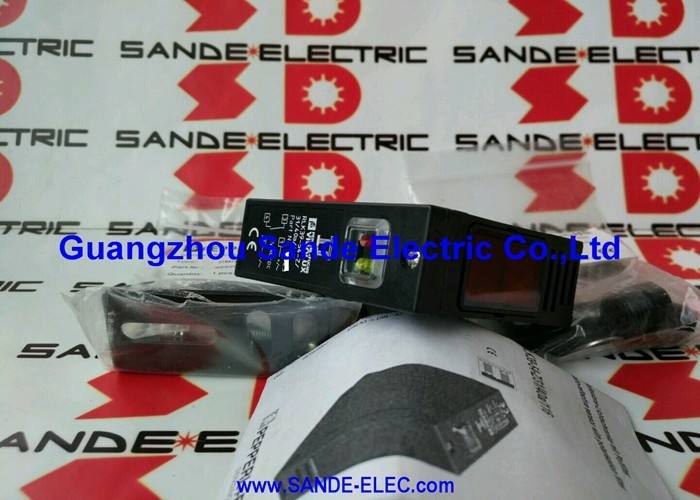
Pepperl+Fuchs RLK39-54-Z/31/40A/116 | Retroreflective Photoelectric Sensor — 7m, Red Light, Polarization Filter, Relay 3A, Timer, Light/Dark On, IP54
Overview
The Pepperl+Fuchs RLK39-54-Z/31/40A/116 is a retroreflective photoelectric sensor combining 7-metre detection range, visible red light with polarization filter, relay contact output, built-in timer function, and a terminal compartment connection — all in the robust block-style housing that defines the RLK39 series' industrial positioning.
It is designed for factory automation applications where the combination of long sensing range, reliable object detection in environments with background reflections, and direct connection to higher-current relay loads makes a transistor output sensor inadequate.
The retroreflective operating principle positions the emitter and receiver together in one housing, requiring only a retroreflector on the opposite side of the detection zone rather than a separate receiver unit.
The sensor projects a beam of visible red light toward the reflector; when an opaque object interrupts the beam between the sensor and reflector, the receiver no longer sees the returned light and the output switches.
For transparent or translucent objects, the standard retroreflective configuration may allow the beam to pass through — in these cases, a separate transparent-object variant of the sensor would be selected.
The Z suffix identifies the timer variant: a built-in delay function that can be configured to suppress output changes for adjustable dwell periods — either ON-delay (output activates after the object has blocked the beam for the set time) or OFF-delay (output remains active for the set time after the beam is restored).
This eliminates false triggering from vibrating or oscillating objects that momentarily interrupt the beam and return.
Key Specifications
| Parameter |
Value |
| Detection Range |
Up to 7 m |
| Light Source |
Visible red light |
| Polarization Filter |
Yes |
| Sensitivity |
Adjustable via potentiometer |
| Output |
Relay contact |
| Output Current |
3 A |
| Operation Mode |
Light-On / Dark-On (switchable) |
| Timer |
Built-in (delay function) |
| Connection |
Terminal compartment |
| IP Rating |
IP54 |
| Operating Temperature |
−25°C to +55°C |
| Indicators |
LED status + receiving indicator |
Retroreflective Sensing — Single-Side Installation
The retroreflective configuration requires physical access to only one side of the detection zone — the side where the sensor is mounted.
A retroreflector (prism tape, corner cube reflector, or dedicated mounted reflector) is installed on the far side of the zone, but it requires no electrical connection, no cable routing, and no control wiring.
This makes retroreflective sensing the practical choice for detection zones where running cable to a far receiver is expensive, difficult, or impossible — across wide conveyor lines, into overhead structures, or through machine frames where a second cabled device would create a maintenance problem.
The maximum 7m range provides generous detection span for a single sensor installation — covering standard industrial conveyor widths, machine enclosure openings, and passage detection zones without the range anxiety of shorter-range diffuse sensors.
The actual effective range in any installation depends on the reflector type, target surface reflectivity, ambient light conditions, and lens cleanliness — the sensitivity potentiometer adjusts the detection threshold to optimise the signal margin for the specific installation.
Polarization Filter (/31) — Detection of Reflective Objects
The standard retroreflective sensor without a polarization filter can be fooled by highly reflective target surfaces — a glossy metal can, shiny polished workpiece, or mirror-finish packaging reflects the light beam back to the receiver, causing the sensor to read "beam not interrupted" even when the target is physically present.
The polarization filter in the RLK39-54-Z changes the light beam's polarisation plane before emission and requires the received light to arrive with a complementary polarisation change — which the retroreflector produces.
A specular (mirror-like) reflection from a target's surface does not rotate the polarisation, so the receiver rejects it.
The retroreflector's geometry does rotate the polarisation, so legitimate beam returns are accepted.
The practical result: the RLK39-54-Z with polarization filter reliably detects reflective objects that confuse standard retroreflective sensors, making it suitable for applications in packaging, metal parts handling, automotive assembly, and any process involving polished or glossy product surfaces.
Relay Output (/40A) — Direct Load Switching at 3A
The relay contact output of the RLK39-54-Z switches loads up to 3A at the supply voltage. Unlike transistor outputs (PNP or NPN), a relay contact is electrically isolated from the sensor's supply circuit — the contact switches independently of the sensor's DC supply polarity and is compatible with both AC and DC load circuits.
This isolation allows the sensor to switch 230V AC solenoids, alarm sounders, motor starters with AC coils, and PLC inputs from a single output without intermediate relays or signal isolators.
Three amperes covers the most common direct-switching loads in factory automation: 24V DC relay coil (50–150mA), 24V solenoid valve (100–500mA), small AC motor starter coil (0.5–2A), and most PLC input modules.
For loads exceeding 3A — large motor contactors, high-current solenoids — the relay output drives an intermediate relay coil rather than the load directly.
Timer Function (/Z) — Suppression of Transient Interruptions
The built-in timer in the Z variant adds a configurable delay between the detected event (beam interruption or restoration) and the output state change.
Two delay modes are available: an ON-delay where the output activates only after the beam has been blocked for the set duration (suppressing brief blockages from dust, particles, or vibration), and an OFF-delay where the output remains active for the set duration after the beam is restored (extending the output pulse for targets that pass quickly through the detection zone).
For applications where vibration causes the target to intermittently break and restore the beam — packaging machinery, conveyor drives, industrial washers — the ON-delay prevents output chatter from becoming a nuisance alarm or control interference.
The timer period is set via an adjustment on the sensor body; the range covers a broad span from fractions of a second to several seconds depending on the specific delay range selected.
FAQ
Q1: What reflector should be used with the RLK39-54-Z/31/40A/116 to achieve the full 7m detection range?
Pepperl+Fuchs designs the RLK39 series for use with compatible retroreflectors from their accessory range — both rigid corner-cube mounted reflectors and retroreflective tape are options, with the mounted reflectors providing more consistent performance at longer ranges.
The 7m maximum applies with an appropriate retroreflector under standard conditions (clean lens, no excessive ambient light interference, polarisation filter active).
At the maximum range, the signal margin is thinner than at shorter distances — sensitivity potentiometer adjustment and reflector cleanliness become more critical for reliable operation. For margins approaching the 7m limit, use a high-efficiency retroreflector and maintain alignment carefully.
Q2: The sensor features Light-On and Dark-On modes — what determines which to select?
Light-On (LO) mode: output activates when the beam reaches the receiver — sensor output is ON when no object is blocking the beam, and switches OFF when the beam is interrupted. Dark-On (DO) mode: the opposite — output is ON when the beam is interrupted.
Choose Light-On for applications where the output should indicate "path clear" and switch when an object is detected (standard object detection).
Choose Dark-On for applications where the output should indicate "object present" and switch when the object leaves (e.g., confirming a part is seated in a fixture).
Q3: The IP rating is IP54 — is the RLK39-54-Z suitable for outdoor or wet environments?
IP54 provides dust protection (partial, no complete dust exclusion as with IP6x) and protection against water sprayed from any direction. It is suitable for indoor industrial environments with moderate splash exposure, but not for high-pressure washdown, continuous water jets, or outdoor exposure to rain without additional housing protection.
For applications requiring IP67 or higher, alternative sensor variants or protective enclosures should be considered.
Q4: Can the RLK39-54-Z/31/40A/116 be used at the full 7m range if the target is a transparent plastic film or bottle?
Standard retroreflective sensors — including this model without special transparent-object optics — are generally not reliable for detecting transparent targets.
Transparent objects allow the beam to pass through and return from the reflector, meaning the receiver continues to see the beam even with the target present.
For transparent object detection, a specialised retroreflective sensor with polarisation optimised for transparent material detection, or an alternative through-beam sensor, is required. Opaque objects are reliably detected at up to 7m.
Q5: How is the timer function set on the RLK39-54-Z, and what delays are available?
The timer function is configured via an adjustment accessible on the sensor body — typically a multi-turn potentiometer or selector. The available delay range depends on the specific RLK39 configuration and variant; the Z designation confirms the timer is present.
Refer to the Pepperl+Fuchs RLK39-54-Z product documentation for the specific delay range and adjustment procedure.
For applications where the precise timer duration is critical to the control sequence, verify the available adjustment range against the application's required delay before selecting the sensor.



 Your message must be between 20-3,000 characters!