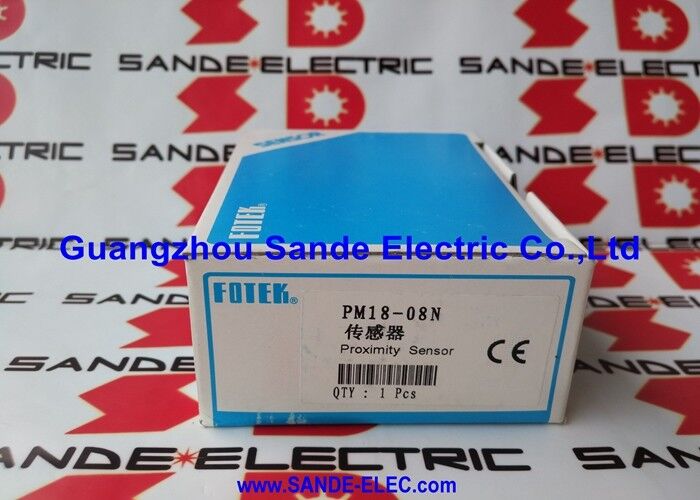
Fotek PM18-08N | Inductive Proximity Sensor — M18 Non-Flush, 8mm Sensing Distance, NPN NO, 10–30VDC, 800Hz, 3-Wire DC
Part Number: PM18-08N (base model: PM18-08N-S)
Manufacturer: Fotek Controls Co., Ltd. (Taiwan)
Housing: M18, cylindrical threaded
Mounting: Non-flush (non-embeddable)
Sensing Distance: 8.0 mm
Output Logic: NPN, normally open (NO)
Supply Voltage: 10–30V DC
Response Frequency: 800 Hz
Wiring: 3-wire DC
Related Variants:
- PM18-08NB-S — NPN, NC
- PM18-08P-S — PNP, NO
- PM18-08PB-S — PNP, NC Condition: New
Overview
The Fotek PM18-08N is an M18 non-flush inductive proximity sensor with 8mm sensing distance, NPN normally open output, and 800Hz switching frequency — part of a clearly organised four-variant family that covers NPN/PNP and NO/NC in a single M18 housing.
The "N" in the part number identifies NPN output, and the absence of "B" confirms normally open logic; add "B" for normally closed, swap "N" for "P" for PNP, and the selection matrix is complete.
An 8mm sensing distance from a non-flush M18 body is a practical specification for a wide range of machine tool and automation applications. Non-flush (unshielded) construction allows the sensor's oscillating electromagnetic field to project forward without lateral attenuation from internal shielding — achieving 8mm detection range from the M18 body diameter while a shielded M18 sensor of the same size would typically reach 5–7mm.
The trade-off is the installation constraint: the sensor tip must protrude from its mounting bracket rather than being flush with the surrounding metal, which requires a metal-free zone around the sensing face.
Eight hundred hertz is a respectable switching frequency for a general-purpose M18 inductive sensor.
At 800Hz, the sensor completes 800 full detection cycles per second — fast enough for most position confirmation, cylinder end-of-travel, and part-present applications, and sufficient for moderate-speed pulse counting from rotating discs or gear teeth where target passing frequencies stay well below 400 events per second.
The PM18 series is Fotek's standard M18 inductive product, manufactured in Taiwan and intended for PLC-based automation in machine tools, assembly equipment, conveyor systems, and material handling.
The full four-variant selection within the PM18-08 family means a single sensor body type covers the most common output requirements without maintaining separate inventory of physically different sensors.
Key Specifications
| Parameter |
Value |
| Housing |
M18, cylindrical threaded |
| Mounting |
Non-flush (non-embeddable) |
| Sensing Distance |
8.0 mm |
| Output |
NPN, NO, 3-wire |
| Supply Voltage |
10–30V DC |
| Response Frequency |
800 Hz |
| Variants Available |
NPN/NO, NPN/NC, PNP/NO, PNP/NC |
| Manufacturer |
Fotek Controls Co., Ltd. |
PM18 Family — Four Outputs, One Body
The PM18-08 family is a deliberately complete set: NPN/NO, NPN/NC, PNP/NO, and PNP/NC, all sharing the same M18 housing, 8mm sensing distance, and 10–30V DC supply range.
This means once a machine designer selects the PM18-08 for a detection point, the output logic choice (NPN vs PNP, NO vs NC) can be changed at any time by substituting the appropriate suffix variant without changing the mechanical installation, mounting brackets, or cable routing.
In PLC systems, the output logic choice is driven by the PLC input card type. NPN (sinking) sensors connect to PLC input cards with NPN/sinking inputs — common in Japanese-standard machine designs.
PNP (sourcing) sensors connect to PLC cards with PNP/sourcing inputs — standard in European machine design. In globally mixed facilities, having all four variants available within a single sensor product simplifies the stocking strategy.
NO versus NC selection depends on the control logic requirement: NO output for standard presence detection (output activates when target is in range);
NC output for fail-safe interlocking (output is normally conducting and de-energises when target is detected, or when the sensor circuit fails — either condition produces the same output state).
Non-Flush Mounting — 8mm From M18
The non-flush designation is the direct consequence of the design decision to maximise sensing distance in the M18 body. Without internal shielding, the M18 coil projects a stronger, longer-reach field that extends laterally as well as forward.
Installation protocol requires the sensor face to protrude above the mounting bracket surface, with a metal-free clearance zone around the tip specified in Fotek's PM18 installation drawings.
The metal bracket bore should match the sensor body diameter without surrounding the tip flush.
In practical machine tool applications, non-flush M18 sensors are typically mounted on extended brackets, standoffs, or in dedicated sensor mounting blocks that position the sensor tip at the correct standoff distance from the machine structure.
The slightly more complex mounting hardware is a common trade-off accepted in exchange for the additional 2–3mm of sensing distance that non-flush construction provides over a comparable flush-mountable M18 model.
800Hz — Fast Enough for Most Industrial Detection Tasks
At 800 complete ON/OFF cycles per second, the PM18-08N handles the detection requirements of the overwhelming majority of machine tool and automation applications. Pneumatic cylinder end-of-travel confirmation, pallet location sensing on conveyor indexers, tool presence detection in machining centres, and part-in-fixture confirmation in assembly cells all operate at rates well below 100 events per second — leaving the sensor's 800Hz capability with an enormous margin.
For pulse counting from rotating components — gear teeth, encoder discs, cam lobes — the frequency limit determines the maximum RPM at which the sensor can count reliably.
At 800Hz with a 24-tooth gear, the maximum RPM is 800 × 60 ÷ 24 = 2,000 RPM. For higher-speed counting, the PM18-08N's 800Hz frequency should be verified against the application's maximum pulse rate requirement.
FAQ
Q1: What is the difference between the PM18-08N-S and PM18-08N (without the -S suffix)?
The -S suffix in the Fotek PM18 series typically identifies a specific cable or connector configuration — in many Fotek sensor ranges, S indicates the standard cable-type version as opposed to a connector-terminated variant. Both versions carry the same sensing specifications (8mm, NPN, NO, 10–30VDC, 800Hz).
Confirm the exact connection type from the product label or Fotek's current PM18 documentation, as suffix conventions may vary across production runs.
Q2: The sensing distance is 8mm — how does temperature affect this across the operating range?
Temperature influences the oscillator frequency within the sensor's inductive circuit, which in turn shifts the switching point.
For standard industrial inductive sensors, the sensing distance varies by approximately ±10% over the operating temperature range. For the PM18-08N at 8mm nominal, this represents a variation of approximately ±0.8mm.
The practical installation gap should be set within 80% of the nominal distance (approximately 6.4mm) to maintain reliable switching across the full temperature range from cold start to steady-state operating temperature.
Q3: Can the PM18-08N detect aluminium or stainless steel components, not just ferrous metal?
Yes, but at reduced sensing distance. Non-ferrous metal correction factors for standard inductive sensors are approximately: aluminium 0.3–0.4× (2.4–3.2mm effective), stainless steel (austenitic) 0.6–0.75× (4.8–6mm effective), brass 0.4–0.5× (3.2–4mm effective).
These are approximate values — actual correction depends on the specific alloy and target geometry. For non-ferrous targets in applications where the 8mm distance is needed, an inductive sensor with a smaller body (shorter nominal distance but higher correction factor per sensor type) or a different sensor technology should be considered.
Q4: How does the NPN output of the PM18-08N connect to a standard PLC?
Three-wire NPN connection: brown wire to supply positive (+24V DC), blue wire to supply common (0V), black wire (output) to PLC NPN digital input terminal.
The PLC input card must have NPN/sinking inputs. When the sensor detects a target, the NPN transistor conducts and pulls the input terminal toward 0V — the PLC registers a logic 1 input.
When no target is present, the output is open (high impedance), and the PLC registers logic 0. Verify the PLC input card's minimum ON-state current requirement (typically 5–15 mA) is met with the supply voltage and cable resistance.
Q5: What happens if the sensor's output is short-circuited to the supply?
If the black output wire is accidentally shorted to the +24V supply (or the blue common in a PNP circuit), the output transistor conducts the full short-circuit current. Standard inductive sensors include output short-circuit protection that limits the current through the output stage to a safe value and prevents transistor damage in brief fault conditions.
For sustained short circuits, power should be removed immediately — the protection circuit handles transient faults but is not designed for continuous operation in a short-circuit condition.


 Your message must be between 20-3,000 characters!