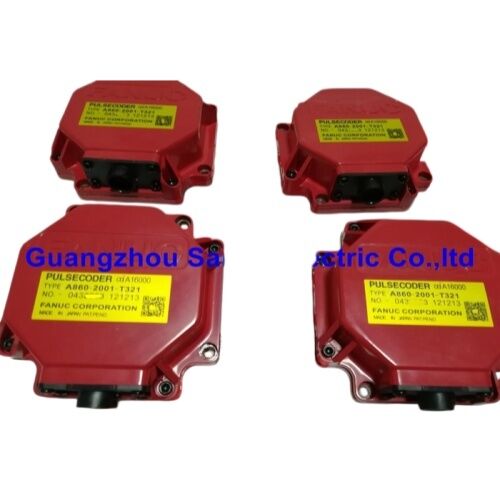
FANUC Incremental Brushless Servo Motor Encoder — A860-2001-T321 / A860-0360-V511
Precision Feedback, Zero Compromise
When axis positioning drifts or a servo alarm brings a production line to a halt, the encoder is the first place to look. FANUC's A860-2001-T321 and A860-0360-V511 are factory-genuine incremental brushless encoders engineered to eliminate that vulnerability — delivering stable, high-resolution position feedback across millions of machine cycles without signal degradation.
Both units are built on a brushless optical architecture. With no contact between rotor and stator, there is no wear surface, no brush residue, and no progressive signal decay. The result is an encoder that performs on day 5,000 the same way it performed on day one.
Two Models. One Clear Selection Logic.
A860-2001-T321 is matched to FANUC αi and αiS series servo motors — the higher-torque, higher-speed drives found in large-format machining centers, five-axis VMCs, and horizontal boring mills. The T-type connector exits from the rear of the unit, keeping cable routing clean in tight servo housings.
A860-0360-V511 is designed for the β and βiS motor family — compact, cost-effective servo drives that power the majority of small-to-mid-size turning centers and entry-level CNC machining centers worldwide. The V-type side-exit connector accommodates the tighter lateral clearances typical of smaller machine cabinets.
Both models communicate via FANUC's native serial interface, connecting directly to αi and βi series amplifiers without signal converters or protocol adapters. Compatibility is seamless out of the box.
Key Specifications at a Glance
A860-2001-T321
- Type: Incremental / Brushless Optical
- Compatible Motor Series: αi, αiS, αiF
- Compatible Amplifiers: αi SV, SVU Series
- Signal Interface: FANUC Serial
- Connector: T-Type (Rear Exit)
- Sealing: IP65 (shaft end)
A860-0360-V511
- Type: Incremental / Brushless Optical
- Compatible Motor Series: βi, βiS
- Compatible Amplifiers: βi SV Series
- Signal Interface: FANUC Serial
- Connector: V-Type (Side Exit)
- Sealing: IP65 (shaft end)
Built for Industrial Reality
Workshops are not controlled environments. Flood coolant, vibration, thermal cycling, and airborne particulates are facts of life on the production floor — and these encoders are specified for exactly that reality.
Sealed preloaded bearings resist coolant ingress and eliminate the shaft play that causes position count errors under vibration. The IP65-rated shaft end sealing keeps cutting fluid out of the optical assembly during wet-cutting operations. Internal components are selected for thermal stability across the full operating temperature range of industrial servo drives, so performance stays consistent whether the machine has been warming up for three minutes or running continuous shifts for twelve hours.
Mechanical tolerances are held to OEM specifications throughout. These encoders seat directly in place of factory originals — no shimming, no adapter plates, and no special tooling required. In most installations, a complete encoder swap takes under an hour.
Understanding Incremental Feedback in CNC Applications
Incremental encoders generate a pulse stream — a fixed count of pulses per revolution — which the servo drive accumulates into a running position total. Each time the machine powers up, that count resets to zero and re-establishes its coordinate reference through a standard reference return cycle (G28 or equivalent). The process takes seconds and is already built into the startup routine of every modern CNC controller.
This architecture is deliberately simple. No battery, no non-volatile memory, no initialization handshake. Fewer components mean fewer failure modes, and when a failure does occur, diagnosis is fast: the encoder is either producing a signal or it isn't. For the vast majority of production CNC environments, incremental feedback offers a cost, simplicity, and parts-availability advantage that makes it the clear practical choice.
Compatibility Reference
| Encoder P/N |
Motor Series |
Amplifier Series |
Typical Application |
| A860-2001-T321 |
αiS, αiF, αi |
αi SV / SVU |
Large VMC / HMC axis & spindle |
| A860-0360-V511 |
βiS, βi |
βi SV |
Compact lathe / entry VMC axis |
| A860-2001-T321 |
αi (legacy) |
Series 16i / 18i / 21i |
Retrofit & legacy maintenance |
| A860-0360-V511 |
βiS (2nd gen) |
30i / 31i / 32i |
Current-gen compact CNC |
Always verify against the motor nameplate part number before ordering.
Frequently Asked Questions
Q1: What is the difference between the A860-2001-T321 and A860-0360-V511, and how do I know which one my machine needs?
The two encoders serve different motor families. The A860-2001-T321 is designed for FANUC αi and αiS series servo motors — the larger, higher-performance units typically found in machining centers and multi-axis equipment. The A860-0360-V511 is matched to the β and βiS series, which are compact servo motors common in smaller lathes and entry-level CNC machining centers. To confirm the correct part, locate the motor nameplate on your machine. If the motor designation begins with "αiS" or "αi," the A860-2001-T321 is the correct encoder. If it reads "βiS" or "βi," select the A860-0360-V511. The two are not interchangeable — even though both are incremental serial encoders, the mechanical interface, connector orientation, and internal configuration differ between the α and β motor families.
Q2: What FANUC alarm codes typically point to an encoder fault on these models?
The most commonly seen alarms associated with a failing encoder include Servo Alarm 364 and 365 (serial encoder communication errors), Servo Alarm 369 (encoder hardware fault), and SV-0368 / SV-0447, which relate to pulse count irregularities and communication breakdown between the encoder and the amplifier. Alarms that appear intermittently under load or at specific spindle speeds — and then clear on a power cycle — are a strong indicator of a degrading optical disc or a loose feedback cable rather than a drive-side fault. Before replacing the encoder, always inspect the feedback cable along its full run for damage and verify the connector is fully seated, as cable faults account for a significant share of apparent encoder failures.
Q3: Can an in-house maintenance engineer replace these encoders, or is specialist certification required?
Encoder replacement on FANUC servo motors is within the capability of an experienced maintenance engineer without specialist certification, provided the correct procedure is followed. The critical steps are: fully power down the machine and allow servo capacitors to discharge before touching any wiring; photograph the cable routing and connector orientation before disconnection; handle the replacement encoder by its housing only and never touch the optical disc or internal components; torque mounting screws to specification to avoid misalignment; and perform a complete reference return cycle after reassembly before resuming production. The most common installation error is a slightly misaligned connector, which produces an immediate alarm on power-up. For teams new to servo motor disassembly, having a qualified engineer present for the first replacement is a reasonable precaution.
Q4: Are aftermarket or rebuilt encoders a viable alternative to genuine FANUC units?
Rebuilt encoders typically cost 30–60% less than new OEM units and can be a reasonable choice for machines with lower utilization or where lead time is the priority constraint. The inherent risk with rebuilt units is that the underlying optical components may have accumulated wear, and there is no method to verify remaining service life before installation. For high-production machines running two or three shifts, the cost of a single unplanned downtime event caused by a re-failed rebuilt encoder almost always exceeds the price difference with a new OEM unit. For critical-path axes on primary production equipment, genuine FANUC encoders with full traceability remain the lower-risk choice. For secondary machines or backup inventory, a reputable rebuilt unit with a documented test report can make economic sense.
Q5: How should these encoders be stored before installation to preserve their service life?
Store units in their original sealed packaging in a clean, dry environment between 0°C and 55°C (32°F to 131°F), away from direct sunlight and electromagnetic sources such as large motors or welding equipment. Avoid stacking heavy items on the packaging — sustained pressure or impact can crack the optical disc, which is the most fragile internal component. Keep units away from solvents, cutting fluids, and aerosols, as vapor ingress can degrade internal seals even in a sealed package over time. Under correct storage conditions, FANUC encoders maintain full specification for several years. Good practice is to rotate stock and use older units first. Before installing any stored encoder, inspect the connector pins for oxidation and clean gently with a dry, lint-free cloth if needed.



 Your message must be between 20-3,000 characters!