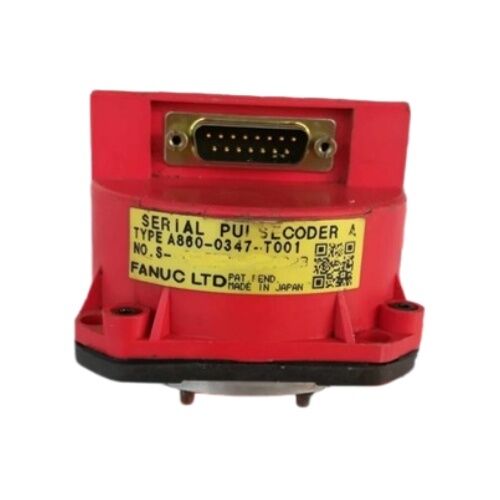
Fanuc A860-0347-T001 | Serial A Absolute Pulse Coder — D-Sub Connector, Fanuc Model 3-0S / 4-0S S-Series AC Servo Motors
Overview
The Fanuc A860-0347-T001 is a Serial A absolute pulse coder fitted to specific models within Fanuc's S-series AC servo motor range — specifically the Model 3-0S and Model 4-0S motors.
The Serial A protocol was Fanuc's first-generation serial encoder format for the S-series, providing absolute position feedback over a serial link from the motor to the servo amplifier, eliminating the need for a reference return at machine startup while delivering position data with a resolution appropriate for the S-series motor's operating characteristics.
The D-Sub connector at the encoder body is the physical identifier of this variant within the A860-0347 family.
D-Sub connectors — the trapezoidal multi-pin industrial standard — were a common choice for servo feedback connections in the era the S-series motors were produced, and the T001's D-Sub mates with the corresponding socket on the motor's feedback cable assembly. This connector arrangement allows the encoder to be replaced without disturbing the cable run — the replacement T001 plugs directly into the existing cable's motor-end socket.
The S-series motors with which the A860-0347-T001 is associated represent an earlier generation of Fanuc servo motors than the alpha series that followed.
The 3-0S and 4-0S designations indicate mid-frame S-series motors in specific torque and speed classifications. Machines built with these motors — turning centres, machining centres, and transfer line equipment from major builders of the 1990s era — continue to operate in production facilities worldwide, making tested replacement pulse coders an active maintenance need rather than a historical curiosity.
Like all absolute serial pulse coders in the Fanuc S-series ecosystem, the A860-0347-T001's absolute position capability relies on battery backup in the servo amplifier to maintain the multi-turn count through machine power cycles.
A healthy amplifier battery is the operational prerequisite for the "no reference return at startup" benefit that distinguishes this encoder from the incremental types used on earlier S-series motors.
Key Specifications
| Parameter |
Value |
| Encoder Type |
Serial A — Absolute |
| Connector |
D-Sub |
| Compatible Motors |
Model 3-0S, Model 4-0S (S-series) |
| Motor Series |
S-series (pre-alpha) |
| CNC Compatibility |
Zero-C/D, 15, 16A, 18A, 21A |
| Feedback Type |
Absolute serial (multi-turn) |
| Battery Required |
Amplifier battery (for position retention) |
| Supply |
Surplus / Exchange |
Serial A Protocol — S-Series Context
The Serial A protocol places the A860-0347-T001 in the first generation of Fanuc serial encoders for the S-series. Prior to Serial A, S-series motors used incremental pulse coders (the A860-0315, A860-0316 families) that produced A/B/Z quadrature signals. Serial A replaced those analogue quadrature outputs with a compact serial data link, reducing the number of conductors required between the encoder and amplifier while simultaneously enabling absolute position feedback that the incremental types could not provide.
The transition to serial absolute feedback was a significant operational improvement for machine operators: machines with Serial A encoders can resume production immediately after any planned or unplanned shutdown, provided the amplifier battery is healthy. Machines with incremental encoders require a structured reference return sequence after every power cycle, adding time to startup and limiting flexibility during maintenance.
The Serial A protocol used on the S-series is distinct from the serial protocols used on subsequent alpha and alpha i encoder generations. A860-0347-T001 is not electrically or protocol-compatible with alpha series encoders (A860-0346, A860-0356 families) or alpha i encoders (A860-2001 series) — they serve different motor generations and communicate with different amplifier interface circuits.
D-Sub Connector — Field Identification and Replacement Notes
The D-Sub connector format on the A860-0347-T001 uses the standard trapezoidal housing with latching retention screws. When examining a motor in the field, the D-Sub socket at the cable's motor end — rather than an Amphenol or flat-pin connector — is the physical indicator that this T001 D-Sub variant is the correct encoder rather than a different A860-0347 series variant.
Before ordering a replacement, confirm the motor's feedback cable has a D-Sub socket at the encoder end; the T001 will not fit a cable terminated with a different connector format.
FAQ
Q1: What CNC alarm appears when the A860-0347-T001 loses communication, and what is the first diagnostic step?
Serial A encoder communication faults typically appear as SV-3xx series alarms on compatible CNC generations — commonly SV360 (serial data error) or an axis alarm indicating the servo cannot be energised.
Before condemning the encoder, disconnect and reseat the D-Sub connector at the encoder body, examining all pins for contamination or physical damage. Inspect the cable run for kinking, crush damage, or chafing at conduit edges.
If the alarm persists through connector and cable inspection, substitute a known-good feedback cable from another axis (if connector-compatible). A fault that clears with the substitute cable points to cable damage; one that remains points to the encoder or its amplifier interface circuit.
Q2: Is the A860-0347-T001 available as a new part, or only as surplus and exchange?
The S-series motor generation predates current Fanuc production, and the A860-0347-T001 is sourced exclusively through the aftermarket — surplus from working machine decommissioning and managed exchange pools from motor repair specialists.
Tested and warranted exchange units from reputable suppliers are the most practical route to a replacement with confidence in its functional condition.
A static bench test alone does not validate the encoder's serial communication performance; testing under rotation on a compatible amplifier and CNC is the meaningful qualification.
Q3: Can the A860-0347-T001 be replaced with a later absolute encoder type if a direct replacement is unavailable?
No — the Serial A encoder's protocol and amplifier interface are specific to the S-series servo amplifiers designed to receive Serial A data.
A replacement with a different Fanuc encoder family would require an amplifier that can accept that encoder's protocol, which in turn would require a servo system change beyond just the encoder.
In practice, the correct approach is to source a compatible A860-0347-T001 from the aftermarket.
A reputable Fanuc S-series motor specialist can advise on whether the exact T001 D-Sub variant is available or whether a compatible alternative within the A860-0347 family with cable adaptation is an option.
Q4: After fitting a replacement A860-0347-T001, what startup procedure is required?
A reference return is required after every encoder replacement. The new encoder has no stored multi-turn count relationship with the machine's mechanical position — the amplifier's SRAM has been reset or contains a count tied to the previous encoder's angular orientation.
Power on the machine, confirm that the encoder communication alarm has cleared (indicating the serial link is established), then drive the axis through a full reference return cycle. Verify the axis position display shows the expected machine zero coordinate after the reference return before running any production programs.
Q5: What are the most common failure patterns for the A860-0347-T001 in long-running S-series machines?
Age-related bearing wear is the primary mechanical failure — the encoder bearing supporting the optical disc assembly develops play, which introduces signal noise and eventually triggers serial communication alarms.
Contamination of the optical disc from coolant mist or oil aerosol entering through the motor shaft seal is the second major failure path; the disc surface becomes obscured, reducing signal amplitude below the detection threshold.
D-Sub connector pin corrosion — from humidity, coolant vapour, or lubricant mist entering the connector — causes intermittent communication faults that worsen over time. In all cases, the encoder is not field-repairable; exchange is the service solution.



 Your message must be between 20-3,000 characters!