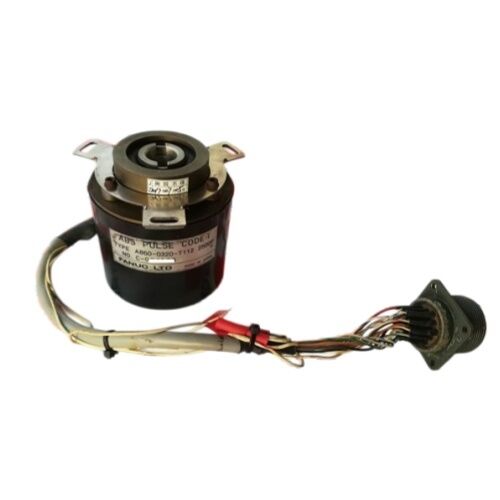
Fanuc A860-0320-T112 | Absolute 2500P Pulse Coder — AC/S-Series Servo Motors 0S–40S, CNC Zero-C/D · 15 · 16A · 18A · 21A — Discontinued, Exchange/Surplus
Overview
The Fanuc A860-0320-T112 is the black-housing absolute pulse coder fitted to Fanuc's AC and S-series servo motors — the generation of motors that powered tens of thousands of CNC machine tools built through the 1980s and into the mid-1990s.
At 2500 pulses per revolution, it delivers the position resolution that Zero-C, Zero-D, and the early 16/18 Model-A controllers require for closed-loop servo operation on lathes, machining centres, drilling machines, and transfer line equipment. Machines with this motor/encoder generation remain actively running in production facilities worldwide, and it is that ongoing operational reality — not collector interest — that keeps the A860-0320-T112 a sought-after replacement component decades after Fanuc discontinued active production.
The absolute design means the encoder reports its shaft position immediately at power-on, without requiring a reference return cycle. The CNC reads the position from the encoder's absolute code immediately upon system initialisation, and the axis is ready for motion.
This was not a universal feature in this motor generation — the earlier incremental pulse coders (A860-0304-T112 and similar) required homing sequences before each use, while the absolute A860-0320-T112 allowed operators to resume production from an accurately known position after any planned or unplanned power interruption.
The convenience difference is tangible on a machine that stops and starts frequently.
The alternate part number A290-0561-V532 appears on some motor assemblies and ordering documents for the same physical encoder — both designations refer to the same unit and are interchangeable for identification and sourcing purposes.
The black plastic housing distinguishes this encoder from the earlier red-cap incremental types and from the metal-bodied alpha series encoders that followed in the next motor generation. In the field, the black housing is the quickest visual confirmation that an AC or S-series motor is fitted with this absolute type rather than an incremental variant.
Key Specifications
| Parameter |
Value |
| Encoder Type |
Absolute (ABS) |
| Resolution |
2500 ppr |
| Housing |
Black plastic |
| Alternate P/N |
A290-0561-V532 |
| Motor Compatibility |
AC/S-series: 0S, 5S, 10S, 20S, 40S and variants |
| CNC Compatibility |
Zero-C/D, Series 15, 16A, 18A, 21A |
| Status |
Discontinued — exchange/surplus only |
The 2500P Resolution in the AC/S-Series Context
The 2500 pulses per revolution figure is the raw disc line count. The amplifier's quadrature decoding produces 10,000 interpolated position increments per shaft revolution from this 2500P base — 4× counting of A and B channel edges.
For a servo motor connected to a 5mm pitch ball screw with a typical gear ratio, this gives positional resolution in the low single-digit micrometre range at the workpiece — more than adequate for the machining applications these motors were designed to serve.
On lathes and machining centres with Series 15 or 16A controls, this resolution underpins the axis positioning accuracy for which Fanuc CNC machines built in this era were known.
The absolute position encoding itself spans one full revolution.
Multi-turn absolute position retention (knowing the position after more than one revolution without the shaft being driven back to a reference) depends on the servo amplifier's battery maintaining the revolution counter through machine power cycles.
A failed amplifier battery does not destroy the encoder's single-revolution absolute data; it means the controller needs to re-establish the axis position reference after power recovery.
Supply Situation and Exchange
Fanuc discontinued the A860-0320-T112 and its immediate predecessor variants as the AC/S-series motor generation aged out of the active product line. The encoder is no longer manufactured. Replacement units come entirely from two sources: tested surplus from decommissioned machines and motor exchange pools maintained by Fanuc specialist service companies.
Most suppliers impose a motor-exchange condition on these encoders because the supply is finite and tied to working motor assemblies.
The practical consequence for a maintenance buyer is that a core (faulty encoder or faulty motor with this encoder) must often accompany the order — the refurbisher fits a tested encoder to the returned motor body, tests the assembly, and supplies a working motor back.
This exchange model is more common for the A860-0320-T112 than simple part-only sales, though surplus stock at various conditions is available from some distributors without exchange requirement.
Testing of any replacement A860-0320-T112 should always be performed under rotation on a compatible amplifier — static bench testing does not validate the encoder's absolute code accuracy, which requires actual shaft rotation to verify that the code sequence is clean and the position data is noise-free across a full revolution.
Common Failure Patterns and Diagnosis
Age-related optical disc contamination is the dominant failure mode.
The A860-0320-T112's black plastic housing seals the optical disc from the motor shaft end, but motor bearing lubricant migration over years of service eventually reaches the optical path, reducing signal amplitude and causing the absolute code to produce errors the CNC reads as position data failure.
The alarm typically appears as a position error alarm or an encoder communication fault on Zero-C/D and 16A controls, often appearing first during machine warmup when bearing lubricant is cold and viscous.
Bearing wear in the encoder's own internal bearing is the second most common issue.
As the bearing develops play, the optical disc wobbles relative to the photodetector array, and signal quality degrades — producing the same types of position error alarms as contamination, but without the visible lubricant evidence inside the encoder when it is opened for inspection.
FAQ
Q1: Is the A860-0320-T112 available without a motor exchange, or must a core be returned?
Availability and exchange requirements vary by supplier. Some specialists sell tested surplus units outright — these come from decommissioned machine teardowns and are available while stock lasts.
Many repair specialists offer this encoder only as part of a motor exchange, where the faulty motor is sent in and a tested motor with a working encoder is returned.
If an outright purchase is required without returning a core, verify with the supplier at the time of enquiry, as stock levels for this discontinued encoder are genuinely limited and change frequently.
Q2: Can the A860-0320-T112 be repaired if contaminated or bearing-worn, or must it be exchanged?
Fanuc designed these encoders as sealed assemblies not intended for field repair. However, some specialist refurbishers do open and clean contaminated units, replace internal bearings, and re-qualify the encoder under rotation on a test rig.
Success rate varies with the degree of contamination and disc condition — if the optical disc itself has been etched or scratched by abrasive contamination, cleaning cannot restore performance. Before committing to repair, ask the refurbisher whether they test the encoder under rotation against a known-good reference after the repair.
Q3: What CNC alarm codes appear when the A860-0320-T112 is failing on a Series 16A control?
On the Fanuc Series 16A, encoder-related alarms typically appear as SV0401 (soft disconnect — pulse coder disconnected) or SV0409 (pulse coder error) on the affected axis. Alarm SV0401 at power-on usually indicates the encoder is not communicating; the same alarm appearing intermittently during operation points to a degraded but partially functioning encoder or a cable connector problem.
SV0409 appearing mid-cycle with no prior history is often the first symptom of optical contamination causing occasional absolute code corruption.
Q4: What is the difference between the A860-0320-T112 and the A860-0304-T112 fitted to similar-looking motors?
The A860-0320-T112 is an absolute type — it reports position immediately at power-on without a reference return.
The A860-0304-T112 is an incremental type — the CNC must drive the axis to a reference point after every power cycle to establish position. Both use 2500P resolution.
Both fit the same motor body styles, but the amplifier's interface card differs between absolute and incremental types.
The motor's nameplate and the amplifier parameter settings will confirm which type is present. Substituting an absolute encoder for an incremental type requires matching amplifier hardware; it is not a plug-and-play swap.
Q5: After fitting a replacement A860-0320-T112, what alignment procedure is required?
Unlike alpha-series encoders with Oldham couplings, the A860-0320-T112 mounts directly to the motor shaft with an alignment between the encoder's mechanical zero position and the motor's electrical zero.
After fitting a replacement, the CNC will typically require a full reference return to re-establish the absolute position reference with the new encoder's mechanical orientation.
The specific parameter adjustment needed to align the new encoder's zero offset with the machine's grid shift and reference point depends on the machine builder's original setup — consult the machine's Fanuc parameter backup if available, and verify axis position at the reference point before returning the machine to production.



 Your message must be between 20-3,000 characters!