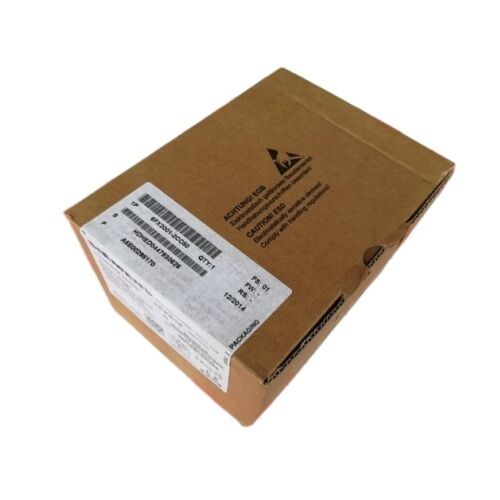
Siemens 6FX2001-2CC50 Incremental Encoder
RS 422 (TTL) | 2500 P/R | Synchro Flange | 6mm Shaft | 5V | Universal Cable Outlet | SINUMERIK / SIMODRIVE Compatible
Precision Feedback for Every Revolution
Motion control is only as good as the feedback behind it. On a SINUMERIK-equipped machine tool or a SIMODRIVE-driven axis, the encoder is the device that continuously tells the drive where the shaft actually is — not where it was commanded to go, but where it physically arrived. Get that feedback wrong and the control loop cannot converge. Get it right at 2,500 times per revolution over a signal interface that rejects noise at distances of up to 100 meters, and the axis behaves exactly as the CNC intends.
The Siemens 6FX2001-2CC50 is an incremental optical rotary encoder with RS 422 (TTL) differential output, 2500 pulses per revolution, and a universal cable outlet that handles both axial and radial cable routing from the same housing. It carries the synchro flange standard that has been the mechanical reference for Siemens motion control encoder mounting across decades of machine tool builds — making it a direct fit across the widest range of SIMODRIVE and SINUMERIK installations.
Technical Specifications
| Parameter |
Value |
| Part Number |
6FX2001-2CC50 |
| Encoder Type |
Incremental, Optical |
| Output Interface |
RS 422 (TTL) — differential |
| Resolution |
2,500 pulses per revolution (P/R) |
| Output Signals |
A, B (90° phase offset), Z (reference pulse) + complements |
| Operating Voltage |
5 VDC (±10%) |
| Max Current Consumption |
150 mA (no load) |
| Max Scanning Frequency |
300 kHz |
| Output Short-Circuit Protection |
Yes (short-circuit proof against 0V) |
| Shaft Type |
6mm plain smooth shaft |
| Mounting |
Synchro Flange |
| Cable Outlet |
Universal (axial or radial exit, selectable) |
| Cable Length (supplied) |
1m with connector |
| Protection Rating |
IP64 |
| Operating Temperature |
–40°C to +100°C |
| Weight |
Approx. 0.3–0.5 kg |
| Product Family |
SIMODRIVE / SINUMERIK Motion Control Encoders |
| Product Status |
Active |
RS 422 (TTL) Interface: Why Differential Signaling Matters on the Machine Floor
A machine tool cabinet is not a quiet electrical environment. Variable frequency drives switch kilowatts at high frequency nearby. Contactors generate inductive spikes. Long cable runs pass through conduits shared with power wiring. In this context, a single-ended TTL encoder signal — referenced to ground — picks up interference proportional to cable length and proximity to noise sources.
RS 422 eliminates this vulnerability by transmitting each signal as a differential pair: two wires carrying complementary voltages. The receiver measures the difference between the pair, not the absolute voltage of either wire. Any noise that couples into the cable affects both wires equally, so its contribution cancels at the receiver. The result is a signal that arrives cleanly over cable runs up to 100 meters — far beyond what single-ended TTL could sustain in the same environment.
For the 6FX2001-2CC50's 2,500 P/R resolution at typical servo speeds, the maximum scanning frequency of 300 kHz is the electrical ceiling. At a shaft speed of 6,000 RPM, the encoder generates 250,000 pulses per second — well within that limit — giving the SIMODRIVE control board plenty of signal quality margin while staying inside the interface specification.
2500 Pulses Per Revolution: Enough Detail for High-Quality Machining
Resolution in an incremental encoder determines the smallest angular increment the drive can detect and respond to. At 2,500 P/R, one pulse corresponds to 0.144° of shaft rotation. After the drive's internal quadrature counting (×4 evaluation of A and B), the effective resolution reaches 10,000 counts per revolution — angular steps of 0.036°.
For a linear feed axis with a 5mm pitch ballscrew, 10,000 counts per revolution translates to a linear resolution of 0.5 µm per count. For a turning center spindle operating in C-axis mode during contour turning, 2,500 P/R provides the angular granularity needed for smooth interpolation. This resolution level covers the demands of precision CNC machining across most standard applications.
Universal Cable Outlet: One SKU, Two Routing Options
The "universal cable outlet" feature is worth understanding before ordering. The 6FX2001-2CC50's cable exit point is designed to accommodate both axial routing (cable exits parallel to the shaft axis) and radial routing (cable exits perpendicular to the shaft) from the same housing. This flexibility means one part number works across machine configurations where the encoder must route its cable in different directions — eliminating the need to stock separate axial and radial variants for the same resolution.
The related variants 6FX2001-2EC50 (radial flange connector) and 6FX2001-2GC50 (axial flange connector) offer fixed-direction options when a hardwired connector mount is preferred. The CC50 universal model with the pre-wired 1m cable is the more flexible choice for retrofits and mixed-configuration maintenance inventories.
Synchro Flange: The Mechanical Standard That Has Stood the Test of Time
The synchro flange is a standardized mechanical interface for encoder mounting, using a precision-ground flange body that locates against a matching recess in the motor or machine end plate, and a clamping collar that secures concentricity without rigid interference fitting. This approach tolerates the small coupling misalignments and thermal expansion differences that exist in real machine assemblies without transmitting bending loads to the encoder shaft.
The 6FX2001-2CC50's synchro flange mounting is mechanically compatible with the broad population of SINUMERIK and SIMODRIVE-equipped machine tools that have used this standard over decades, making it straightforward to use as a replacement encoder without modifying the machine's encoder mounting interface.
Compatibility with Siemens Control Systems
The 6FX2001-2CC50 is a system-tested, certified Siemens motion control component documented for use with:
- SINUMERIK CNC systems (including 840D sl, 810D, and related platforms)
- SIMODRIVE 611 drive systems (analog and digital variants with TTL encoder input)
- SIMOTION motion control systems
- SIMATIC technology controllers with encoder input modules
- SINAMICS drive systems with appropriate TTL encoder interface modules
The encoder is classified within Siemens' motion control encoder family as suitable for feed axis and spindle applications on machine tools where the encoder is mounted directly to the axis motor or gearbox shaft.
Frequently Asked Questions
Q1: What is the difference between the 6FX2001-2CC50 and the 6FX2001-3CC50?
Both are 2,500 P/R encoders with a synchro flange and 6mm shaft, and both use the universal cable outlet. The key difference is the output interface. The 6FX2001-2CC50 outputs RS 422 (TTL) digital differential signals directly usable by drive controllers with a TTL encoder input. The 6FX2001-3CC50 outputs 1V peak-to-peak sinusoidal signals (the sin/cos 1Vpp format), which require a sin/cos-capable input on the drive or CNC to achieve finer position resolution through interpolation. Check your drive's encoder input specification before ordering — TTL and sin/cos inputs are not interchangeable.
Q2: Can this encoder be used with SIMODRIVE 611 digital drive modules?
Yes, provided the 611 digital control unit is fitted with a TTL encoder evaluation input. Many SIMODRIVE 611 digital axis control units support RS 422 (TTL) incremental encoder input as part of their standard specification. Confirm the exact control board variant installed in your drive module and verify it supports TTL encoder evaluation before connecting the 6FX2001-2CC50.
Q3: The encoder includes a reference pulse (Z signal). How is this used?
The Z signal is a single pulse output once per revolution at a precise angular position. In incremental encoder systems, the Z pulse is used for the reference point approach (homing) procedure — the drive moves the axis until the Z pulse is detected, establishing a known repeatable position reference after power-up. Without reference homing, the incremental encoder's position count has no defined starting point. Correctly using the Z pulse in the CNC's homing configuration ensures that the machine homes to the same physical position every time.
Q4: What happens if the supply voltage deviates from exactly 5V?
The 6FX2001-2CC50 tolerates ±10% variation on the 5V supply, so it operates correctly anywhere from 4.5V to 5.5V. Outside this range, signal quality may degrade. If the supply voltage is unstable or noisy, a regulated 5V supply with adequate decoupling close to the encoder is recommended. Note that other variants in the 6FX2001 family with the "-2N" suffix support wider operating voltage ranges (10–30V), which may be more suitable if precise 5V regulation is difficult.
Q5: How should the encoder be mechanically coupled to avoid premature bearing failure?
Direct rigid coupling between the encoder shaft and the machine shaft is not recommended. Any residual misalignment — angular or parallel — translates directly into radial and axial loading on the encoder's internal bearings, shortening service life. A flexible coupling that accommodates small misalignments (typically less than 0.1mm parallel offset and less than 0.5° angular misalignment) should always be used between the encoder shaft and the driven shaft. Do not drive the encoder shaft with a belt or chain without intermediate coupling — the lateral forces from belt tension can exceed the shaft's permissible radial load.



 Your message must be between 20-3,000 characters!