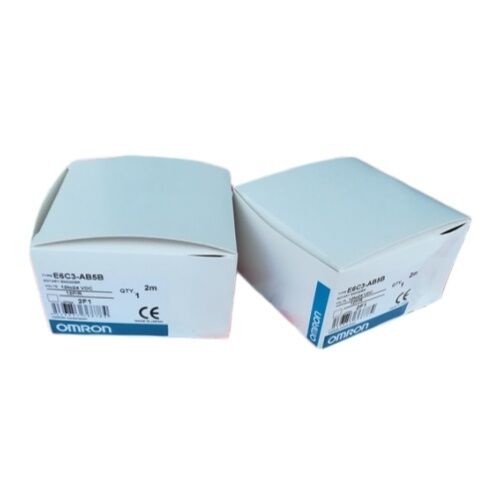
OMRON E6C3-AB5B 12P/R Rotary Encoder
Absolute | BCD Output | PNP Open Collector | 12 Positions/Rev | 50mm Housing | IP65 | 12–24 VDC
Position That Never Needs Resetting
There's a practical difference between a position sensor that counts pulses and one that always knows where it is. Incremental encoders start from zero and count from there — reliable enough, but dependent on a reference run every time the system powers up. Absolute encoders hold a unique code for every shaft position, independent of power history. The E6C3-AB5B 12P/R is the latter type: a rugged absolute rotary encoder that outputs the shaft's current angular position the instant power is applied, with no initialization sequence, no homing cycle, no waiting.
Part of OMRON's E6C3-A series, this encoder is built into a compact 50mm diameter aluminium housing with a sealed bearing design, rated IP65 for dust and low-pressure water protection. Its 12 position per revolution resolution and BCD output make it particularly well-suited to applications where the receiving controller — a PLC, a cam positioner, or a count display — needs to read position directly in decimal-compatible code without complex binary conversion in the software.
Technical Specifications
| Parameter |
Value |
| Encoder Type |
Absolute, Optical |
| Resolution |
12 P/R (positions per revolution) |
| Output Code |
BCD (Binary-Coded Decimal) |
| Output Type |
PNP Open Collector |
| Max Applied Voltage |
30 VDC |
| Max Source Current |
35 mA |
| Residual Voltage (at 35 mA) |
0.4 V max. |
| Supply Voltage |
12 to 24 VDC |
| Max Switching Frequency |
20 kHz |
| Max Rotational Speed |
5,000 RPM |
| Shaft Diameter |
8 mm (solid) |
| Housing Diameter |
50 mm |
| Flange Diameter |
50 mm |
| Housing Material |
Aluminium alloy |
| Shaft Material |
SUS303 Stainless Steel |
| Mounting |
Flange mount |
| Friction Torque |
0.01 N·m |
| Moment of Inertia |
2.3 × 10⁻⁶ kg·m² |
| Max Radial Load |
80 N |
| Current Consumption |
70 mA max. |
| Protection Rating |
IP65 (oil-proof with sealed bearings) |
| Operating Temperature |
–10°C to +70°C |
| Storage Temperature |
–25°C to +85°C |
| Vibration Resistance |
10 to 500 Hz, 150 m/s² (destruction) |
| Weight |
Approx. 300 g |
| Available Cable Lengths |
1m / 2m (pre-wired, bare end flying leads) |
BCD Output: Decimal-Ready Position Data
Most absolute encoders in the E6C3-A lineup use Gray code or binary output — both effective, but both requiring the receiving system to interpret binary-weighted bit patterns and convert them into position values. BCD output takes a different approach: each group of 4 output bits encodes one decimal digit directly.
With 12 positions per revolution, the E6C3-AB5B's output at any shaft position corresponds directly to the decimal position number — 0 through 11 — expressed in BCD. When the shaft sits at position 7, the output reads the BCD representation of 7. When it sits at position 11, the output reads BCD 11. No conversion math required at the controller end.
This matters in applications where the receiving PLC handles the position value as a decimal number, where a numeric display shows raw position output, or where the system design benefits from direct human-readable position codes. BCD simplifies the interface logic and reduces the software overhead needed to interpret position data from the encoder.
PNP Output: Current Sourcing Into Standard PLC Inputs
The "B" in E6C3-AB5B identifies the PNP (sourcing) output configuration. In PNP mode, the output transistors source current — outputs pull to the positive supply when active. This is the natural companion to the NPN (sinking) digital inputs found on most OMRON PLCs and many other PLC families, where the input requires a current source to register a high state.
For applications where the controller uses PNP inputs (common in European machine tool and packaging industry installations), the related variant E6C3-AC5B provides NPN (sinking) outputs instead. Always confirm the input configuration of the receiving controller before specifying the output type.
12 Positions: The Right Granularity for Coarse Angular Detection
Twelve positions per revolution means one position every 30°. That's exactly the resolution needed for applications where the meaningful states are discrete — a 12-station rotary indexing table, a 12-position dial, a feed mechanism with 12 defined positions, or any angular control task where 30° steps are the natural unit of motion.
The 12 P/R resolution places this encoder in a different category from higher-resolution models (256, 360, 1024 P/R) that are designed for smooth angle monitoring or cam-timing precision. The E6C3-AB5B 12P/R is built for coarse absolute position confirmation — where you need to know which of 12 stations is active, not an interpolated angle — and its BCD output is perfectly matched to that use case, since each of the 12 positions maps directly to a BCD decimal value.
IP65 and Rugged Construction: Built for Real Environments
The E6C3-A series earns its "rugged" designation from the combination of its housing construction and environmental ratings. The aluminium alloy housing provides mechanical rigidity and thermal stability across the –10°C to +70°C operating temperature range. The SUS303 stainless steel shaft resists mild corrosion from industrial atmospheres. Sealed bearings behind the IP65-rated housing prevent oil mist, metal particles, and water splash from reaching the optical disc and electronics.
The 80N maximum radial load rating is substantially higher than lighter 50mm encoders — important when timing belt drives or coupling arrangements generate radial forces at the shaft. The 5,000 RPM maximum speed covers most rotary indexing and dial applications with significant margin.
For outdoor installations or direct washdown exposure, the E6C3-A series' IP65 rating covers water jets but not submersion. For those environments, a more heavily sealed housing would be required.
Typical Application Areas
The E6C3-AB5B 12P/R serves best where coarse absolute position detection, decimal-compatible output, and rugged construction need to come together:
- Rotary indexing tables — confirming which station is positioned under the process head
- Dial and knob position detection — reading the selected position on a machine's manual adjustment dial
- Cam positioner systems — position input for OMRON's H8PS and similar cam positioner controllers
- Packaging and filling machines — detecting which of several rotary positions a turret or star wheel occupies
- Conveyor indexing — absolute confirmation of each stop position without homing cycles
- General PLC-connected position sensing — anywhere that requires a position value in a form the PLC can read directly as a decimal integer
Frequently Asked Questions
Q1: Why choose 12 P/R over higher-resolution variants in the same series?
Higher resolution is not always better. For applications with 12 defined stop positions — indexing tables, position selectors, turrets — a 12 P/R encoder maps each physical position to exactly one encoder position, simplifying both the mechanical design and the PLC logic. There's no ambiguity about which step the machine is at, and no filtering or windowing required in software to decide whether a slightly off-center position is "position 7" or not. Higher-resolution models make sense for continuous angle monitoring; the 12 P/R model makes sense for discrete position confirmation.
Q2: Can this encoder be wired directly to OMRON SYSMAC PLC digital inputs?
Yes, for PLC variants with NPN (sinking) input modules that are compatible with PNP output devices. The E6C3-AB5B sources current from the positive supply rail, which matches directly to sinking input channels on OMRON's CJ, CS, CP, and CQM series PLCs. The number of PLC input points required equals the number of output bits active for the resolution — for a 12 P/R BCD encoder, you need at least 4 input points to capture the full BCD digit.
Q3: What is the difference between the E6C3-AB5B and the E6C3-AC5B at 12 P/R?
The only difference is output transistor polarity. The AB5B uses PNP (sourcing) outputs; the AC5B uses NPN (sinking) outputs. Electrical specifications, resolution, housing, IP rating, and cable options are identical. Choose AB5B for controllers with NPN (sinking) inputs; choose AC5B for controllers with PNP (sourcing) inputs.
Q4: Does the E6C3-AB5B retain its position reading when power is removed?
Yes, because it is an absolute encoder. The output code is determined by the physical position of the optical disc — it reflects where the shaft actually is, not where a counter says it is. Remove power, rotate the shaft anywhere within the 12 positions, restore power: the encoder immediately outputs the correct BCD code for the new shaft position without any initialization sequence.
Q5: What happens to the output if the shaft is rotated beyond the 12 positions — can it handle continuous multi-turn rotation?
The E6C3-AB5B is a single-turn absolute encoder. The 12 positions span one full revolution (0 to 11, each 30°). On the transition between position 11 and position 0, the output simply wraps — position 11 is followed by position 0 on the next step. The encoder has no multi-turn counting capability. If the application requires tracking multiple revolutions, a multi-turn absolute encoder (such as the E6C3-AB5B running through a gear train to a multi-turn capable unit) or a combination of this encoder with separate revolution counting logic would be needed.



 Your message must be between 20-3,000 characters!