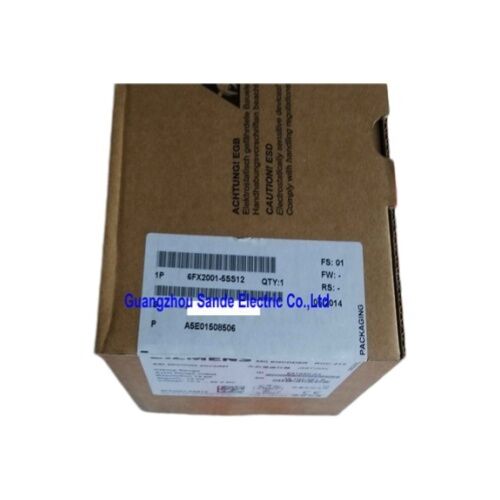
Siemens 6FX2001-5SS12 Absolute Value Encoder
Single-Turn | 13-Bit SSI | Strip Flange | IP67 | Built for Siemens Motion Control Ecosystems
Precision That Doesn't Need a Head Start
Every time a machine powers up, an incremental encoder starts from zero and works its way back to a known reference point. It's a routine that burns time, adds wear cycles, and introduces the occasional homing error when things go wrong mid-cycle.
The Siemens 6FX2001-5SS12 takes a different approach. As a single-turn absolute value encoder, it outputs a unique position code for every angular position across the full 360° range — right from the moment power is applied. No reference run. No lost position data. The control system knows exactly where the axis is, instantly.
Technical Specifications
| Parameter |
Value |
| Encoder Type |
Absolute, Single-Turn |
| Resolution |
13-bit (8,192 positions/revolution) |
| Communication Interface |
SSI (Synchronous Serial Interface) |
| Supply Voltage |
10 to 30 VDC (nominal 12V / 24V) |
| Max. Rotational Speed |
15,000 RPM |
| Shaft Diameter |
10 mm |
| Shaft Length |
20 mm |
| Shaft Type |
Solid |
| Flange Type |
Strip Flange (Clamping Flange) |
| Connector |
Axial M23 Flange Socket |
| Measurement Accuracy |
±27 arcsec (±0.0074°) |
| Protection Rating |
IP67 |
| Operating Temperature |
-40°C to +85°C |
| Origin |
Germany |
13-Bit Resolution — What It Actually Means on the Shop Floor
Thirteen bits translates to 8,192 discrete positions per revolution. Put another way, the encoder resolves angular movement down to roughly 0.044° per step. Combined with a mechanical accuracy of ±27 arcseconds — just ±0.0074° — this level of precision is well-suited to demanding motion control tasks where positional repeatability directly affects part quality.
For context: at a 100mm radius, ±27 arcseconds corresponds to a linear positional uncertainty of approximately ±0.013mm. That's the kind of tolerance that matters in machine tool contouring, robotic joint control, and precision assembly equipment.
SSI Interface — Reliable, Deterministic, Noise-Resistant
The Synchronous Serial Interface (SSI) has been a workhorse in industrial position sensing for decades, and for good reason. It uses differential signal transmission, which gives it strong immunity to electrical noise in environments with variable-frequency drives, large motors, or other EMI sources running nearby.
SSI is also deterministic: the controller initiates the data transfer with a clock pulse train, and the encoder responds with its position word in a fixed, predictable timeframe. There are no bus arbitration delays, no collision handling — just clean, clock-synchronous position data on demand. For time-critical motion control loops, that predictability is as valuable as the accuracy itself.
Designed to Live Inside Siemens Automation
The 6FX2001-5SS12 isn't just a generic SSI encoder — it's a Siemens motion control component that's been system-tested and certified for direct integration with:
- SINUMERIK CNC systems (including 840D sl and related platforms)
- SINAMICS drive systems (connected via Sensor Modules SMC or SME)
- SIMOTION motion control systems
- SIMATIC programmable logic controllers with technology modules
This matters in practice. System-tested components eliminate guesswork around parameter configuration, connector pinouts, and signal timing. When something needs commissioning or troubleshooting, the Siemens documentation chain covers this encoder as part of the ecosystem — not as an external third-party device.
IP67 and -40°C: Serious Environmental Ratings
The IP67 rating confirms protection against complete temporary immersion in water — well beyond what most machine tools or assembly environments will ever demand. Dust ingress is fully blocked. For applications near coolant or wash stations, this rating provides genuine margin, not just compliance checkbox.
The -40°C cold-side operating limit is equally notable. Most industrial encoders bottom out at -10°C or -20°C. The 6FX2001-5SS12 handles deep cold storage environments, outdoor installations in cold climates, or applications where the machine sits in an unheated facility overnight before a morning shift startup.
Strip Flange, Axial M23 — Installation Specifics
The strip flange (clamping flange) design allows secure axial mounting to a shaft without requiring a precision bore fit — the flange collar grips the shaft mechanically once tightened. Combined with the 10mm solid shaft and axial M23 connector orientation, the installation footprint is compact and the cable route exits cleanly along the shaft axis, reducing the risk of cable fouling in tight spaces.
The M23 connector is a standard industrial circular connector format widely used across Siemens encoder products, so existing cable assemblies from compatible systems are often reusable.
Frequently Asked Questions
Q1: Does the 6FX2001-5SS12 require a reference point run after power-on?
No. As an absolute encoder, it outputs a unique position value for every shaft angle from the moment power is applied. The control system receives the current position immediately — no homing cycle is needed.
Q2: How is this encoder connected to a SINAMICS drive system?
The 6FX2001-5SS12 connects to SINAMICS drives via a SINAMICS Sensor Module — either the SMC (Cabinet-Mounted) or SME (Motor-Mounted) variant, depending on your drive topology. The sensor module handles the SSI protocol and presents the position data to the drive's internal position controller.
Q3: What is the difference between the 6FX2001-5SS12 and the 6FX2001-5QS12?
Both are 13-bit SSI single-turn absolute encoders with the same electrical specifications. The key physical difference is the connector orientation: the 6FX2001-5SS12 has an axial flange socket (cable exits along the shaft axis), while the 6FX2001-5QS12 has a radial flange socket (cable exits perpendicular to the shaft). Choose based on your installation geometry and cable routing constraints.
Q4: Is this encoder compatible with third-party SSI controllers, or only Siemens systems?
The SSI protocol itself is an open industrial standard, so the 6FX2001-5SS12 can interface with any SSI-compatible controller provided the clock frequency, data word length, and supply voltage requirements are met. That said, it is specifically designed, tested, and documented as part of the Siemens automation ecosystem, so native integration with SINUMERIK, SINAMICS, and SIMOTION platforms will always be the most straightforward path.
Q5: What is the maximum cable length supported with SSI at this resolution?
SSI cable length depends on clock frequency — lower clock speeds allow longer cable runs. At typical SSI clock rates used with 13-bit encoders (around 100–200 kHz), cable lengths up to 100 meters are generally achievable using appropriate shielded cable. For exact recommendations, consult the SINAMICS Sensor Module documentation relevant to your installation.



 Your message must be between 20-3,000 characters!