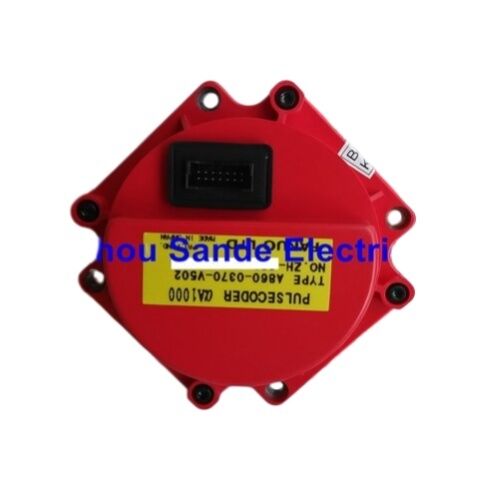
FANUC A860-0370-V502 Alpha Pulsecoder (aA1000)
Absolute Type | 1,000,000 Pulses/Rev | Serial Output | FANUC Alpha AC Servo Motors a3 / a6 / a12 / a22 / a30 / a40 / aM Series | No Built-in Cable | Made in Japan
The Encoder That Remembers Where It Is
Walk up to a machine tool equipped with a FANUC Alpha servo system and power it on. Within seconds, every axis knows exactly where it is — no homing cycle, no slow reference return creep, no waiting for each axis to crawl back to a reference point before the machine can accept a program. That immediate, power-up absolute position knowledge is not delivered by the servo amplifier or the CNC control. It comes from the pulsecoder on the back of each servo motor.
The FANUC A860-0370-V502 is the aA1000 absolute pulsecoder — the built-in optical feedback device for the FANUC Alpha series AC servo motor family. Carrying a resolution of 1,000,000 pulses per revolution across a serial interface, it is the component that closes the servo loop, provides absolute position retention across power cycles, and enables the refined positioning accuracy that defines FANUC Alpha motor performance in machining center, turning center, and precision automation applications.
Technical Specifications
| Parameter |
Value |
| Part Number |
A860-0370-V502 |
| FANUC Designation |
Alpha aA1000 Pulsecoder |
| Encoder Type |
Absolute (with battery-backed position retention) |
| Resolution |
1,000,000 pulses per revolution |
| Output Interface |
Serial (FANUC Alpha serial pulsecoder protocol) |
| Cable |
Not built-in (encoder body only, cable not integrated) |
| Compatible Motor Series |
FANUC Alpha: a3, a6, a12, a22, a30, a40, aM, aL, and related variants |
| Mount Location |
Rear of motor (non-drive end) |
| Country of Origin |
Japan |
| Related Version |
A860-0370-V501 (alternate software/hardware variant) |
What aA1000 Means in the FANUC Encoder Hierarchy
FANUC's Alpha series pulsecoder naming follows a clear system: the "A" prefix identifies absolute type, and "1000" refers to the thousand-thousand — one million — pulses per revolution resolution class. This places the aA1000 in the high-resolution tier of the original Alpha pulsecoder family, well above the earlier 2000P, 3000P, and incremental variants that equipped the S-series and early red cap AC motors.
The jump from 3,000 pulses per revolution (the standard on earlier FANUC AC servo encoders) to 1,000,000 represents a 333× increase in native resolution. For the servo amplifier's position and velocity loop calculations, this change is fundamental. At 3,000 ppr, position loop feedback at 3,000 RPM arrives at roughly 150,000 counts per second — a figure that works for general positioning but leaves velocity smoothness at the mercy of quantization noise at lower speeds. At 1,000,000 ppr running the same 3,000 RPM motor, the feedback rate climbs to 50,000,000 counts per second, making smooth velocity control at both low and high speeds dramatically more achievable.
That resolution is why FANUC documentation for the Alpha series specifically notes that the 1,000,000 ppr pulsecoder enables applications ranging from simple positioning to those requiring high precision — the same hardware serves everything from coarse rapid traverse to fine-finish contouring without degradation in position quality.
Absolute Position: The Feature That Changes Machine Operation
The "absolute" classification of the A860-0370-V502 is not a minor technical footnote. It defines a fundamentally different machine behavior from the axis start of every shift.
An incremental encoder loses its position reference the moment power is removed. The CNC control has no memory of where the axis stopped — the position count that existed in the servo amplifier when the machine shut down is gone. On power-up, that axis has no valid position. Before any program can run, every incremental axis must home — returning to a fixed reference point at controlled speed so the control can re-establish position from scratch. On a large machining center with six or more axes, a complete reference return can take several minutes.
The A860-0370-V502 works differently. An internal battery (supplied separately, mounted in the servo amplifier or CNC cabinet) continuously powers the absolute position counter through power interruptions, machine shutdowns, and even battery-change procedures. When main power returns, the encoder serial interface transmits the stored position immediately — the CNC knows every axis position with the same confidence as during operation. Power on, verify, and run.
This is particularly meaningful in environments where production pressure is constant. A machine that spends two minutes homing every morning, after every E-stop, and after every power interruption accumulates meaningful dead time. The absolute pulsecoder system eliminates that category of downtime entirely.
Serial Interface: One Cable, Complete Information
Earlier FANUC pulse coders used parallel electrical output — separate wires for A-phase, B-phase, Z-phase, and commutation signals, with the resolution limited by the electrical characteristics of those parallel lines. The Alpha A1000 pulsecoder changed the interface architecture entirely.
The aA1000 uses a serial communication protocol between the encoder and the servo amplifier. Position data, absolute multi-turn count (where applicable), alarm status, encoder temperature data, and the encoder's internal identification — all of it travels on a single differential serial line pair rather than a bundle of parallel signals. The servo amplifier decodes the serial data stream to extract the position value it needs for the control loop, running this exchange at a rate fast enough to update the position loop at the amplifier's internal control frequency.
One practical consequence of this architecture: there is no incremental quadrature output from the serial pulsecoder that an external counter or motion controller can simply read. The position data exists exclusively in the serial protocol. This is why, for retrofit and third-party drive applications, interfacing to the A860-0370-V502 requires either FANUC's own amplifier hardware or a purpose-built serial pulsecoder interface adapter.
Motor Compatibility: The Alpha Family This Encoder Serves
The A860-0370-V502 fits the FANUC Alpha servo motor family — the generation of AC servo motors that succeeded the S-series red cap motors and preceded the current Alpha i series. Within that generation, this encoder was fitted to a wide span of motor sizes: the small a3 and a6 frame motors used on light-duty axes, through the mid-range a12 and a22 models that powered the majority of machining center feed axes, up to the larger a30 and a40 motors on heavy-axis and gantry applications.
Variations within the Alpha family — the standard Alpha (α) series, the Alpha M (αM) series for high-speed applications, the Alpha L (αL) for large-frame high-torque needs — also used this encoder family across their motor sizes. The encoder body design and mounting arrangement are consistent across the compatible motor range, and the absence of a built-in cable is a deliberate design feature: it allows the encoder assembly to be exchanged without disturbing the motor's cable routing, which matters significantly during motor repair and refurbishment.
The A860-0370-V502 is specifically identified for motors including the a12, a22, a30, and a40 frame sizes, along with aM variants, though the full applicability range extends across the Alpha series. Confirming the correct encoder against a specific motor's part number is always the recommended step before replacement.
No Built-in Cable: A Maintenance Advantage
Unlike older FANUC pulse coders that integrated the signal cable directly into the encoder body, the A860-0370-V502 uses a separate connector interface — the encoder body connects to the motor and terminates at a connector that accepts the encoder signal cable as a separate assembly. This design separates two separate failure modes that are often confused in the field.
Encoder cables on servo motors fail more frequently than the encoders themselves, particularly on axes with extensive travel. Cable wear, connector corrosion, and mechanical damage at bend points are common causes of what appear to be encoder alarms. With the cable separate from the encoder body, cable replacement or inspection is straightforward: the encoder remains mounted on the motor, the cable is unplugged and replaced, and the system is retested. If the alarm clears, the encoder was never the problem. If it persists, the encoder itself can then be exchanged without the cable having complicated the diagnosis.
This architecture also simplifies stocking for repair shops and maintenance departments — encoder bodies and cables are separate line items that can be held in independent inventory rather than one SKU that represents both components together.
The A860-0370-V502 vs. V501: Version Notes
The A860-0370 family exists in two primary variants: V501 and V502. These are successive production or software versions of the same aA1000 encoder hardware. Both are absolute, both output 1,000,000 ppr over the FANUC serial interface, and both are physically compatible with the same Alpha motor mounting arrangement. In most maintenance contexts, either can replace the other functionally.
However, FANUC CNC specialists advise confirming compatibility with the specific servo amplifier software version in use before cross-substituting V501 and V502 units in systems where software interaction between the encoder version and amplifier firmware may be relevant. For general maintenance replacement on standard Alpha series systems — the vast majority of the installed base — this is not a practical concern.
Frequently Asked Questions
Q1: How do I confirm that the A860-0370-V502 is the correct pulsecoder for my specific FANUC Alpha motor?
The most reliable verification is the motor's nameplate part number. FANUC Alpha servo motor part numbers follow a structured format; the designation for the motor's feedback type is embedded in the "B" suffix segment. For motors fitted with the aA1000 absolute serial pulsecoder, the motor part number will reflect this specification in a suffix ending in the appropriate absolute pulsecoder designation. If the nameplate is unreadable, the physical encoder itself — if the failed unit is still attached — typically carries the part number A860-0370-V502 (or V501) on its label. Comparing that against the replacement confirms correctness. FANUC Alpha specialists can also cross-reference from the motor's full part number to the correct encoder if the motor documentation is available.
Q2: Does the A860-0370-V502 require a backup battery, and what happens if the battery fails?
Yes. Absolute position retention requires a battery to maintain the encoder's internal position counter through power interruptions. The battery is typically a 3V lithium type mounted in the servo amplifier or, in some system configurations, in the CNC cabinet rather than in the encoder body itself — the battery circuit supplies power to the encoder through the signal cable. When the battery voltage drops below threshold, the CNC will display a battery low alarm before the battery is completely discharged. If the battery is allowed to deplete fully, the absolute position data in the encoder is lost. On the next power-up, the CNC will generate an APC (Absolute Pulse Coder) alarm and require a reference return to re-establish the axis zero position — essentially a one-time homing procedure after which absolute operation resumes normally once the battery is replaced.
Q3: What CNC alarm codes indicate a fault with the A860-0370-V502 on FANUC 0i, 16i, and 18i controls?
Absolute pulsecoder faults on FANUC 0i/16i/18i class controls appear primarily in the servo alarm category. The most common encoder-related alarms are: SV0300 (APC Alarm: Need to Return to Reference Position), which follows a battery failure or encoder replacement; SV0360 (Pulse Coder Communication Error), indicating a serial data transmission fault between encoder and amplifier; and SV0368/SV0369 (Pulse Coder Hardware Alarm), indicating an internal encoder fault detected by the serial self-diagnostic data. The specific alarm number provides diagnostic direction — communication alarms often trace to cable or connector problems, while hardware alarms point to the encoder assembly itself. Always check the encoder signal cable and its connectors at both the motor and amplifier ends before condemning the encoder body.
Q4: Can the A860-0370-V502 be repaired, or should it be replaced when it fails?
FANUC Alpha aA1000 encoders are generally not repairable to a level that restores reliable long-term operation. The optical elements and internal electronics of these encoders are manufactured to tight tolerances and are sealed assemblies — field-level component repair is not practically viable, and specialist repair centers consistently note that these units are rarely repairable. When an encoder fails or becomes suspect, exchange with a tested unit from a reputable FANUC parts specialist is the standard approach. Testing should always be performed with the encoder mounted on an actual Alpha motor running on FANUC drive hardware — bench electrical tests that do not exercise the encoder on its intended motor cannot replicate the thermal and vibration conditions that reveal intermittent faults.
Q5: Is the A860-0370-V502 compatible with FANUC Alpha i series motors or current-generation αi series amplifiers?
No. The A860-0370-V502 is a first-generation FANUC Alpha series encoder, designed for the original Alpha (α) motor family. The later Alpha i (αi) and current αi series motors use different encoder generations — including the A860-2001-T321 (αi A16000, 16 million pulses/rev) and similar successors — with different physical mounting, different serial protocol implementations, and different electrical interfaces. The A860-0370-V502 cannot be installed on an αi series motor, and the αi series servo amplifiers are not designed to communicate with the earlier aA1000 serial protocol. For machines using α (non-i) Alpha series motors and original Alpha series amplifiers (SVU, SVUC, A06B-6058, A06B-6066 era), the A860-0370-V502 is the correct unit. For machines using the later αi system, the appropriate encoder comes from the A860-20xx series.



 Your message must be between 20-3,000 characters!