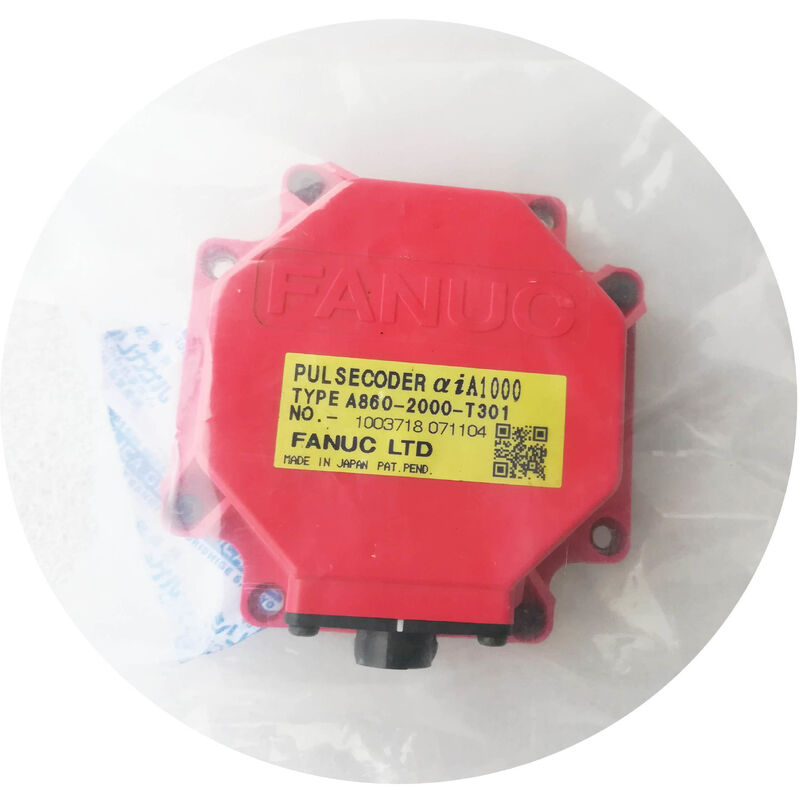
FANUC A860-2000-T301 Pulsecoder (αiA1000)
Absolute Type | 1,000,000 Pulses/Rev | Serial Interface | FANUC Alpha i (αi) AC Servo Motors | Oldham Coupling | IP65 | 10-Pin Connector | Made in Japan
The Encoder at the Heart of the αi Servo System
Every movement on a FANUC αi-equipped machine — a 0.001mm increment on a CNC turning center, a 6-axis interpolation on an industrial robot, a rapid traverse covering 500mm in a fraction of a second — depends on position data that originates inside a small optical device mounted to the rear of each servo motor. Without accurate, continuous, and reliable feedback from that device, there is no closed-loop control. There is only open-loop motion: fast, approximate, and unsuitable for precision manufacturing.
The FANUC A860-2000-T301 is the αiA1000 absolute pulsecoder — the feedback sensor designed specifically for the FANUC Alpha i (αi) series AC servo motor family. With 1,000,000 pulses per revolution delivered over a serial interface, absolute position retention through power cycles, and an Oldham coupling design that tolerates shaft misalignment without compromising accuracy, this encoder is both the most widely deployed and most maintenance-critical component in the αi servo system.
It is found on CNC machining centers, turning centers, laser cutters, and FANUC industrial robots on factory floors across every major manufacturing industry worldwide.
Technical Specifications
| Parameter |
Value |
| Part Number |
A860-2000-T301 |
| FANUC Designation |
αiA1000 Pulsecoder |
| Encoder Type |
Absolute (battery-backed position retention) |
| Resolution |
1,000,000 pulses per revolution |
| Output Interface |
Serial (FANUC αi serial pulsecoder protocol) |
| Connector |
10-pin, IP65 rated |
| Protection Rating |
IP65 |
| Coupling Type |
Oldham coupling |
| Cable |
Not built-in (separate encoder cable required) |
| Recommended Cable |
A660-2005-T506 (5m), A660-2005-T507 (10m) |
| Compatible Motor Series |
FANUC Alpha i (αi) AC servo motors |
| Compatible CNC Controls |
FANUC 0i, 16i, 18i, 21i, 30i/31i/32i series |
| Compatible Robot Controllers |
R-J3, R-J3iB, R-30iA, R-30iB |
| Motor Example |
A06B-0243-B100 and related αi series |
| Country of Origin |
Japan |
From Alpha to Alpha i: Where This Encoder Fits in FANUC History
The FANUC servo motor product line evolved across clearly defined generations, and the encoder naming reflects this progression directly. The original Alpha (α) series — the motors fitted with the A860-0370-V502 (αA1000) encoder — represented FANUC's first-generation serial pulsecoder platform. The Alpha i (αi) series that followed brought significant advances in motor performance, drive system communication, and safety function integration, and required a new generation of pulsecoder hardware to match.
The A860-2000-T301 is that new generation. The "i" in αiA1000 is not cosmetic — it signifies a revised serial interface protocol, updated internal hardware, and compatibility with the αi series amplifiers (A06B-6114, A06B-6117, A06B-6130 families) and the generation of FANUC CNC and robot controllers that work with them. The αi motors and the A860-2000-T301 are system-matched components; the older αA1000 from the original Alpha series cannot substitute for the αiA1000, and the amplifier hardware will reject it.
Understanding this generational boundary matters most when sourcing replacements. A machine with αi series motors requires the A860-2000-T301. An older machine with original Alpha (non-i) motors needs the A860-0370-V502. Mixing the two is not possible without both amplifier and motor changes.
1,000,000 Pulses Per Revolution: What This Resolution Delivers
One million counts per shaft revolution is not a figure that exists for marketing purposes. It has a concrete physical meaning for the machine's positioning capability.
FANUC's servo amplifier αi series documentation (B-65262EN) explicitly states that the 1,000,000 ppr resolution class enables the motor to serve applications ranging from simple positioning to those demanding the highest precision. The reason traces directly to how position and velocity control loops function. At 1,000,000 ppr, a motor turning at 3,000 RPM generates 50,000,000 feedback counts per second — a rate so high relative to the control loop's update frequency that velocity measurement noise effectively disappears. The servo can calculate accurate instantaneous speed at any RPM without the quantization artifacts that lower-resolution encoders introduce, particularly at slow feeds.
For a machining center cutting at 100 mm/min feed rate on a ballscrew axis, the servo motor may be turning at only 50–200 RPM. At those speeds, encoder resolution is at a premium. A 3,000 ppr encoder produces just 150–600 counts per second under those conditions — barely enough to maintain smooth velocity feedback. The αiA1000's 1,000,000 ppr delivers 833,000–3,333,000 counts per second at the same mechanical speeds, giving the velocity loop the resolution it needs for smooth, chatter-free cuts at slow feeds.
Absolute Position: Zero Homing, Zero Waiting
The operational difference between an absolute and an incremental encoder is felt every single time a machine powers up.
An incremental encoder has no memory. Position resets to zero at power-on. The CNC must run a reference return — commanding each axis to travel to its hard stop or reference cam switch at controlled speed — before any valid position exists. On a large machining center with four or five axes, completing reference returns takes minutes. If the machine E-stopped mid-cycle, reference returns are required before production can restart.
The A860-2000-T301 maintains its absolute position count continuously, backed by a 3V lithium battery in the servo amplifier cabinet. When main power returns after any interruption — a controlled shutdown, an emergency stop, a power failure — the encoder serial interface immediately transmits the stored absolute position. Every axis is known. The CNC verifies positions, the operator acknowledges, and production resumes.
The battery protection mechanism is graduated: the servo amplifier monitors battery voltage and generates a low-battery warning alarm before the voltage reaches the level at which position data could be lost. A timely battery replacement — performed while position data is still safely held — causes no disruption to axis calibration whatsoever.
The Oldham Coupling: Engineering Out Misalignment Failures
One of the more distinctive features called out in the Radwell and IQ Electro product listings for the A860-2000-T301 is the Oldham coupling interface. This mechanical detail is worth understanding because it directly affects encoder longevity.
An Oldham coupling is a three-piece mechanical device that transmits rotation between two shafts that may not be perfectly coaxial. The two outer discs connect to the motor shaft and the encoder disc respectively, while a center floating disc with orthogonal slots on each face compensates for both parallel offset and slight angular misalignment between the two shafts. This compensation happens without transmitting the misalignment forces to the encoder's internal bearings.
Why does this matter? In the α and αi series pulsecoder design, the encoder is mounted to the rear of the motor and driven through this coupling. Over the motor's service life, thermal cycling, mechanical shock from axis overtravel, and general wear can introduce small amounts of shaft runout that would otherwise load the encoder bearings asymmetrically. The Oldham coupling absorbs this misalignment continuously, dramatically reducing bearing stress inside the encoder. Failed couplings — which can crack or wear after significant operating hours — are themselves a documented failure mode in αiA1000 pulsecoder systems and should be inspected whenever the encoder is accessed.
Application Range: CNC Machines and Robots Alike
The A860-2000-T301 spans two distinct FANUC application domains, which reflects how widely the αi servo motor platform was adopted.
CNC Machine Tools — Machining centers, turning centers, mill-turn machines, and grinding systems using FANUC 0i, 16i, 18i, 21i, 30i, 31i, and 32i controls with αi series drives routinely carry this pulsecoder on their feed and auxiliary axes. The αiS (standard inertia) and αiF (high-speed) motor families across the 4/4000 through 40/4000 rating range represent the core machine tool population.
FANUC Industrial Robots — The R-J3, R-J3iB, R-30iA, and R-30iB robot controllers paired with αi joint motors also use the A860-2000-T301. On robot joints, absolute position retention is especially critical — a robot without valid joint positions cannot safely move, and a reference return procedure on a 6-axis industrial robot arm is a slow, space-consuming process that production environments strongly prefer to avoid. The absolute pulsecoder eliminates that requirement entirely in normal operation.
A verified example from the FANUC parts specialist community: the A06B-0243-B100 motor (an αiS 4/4000 axis motor) carries the A860-2000-T301 as its factory-specified pulsecoder. Similar specification applies across the broader αiS and αiF motor family.
Encoder Cable: Sourcing the Correct Companion
The A860-2000-T301 does not include an integrated cable — the encoder body terminates at a 10-pin IP65 connector that accepts a separate signal cable assembly. The FANUC-specified cable family for this encoder includes the A660-2005-T505 (5 metres, straight connectors) and A660-2005-T506 (alternative 5m specification), with longer versions available in the A660-2005 series up to 15 metres.
The importance of cable condition in encoder fault diagnosis cannot be overstated. Encoder signal cable failures — connector corrosion at the motor or amplifier end, insulation chafing at cable management entry points, and broken shield continuity — are documented as frequent causes of encoder-related alarms on FANUC αi systems. Before condemning the pulsecoder body itself, inspecting and replacing the signal cable is the recommended first diagnostic step by FANUC CNC specialists. The cable is a separate, lower-cost component, and its failure mode is indistinguishable from encoder body failure at the alarm level.
Frequently Asked Questions
Q1: What is the difference between the A860-2000-T301 and the older A860-0370-V502, and can they be used interchangeably?
The two encoders are from different FANUC servo motor generations and are not interchangeable. The A860-0370-V502 (αA1000) was designed for the original Alpha (α) series motors and amplifiers. The A860-2000-T301 (αiA1000) is the successor, built for the Alpha i (αi) series with a revised serial interface protocol. The physical mounting dimensions may be similar, but the electrical interface and communication protocol differ between the two generations. Inserting an A860-0370-V502 into an αi series amplifier system will result in a communication fault; the amplifier cannot decode the older encoder's serial data. Always confirm the encoder generation matches the motor and amplifier series before ordering.
Q2: What CNC alarms indicate A860-2000-T301 encoder failure on FANUC 0i and 30i series controls?
Pulsecoder faults on FANUC 0i/16i/18i/30i controls fall within the servo alarm category. The most relevant are SV0300 (APC Alarm: Need to Return to Reference Position), which appears after battery failure or encoder replacement; SV0360 (Pulse Coder Communication Error), pointing to a serial data link problem — cable, connector, or encoder electronics; and SV0368/SV0369 (Pulse Coder Hardware Alarm), indicating a fault detected in the encoder's internal self-diagnostics. An SV0362 alarm (Pulse Coder Phase Alarm) can indicate optical element degradation. Before replacing the encoder body, always inspect and if necessary replace the encoder signal cable, as cable faults generate identical alarm presentations to encoder body failures and are significantly more common.
Q3: Does replacing the A860-2000-T301 require a reference return after installation?
Yes, but only once. When an absolute pulsecoder is replaced, the encoder's internal absolute position counter starts fresh — it has no history of where the axis was positioned. The CNC will generate an APC alarm (SV0300) requesting a reference return. After performing the reference return — which establishes the axis zero position — the encoder stores absolute position data backed by the battery, and normal absolute operation resumes. No further reference returns are needed unless the battery is allowed to deplete fully, the encoder is replaced again, or the motor is disconnected from the drive system for an extended period that exhausts the backup battery.
Q4: What is the Oldham coupling, and how does its failure affect encoder performance?
The Oldham coupling is a three-piece flexible mechanical coupler that connects the motor's rear shaft to the encoder's measurement disc, compensating for small amounts of shaft misalignment without transmitting misalignment forces to the encoder's internal bearings. When the Oldham coupling wears or cracks — a condition that can develop after high operating hours, particularly in environments with frequent rapid acceleration and deceleration — the encoder may produce intermittent signal anomalies, irregular position counts, or increased noise in the velocity feedback signal. These symptoms can resemble optical element degradation or cable interference. During any pulsecoder exchange or motor service, inspecting and replacing the Oldham coupling alongside the encoder body is considered good practice by FANUC maintenance specialists. Replacement coupling sets are typically available as separate service items.
Q5: Is the A860-2000-T301 compatible with FANUC robot systems in addition to CNC machine tools?
Yes. The A860-2000-T301 is used in both CNC machine tool and FANUC industrial robot applications. FANUC robot controllers R-J3, R-J3iB, R-30iA, and R-30iB use αi series joint motors with this pulsecoder as the feedback device. The absolute position retention function is particularly important in robot applications — a robot joint without valid absolute position data cannot execute safe motion, and referencing robot joint positions requires physically moving each joint to a reference mark, which is time-consuming and requires the robot workspace to be clear. The αiA1000's absolute position retention eliminates this procedure under normal operating conditions. When servicing robots, the same battery maintenance, cable inspection, and encoder replacement procedures apply as for CNC machine tool axes.



 Your message must be between 20-3,000 characters!