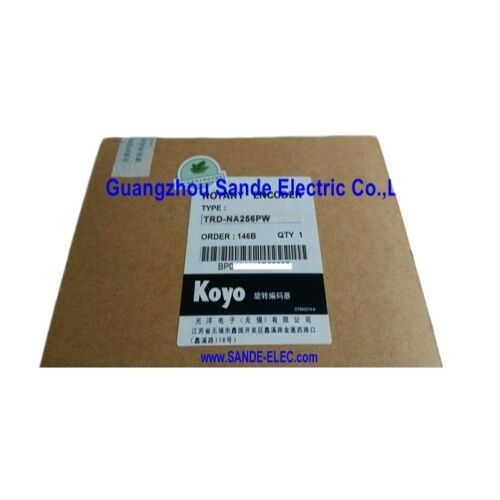
Koyo TRD-NA256PW | TRD-NA Series Absolute Rotary Encoder — 256 PPR, 8mm Shaft, PNP / IP65
Part Number: TRD-NA256PW
Manufacturer: Koyo Electronics Industries (JTEKT Group, Japan)
Product Type: Absolute Rotary Encoder — Solid Shaft, Medium Duty
Series: TRD-NA Resolution: 256 PPR (pulses per revolution)
Absolute Position Without Homing
The TRD-NA256PW is an absolute rotary encoder from Koyo's TRD-NA series — a medium-duty, solid-shaft absolute encoder with 256 positions per revolution. Unlike incremental encoders, which count pulses from an arbitrary reference point and need a homing cycle to establish position, the TRD-NA256PW outputs the absolute angular position on power-up. The controller knows where the shaft is immediately, without any movement.
The "256PW" in the part number defines the key specifications: 256 is the resolution in pulses per revolution, P indicates the output type (PNP open collector), and W indicates the waterjet-proof IP65 protection rating. The TRD-NA series also appears in other resolution variants — 512 and 1024 PPR — and in NPN (N suffix) output versions. All TRD-NA variants share the same 50mm body diameter and mounting footprint, making resolution upgrades straightforward without mechanical redesign.
PNP open collector output is the standard for sensors operating in environments where the control system uses a source-type input card — common on Mitsubishi, Omron, and IDEC PLCs with 24V DC sourcing inputs. The output connects directly to these inputs without additional signal conditioning.
Key Specifications
| Parameter |
Value |
| Part Number |
TRD-NA256PW |
| Series |
TRD-NA |
| Type |
Absolute rotary encoder |
| Resolution |
256 PPR |
| Shaft |
8mm solid |
| Body Diameter |
50 mm |
| Supply Voltage |
10.8–26.4V DC |
| Output |
PNP open collector |
| Output Load |
30V DC max |
| Current |
30 mA max |
| Protection |
IP65 |
FAQ
Q1: What is the practical difference between the TRD-NA256PW (256 PPR) and a TRD-NA1024PW (1024 PPR) in a position control application?
Higher PPR gives finer angular resolution per revolution — 1024 PPR divides the shaft rotation into four times as many distinct positions as 256 PPR. For a positioning table where one shaft revolution moves the table 10mm, 256 PPR gives 39-micron resolution and 1024 PPR gives about 10 microns. If the application's positioning accuracy requirement is within the 256 PPR resolution capability, the TRD-NA256PW is the appropriate choice. If sub-10-micron accuracy is needed, a higher-resolution encoder is required.
Q2: The encoder is described as PNP output. Can it connect directly to an NPN input card?
No — PNP output (sourcing) and NPN input (also sourcing, expecting current from the sensor) can be directly connected. However, PNP output cannot directly connect to a PNP-type input card (sourcing input). Verify the input card type before wiring. Most modern PLC input modules accept both PNP and NPN sensors by selectable common wiring.
Q3: The encoder shows correct position at power-up but drifts after a few hours of operation. What could cause this?
Position drift in an absolute encoder after initial correct reading is unusual — absolute encoders do not accumulate counting errors. Drift in the mechanical system (shaft slip, coupling looseness) or intermittent noise on the output signal cable producing occasional counting errors at the PLC are more likely causes. Check coupling tightness, cable shielding, and the routing of the encoder cable relative to motor power cables.
Q4: Magnetic dust is a concern near the installation. Does the TRD-NA256PW use optical or magnetic sensing technology?
The TRD-NA series uses optical encoding technology — a light source, code disc, and photodetectors. Magnetic dust on the code disc surface can contaminate the optical path and cause reading errors. The IP65 seal protects against direct water ingress, but if the shaft seal is compromised or if particles enter during assembly, the code disc can become contaminated. Keep the shaft seal intact and avoid mounting in direct swarf or coolant spray without an additional protective enclosure.
Q5: Can the TRD-NA256PW replace a TRD-NA256PN (NPN output) directly?
Mechanically yes — both share the same TRD-NA body. Electrically no — PNP and NPN outputs drive the signal in opposite directions. The PW (PNP) version pulls the output line high (to supply voltage) when active; the PN (NPN) version pulls it low (to ground). The PLC input card must be compatible with the output type. Confirm the PLC's input type before substituting one for the other.



 Your message must be between 20-3,000 characters!