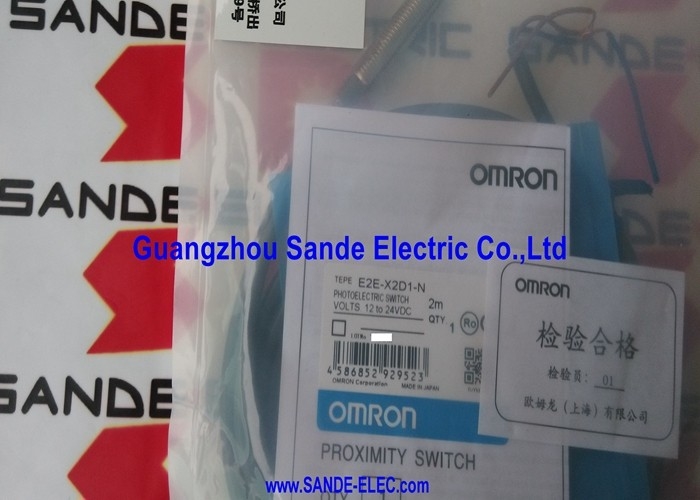
Omron E2E-X2D1-N | M8 Shielded Inductive Proximity Sensor — 2mm / DC 2-Wire NO / 1.5kHz / 2m Oil-Resistant Cable
Part Number: E2E-X2D1-N
Manufacturer: Omron (Japan)
Product Type: Inductive Proximity Sensor — M8 Shielded, Pre-Wired
Two Wires, No Complexity
The DC 2-wire circuit puts the sensor in series between the DC supply and the load. No separate power wire — the sensor and load share the same two conductors. When no target is present, the output blocks and current stops (apart from 0.8 mA leakage). When a metal target enters the 2mm sensing field, the output conducts and current flows through the load.
For machine builders, fewer wires per sensor means real savings: shorter cable runs, fewer connectors, simpler panel terminal layouts. On a machine with thirty position sensors, the difference between 2-wire and 3-wire wiring across all those positions accumulates quickly.
Two practical constraints come with the 2-wire circuit. First, the load must draw at least 3 mA minimum current for the output to switch cleanly — standard 24V PLC input cards are well above this. Second, the 0.8 mA leakage must stay below the PLC input's OFF-state threshold — for any standard industrial PLC input, this is not an issue. The sensor connects to conventional machine I/O without any special handling.
The "with polarity" designation means the brown and blue wires are not interchangeable. Reversing them prevents operation, but the built-in surge suppressor protects the sensor from damage during a wiring mistake — so the error can be corrected without sensor replacement.
Stainless Steel and Oil-Proof — Built for Machine Tool Environments
Nickel-plated brass is the standard for M12 E2E sensors. The E2E-X2D1-N specifies SUS303 stainless steel — a deliberate materials choice for the M8 format. In machine tool environments where coolant concentration, cutting oil, and chip conveyors create persistent chemical exposure, stainless housing outlasts brass or zinc.
The PBT sensing face resists the same chemical attack, and the "oil-proof" sealing extends beyond IP67's water immersion rating to cover the cutting oils and metalworking fluids that are the actual chemical environment for most of these sensors' service lives.
Key Specifications
| Parameter |
Value |
| Sensing Distance |
2 mm (±10%) |
| Setting Distance |
0–1.6 mm |
| Output |
DC 2-wire NO, polarised |
| Supply |
12–24V DC |
| Switching |
3–100 mA |
| Leakage |
0.8 mA max |
| Response |
1.5 kHz |
| Cable |
2m oil-resistant PVC |
| Housing |
M8, SUS303 stainless |
| IP |
IP67 + oil-proof |
FAQ
Q1: How does the E2E-X2D1-N (NO) differ from the E2E-X2D2-N (NC)?
Electrically identical sensors with opposite output logic. D1 (NO): output OFF with no target, ON when target detected. D2 (NC): output ON with no target, OFF when target detected. Use NO for standard presence detection. Use NC for fail-safe circuits where an open circuit (sensor failure, cable break) should produce the same signal as "no target detected."
Q2: Will the 0.8 mA leakage current cause a false ON reading at the PLC input?
For virtually all standard industrial PLC input cards, no. The leakage is well below the minimum ON-state current threshold (typically 2–5 mA). If using an unusually sensitive input where this is a concern, connect a 5.6 kΩ to 10 kΩ bypass resistor in parallel with the PLC input to shunt the leakage current.
Q3: The target is smaller than the 12 × 12mm standard test size. How does this affect the 2mm sensing distance?
Smaller targets return less electromagnetic flux and produce shorter effective sensing distances. For M8 sensors, a 6 × 6mm iron target gives approximately 85% of rated distance (about 1.7mm); a 4 × 4mm target, approximately 70% (1.4mm). Always measure the actual switching point with the specific target in the installation before fixing the mechanical gap.
Q4: Can the E2E-X2D1-N operate on a 12V DC supply?
Yes — the operating range is 10–30V DC. At 12V, the output transistor's residual voltage reduces the effective load voltage slightly. Verify the connected PLC input still meets its minimum ON-state voltage requirement at the reduced voltage after accounting for cable drop and the sensor's residual output voltage.
Q5: What does the "oil-proof" designation add beyond IP67?
IP67 covers dust ingress and temporary water immersion. "Oil-proof" extends sealing validation to cutting oils, hydraulic oils, and metalworking coolants — fluids with different surface tension and chemical properties from water that attack standard seal materials differently. The stainless housing and PBT sensing face back this up at the material level, qualifying the E2E-X2D1-N for continuous oil exposure throughout its service life.



 Your message must be between 20-3,000 characters!