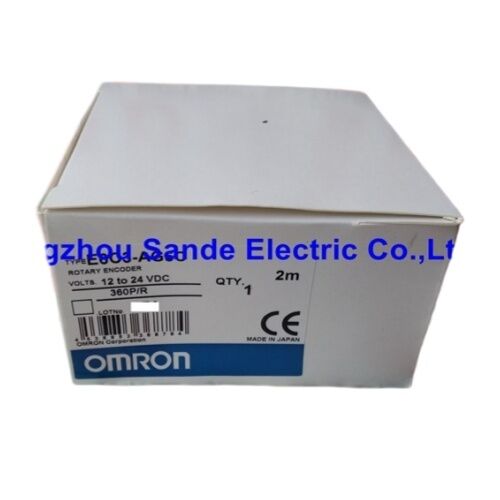
Omron E6C3-AG5C 360P/R Absolute Rotary Encoder — 9-Bit Gray Code, IP65, 50 mm, NPN Open Collector
Brand: OMRON
Series: E6C3-A
Part Number: E6C3-AG5C 360P/R / E6C3AG5C
Absolute | NPN Open Collector | Gray Code | IP65 | In Stock
Built for the Floor, Not the Lab
Industrial encoders live in environments that would disable lesser instruments within weeks — coolant mist, cutting oil vapor, vibration transmitted through steel machine frames, temperature swings from cold morning startup to sustained production heat. The Omron E6C3-AG5C was engineered with exactly these conditions in mind. Its IP65-rated aluminium alloy body, sealed bearing system, and SUS303 stainless steel shaft are not incidental features. They are the reason this encoder family has been the default choice for machine builders and maintenance engineers requiring absolute position feedback in real industrial environments for decades.
The 360 P/R resolution variant — this listing — provides 9-bit absolute position data across one full shaft revolution, with output structured in Gray code to eliminate the single-bit error transitions that binary coding would introduce at position boundaries. Every combination of output states maps to exactly one angular position within the 360° range. At power-on or after an unexpected stop, the controller reads the encoder's current output and knows the shaft position immediately, without any homing procedure or reference return sequence.
Technical Specifications
| Parameter |
Specification |
| Model |
E6C3-AG5C 360P/R |
| Encoder Type |
Absolute rotary encoder |
| Resolution |
360 P/R (9-bit) |
| Output Type |
NPN open collector |
| Output Code |
Gray code |
| Supply Voltage |
12 to 24 VDC (−10% to +15%, ripple p-p 5% max) |
| Current Consumption |
70 mA max |
| Output Applied Voltage |
30 VDC max |
| Output Current |
35 mA max |
| Max Switching Frequency |
20 kHz |
| Max Rotational Speed |
5,000 r/min |
| Friction Torque |
0.01 N·m max |
| Moment of Inertia |
2.3 × 10⁻⁶ kg·m² |
| Shaft |
SUS303 stainless steel, 8 mm diameter |
| Housing |
Aluminium alloy |
| Body Diameter |
50 mm |
| Flange |
50 mm |
| Max Radial Load |
80 N |
| Protection |
IP65 (improved oil-proof, sealed bearings) |
| Operating Temperature |
−10°C to +70°C |
| Storage Temperature |
−25°C to +85°C |
| Cable |
Pre-wired, 1 m standard (2 m available) |
| Mounting |
Flange mounting |
Data sourced from Omron E6C3-A series product documentation.
360 Positions. One Complete Picture.
Choosing a resolution for an absolute encoder is always a balance — between the angular granularity the application genuinely requires and the number of output wires the receiving controller can practically accommodate.
The 360 P/R figure means the encoder divides one full mechanical revolution into 360 discrete, uniquely addressable positions. At 9-bit resolution, that produces 512 available codes, of which 360 are assigned to angular positions spaced exactly 1° apart across the shaft's full rotation. For applications where position is expressed naturally in degrees — rotary tables, indexing mechanisms, cam-driven systems, conveyor angle tracking — this resolution maps directly to the unit the operator and programmer think in. One encoder count equals one degree of shaft rotation. No conversion factor, no approximation.
Where higher-resolution variants like the 1,024 P/R model offer finer angular granularity (approximately 0.35° per count), the 360 P/R variant simplifies programming logic and controller interface design in systems where degree-by-degree resolution is sufficient. Both share the same 50 mm body, IP65 protection, and Gray code output structure — the resolution selection is purely a function of application need.
Gray Code Output — Why It Matters for Absolute Encoders
Most engineers working with absolute encoders are familiar with the name but worth revisiting why Gray code is specified here rather than standard binary.
In a pure binary code, transitions between adjacent counts can require multiple bits to change simultaneously. Moving from decimal 7 (binary 0111) to decimal 8 (binary 1000), for instance, requires all four bits to flip at once. In practice, the bits in a real signal never transition at precisely the same instant — one leads slightly, others follow. During that brief interval, the encoder output passes through intermediate states that correspond to completely incorrect position values. For a system reading the encoder at the moment of transition, the result can be a large, spurious position error.
Gray code eliminates this by ensuring that adjacent position values always differ by exactly one bit. Any transition — no matter the shaft speed or the read timing — passes through only one undefined state. The result is clean, reliable position data even when the controller samples the output during a shaft movement. For absolute encoders in motion control applications, Gray code is not a luxury specification; it is the appropriate choice wherever position data feeds into active control decisions.
IP65 vs IP50 — The Reason the E6C3-A Exists
Understanding where the E6C3-AG5C fits within Omron's encoder range requires a straightforward comparison with its more economical sibling, the E6CP-A series.
The E6CP-A carries an IP50 rating — protected against dust ingress but with no tested protection against water or oil contact. Its plastic housing suits it well for light-duty applications in protected enclosures, panel-mounted angle control, or environments where liquid contamination is not a realistic concern. It is a cost-effective choice within its appropriate application boundaries.
The E6C3-AG5C steps up in every structural dimension. The aluminium alloy housing replaces plastic. The IP65 rating — tested for protection against low-pressure water jets from any direction — reflects the addition of sealed bearings and improved sealing at the shaft entry point. The SUS303 stainless steel shaft resists the corrosive effects of cutting fluid exposure that would degrade a standard steel shaft over time. The maximum radial load rating increases to 80 N, accommodating more demanding coupling arrangements.
For machine tools, automated assembly equipment, food processing machinery, or any application where liquid, oil mist, or heavy particulate contamination is part of the normal operating environment, the E6C3-A's construction specification is what makes long-term reliable service possible.
Connectivity and Compatible Accessories
The E6C3-AG5C 360P/R ships with a 1-metre pre-wired cable terminating in bare leads. A 2-metre cable version of the same 360 P/R model is also available as a standard stocking item — specify the cable length at the end of the model number when ordering.
Important note on H8PS cam positioner compatibility: The E6C3-AG5C (bare-lead cable version) is not directly connectable to the Omron H8PS Cam Positioner. To interface with the H8PS, the connector version — E6C3-AG5C-C — is required. The -C suffix indicates the pre-wired connector termination designed specifically for H8PS integration. The 360 P/R and 720 P/R resolutions for the -C version are available in 2-metre cable length as standard.
Available accessories:
- E69-FCA04 — Mounting flange accessory (the E69-2 Servo Mounting Bracket is supplied with the E69-FCA04 flange)
- E69-2 — Servo mounting bracket
- E69-DF5 — Extension cable, 5 m (applicable to the E6C3-AG5C-C connector model)
- Extension cables are also available in 15 m and 98 m lengths for remote installations
Wiring Overview
The E6C3-AG5C uses NPN open-collector outputs. Each output bit represents one position bit in the 9-bit Gray code word. The number of active output conductors corresponds to the resolution: the 9-bit (360 P/R) model uses 9 data output lines plus power and ground.
In NPN open-collector configuration, the output transistor pulls the output line low (toward 0 V) when active. The receiving controller or PLC input must supply the pull-up voltage through its own input circuitry, or an external pull-up resistor network must be provided if the input circuit does not include internal pull-ups. Maximum output applied voltage is 30 VDC; maximum sink current is 35 mA per output. A shield conductor is included in the cable assembly — connect it to system ground at the controller end to minimize noise pickup on the data lines.
The GND terminal should normally be connected to 0 V or to an external protective earth ground. Direction of rotation for output code sequencing is clockwise as viewed from the shaft end.
Application Notes
Cam positioner and PLC angle control. The 360 P/R resolution's 1°-per-count characteristic makes it a natural fit for applications managed by Omron H8PS Cam Positioners or any PLC-based system where cam switch setpoints are programmed in degrees. The direct degree correspondence simplifies setpoint entry and eliminates the scaling calculations required with non-degree-aligned resolutions.
Rotary indexing tables. Absolute output means the controller knows table position at power-on without requiring an initial homing cycle. This is valuable on indexing equipment where homing motion must be avoided — either because tooling occupies the home position, or because a power interruption mid-cycle requires resuming from whatever position the table stopped at.
Packaging and labeling machinery. Label placement, print registration, and product indexing all depend on reliable angular position reference. The E6C3-AG5C's IP65 rating and sealed bearing construction handle the washdown exposure common in food and beverage packaging environments.
General factory automation. Conveyors, winders, cut-to-length systems, and web tension controls all benefit from the absolute output's immediate position validity at startup. The 5,000 r/min maximum speed accommodates direct shaft coupling in the majority of these applications without gear reduction.
FAQ
Q1: What is the difference between the E6C3-AG5C and the E6C3-AG5C-C, and which one should I order?
The E6C3-AG5C is the bare-lead pre-wired version — the cable exits the encoder body and terminates in individual bare conductors that are wired directly into the controller terminal block or connector housing. The E6C3-AG5C-C adds a pre-assembled connector at the cable end, and this connector version is specifically required for direct connection to the Omron H8PS Cam Positioner. If your application does not involve an H8PS, either version can be used; the bare-lead version offers more flexibility for custom wiring, while the -C version simplifies connection to compatible Omron equipment. For 360 P/R resolution, both versions are available with a 2-metre cable as a standard stocking item.
Q2: The encoder output is NPN open collector. Does this mean it is not compatible with PLC inputs that use PNP (sourcing) logic?
NPN open-collector outputs are compatible with PLC inputs configured for NPN (sinking) operation, which is the standard input type across most industrial PLCs. For PLCs that require PNP (sourcing) input signals, direct connection to the E6C3-AG5C's NPN outputs is not straightforward — the logic polarity is reversed. In practice, many modern PLCs allow input mode selection between NPN and PNP via DIP switch or wiring configuration, and some accept either type without adjustment. Check the input specification of the specific PLC module being used. If PNP output is required and cannot be accommodated at the PLC input stage, Omron also offers PNP open-collector variants within the E6C3-A series (designated with "N" rather than "G" in the output type position of the model number) for applications where sourcing outputs are needed.
Q3: The E6C3-A series lists a maximum speed of 5,000 r/min, but the maximum electrical response frequency is 20 kHz. Which limit actually applies to my installation?
Both limits apply, and which one constrains your installation depends on the resolution selected. The maximum electrical response speed is determined by multiplying the switching frequency limit by 60 and dividing by the resolution: for the 360 P/R model, 20,000 Hz × 60 ÷ 360 = 3,333 r/min maximum electrical response speed. This is lower than the 5,000 r/min mechanical speed limit, which means the electrical response constraint is the binding limit for the 360 P/R variant at maximum frequency. Operating the encoder at shaft speeds above 3,333 r/min on the 360 P/R model risks the controller missing output transitions, producing incorrect position data. The mechanical speed rating applies to bearing and coupling durability, not signal reliability. For applications requiring higher shaft speeds with reliable absolute position output, the lower-resolution 256 P/R variant raises the electrical response ceiling to approximately 4,444 r/min at the same 20 kHz switching frequency.
Q4: The E6C3-AG5C is described as a single-turn absolute encoder. Does this mean position data is lost if the shaft rotates more than one full revolution?
Yes — the E6C3-AG5C provides absolute position within a single 360° revolution. After one complete shaft rotation, the output code sequence repeats from the beginning. The encoder does not count cumulative multi-turn revolutions or maintain a record of how many complete rotations have occurred since power-on. For applications where shaft travel spans multiple revolutions and total accumulated position must be known across power cycles — lead screw axis positioning, for instance — the single-turn absolute output from the E6C3-AG5C must be supplemented with external multi-turn counting logic in the controller, or a multi-turn absolute encoder of a different type should be considered instead. For applications inherently confined to one rotation per operational cycle — cam mechanisms, rotary tables, indexing dials, angular positioning within 360° — the single-turn absolute characteristic is exactly what is needed, and no supplementary counting logic is required.
Q5: What is the recommended wiring practice for the shield conductor, and does the GND wire need to be connected to protective earth?
The shield conductor in the E6C3-AG5C cable should be connected to system ground at the controller end of the cable. Connecting both ends of the shield can create a ground loop — a conductive path that can actually increase interference pickup in some installations rather than reduce it. Single-end grounding at the controller is the standard practice. Regarding the GND terminal on the encoder: Omron's documentation specifies to normally connect GND to 0 V (the supply negative) or to an external ground. In most industrial installations, the 0 V supply rail and the machine protective earth are bonded together at the power supply, meaning GND connection to the 0 V terminal achieves both functions simultaneously. In systems where the 0 V rail is floating (not bonded to protective earth), connecting the encoder GND to both 0 V and a separate earth bond point improves noise immunity and is consistent with Omron's installation guidance.



 Your message must be between 20-3,000 characters!