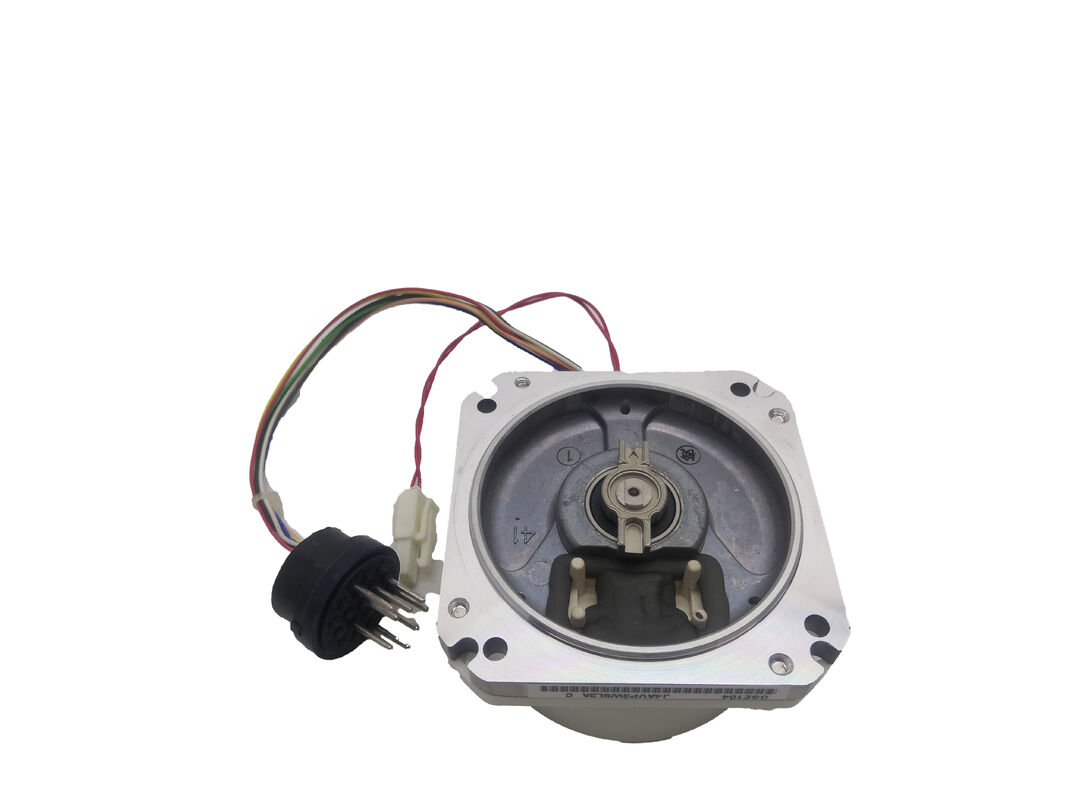
Mitsubishi OSE104 Servo Motor Encoder — 100,000 PPR Incremental Serial Encoder, MELDAS Compatible
Product Overview
Part Number: OSE104
Also Searched As: Mitsubishi OSE104, OSE-104, Mitsubishi OSE 104, MELSERVO OSE104
Type: Internal Servo Motor Encoder (Incremental Serial)
Classification: Mitsubishi MELSERVO Series Internal Rotary Encoder — 100,000 PPR, 5V TTL Serial Interface, Battery-Backed, Compatible with MDS-A / MDS-B / MDS-C1 Servo Amplifier Series
Technical Specifications
| Parameter |
Value |
| Part Number |
OSE104 |
| Type |
Internal servo motor encoder |
| Detection Method |
Incremental (serial) |
| Reported Resolution |
100,000 pulses/revolution |
| Internal Optical Disc |
20-bit (1,048,576 counts/rev) |
| Interface |
Serial, 5V TTL |
| Communication Lines |
4-wire (MR, MRR, MD, MDR) |
| Position Backup |
Battery-backed |
| Mounting |
Internal motor-end encoder |
| Compatible Amplifiers |
MDS-A, MDS-B, MDS-B-V, MDS-C1 series |
| Compatible Motors |
HA-N, HA-LF, HC series Mitsubishi servo motors |
| Origin |
Japan |
| Status |
Available — new, refurbished, exchange |
What the OSE104 Is — and Why Getting It Right Matters
The Mitsubishi OSE104 is an internal rotary encoder — a position and speed feedback device built into the rear of Mitsubishi servo motors as an integral component of the MELSERVO closed-loop servo system. It is not a standalone rotary encoder that can be mounted independently. It lives inside the motor body, coupled directly to the motor shaft, and communicates with the Mitsubishi MDS series servo amplifier through a dedicated 4-wire serial interface.
When an OSE104 fails — or when contamination degrades its optical disc to the point where the feedback signal becomes unreliable — the axis it serves stops functioning correctly. The servo amplifier cannot maintain the closed loop, the CNC issues encoder or detector alarms, and production stops. Understanding precisely what this encoder is, which motors it fits, and which amplifier series it works with is the starting point for getting the machine back into operation without ordering the wrong part.
The OSE designation identifies this encoder as the incremental variant in Mitsubishi's OSx encoder family. Its counterpart, the OSA104, carries the same 100,000 ppr resolution but is an absolute encoder that retains multi-turn position through power-off events. The OSE104 is incremental — it requires a reference-return (homing) cycle on every power-up to establish the axis coordinate.
100,000 PPR — Understanding the Resolution Figure
The 100,000 pulses per revolution specification describes what the OSE104 reports to the Mitsubishi MDS servo amplifier as the usable encoder resolution for position loop closure. The number that appears in the encoder's internal hardware is actually higher — the 20-bit optical disc produces 1,048,576 counts per revolution — but the drive system scales this to 100,000 ppr as the reported working resolution.
In practical terms, what does 100,000 ppr mean on a CNC machine tool axis? On a 5mm pitch ball screw in direct coupling, 100,000 counts per revolution resolves each encoder count to 50 nanometres of linear displacement. For the vertical machining centres, CNC lathes, and multi-axis turning centres where the OSE104 is commonly found — particularly Mazak machines running MELDAS controls — this resolution provides the feedback quality the control system needs to hold tight positional tolerances and deliver the surface finish quality the machine was designed to produce.
The OSE104 sits at the mid-resolution tier of Mitsubishi's encoder family. Above it sits the OSE105 at 1,000,000 ppr — ten times the working resolution, used where maximum contouring precision is required. Below the OSE104 are older encoder types (OHE25K, etc.) that used quadrature parallel interfaces rather than the serial protocol. The OSE104's 100,000 ppr is the correct specification for the motor-amplifier combinations it was designed for — neither insufficient for its application nor under-utilised by the control system.
The Serial 5V TTL Interface — Four Wires, Digital Protocol
The OSE104 communicates via a proprietary Mitsubishi serial protocol over four 5V TTL lines:
- MR / MRR (Request lines, differential pair) — the amplifier sends request pulses or data codes to the encoder to command a position data transmission
- MD / MDR (Data lines, differential pair) — the encoder transmits position data back to the amplifier in response to the request
This is a request-response serial architecture: the encoder does not continuously broadcast position data. The MDS servo amplifier initiates each data exchange by sending a request code on the MR/MRR lines, and the encoder responds with the current position data on the MD/MDR lines. The protocol operates at 5V TTL signal levels and is not compatible with RS-422 or any other standard serial interface — it is Mitsubishi-proprietary.
A practical consequence of this design: the OSE104 will not output position data by itself when powered up. Applying 5V supply to the encoder without a connected MDS amplifier issuing requests produces no output on the data lines. This is normal behaviour — it does not indicate a faulty encoder. Technicians troubleshooting encoder faults without the actual machine amplifier must account for this: generic encoder testers that apply power and look for A/B/Z output will not work with the OSE104.
The differential pair on both the request and data lines provides the noise immunity appropriate for a machine tool environment — where power wiring, variable frequency drives, and other noise sources are present in close proximity to the encoder cable routing.
Battery-Backed Position Retention
Despite being an incremental encoder — which by definition does not retain position through power-off — the OSE104 incorporates a battery-backed position counter that stores the accumulated count value when the motor and control power is removed.
The battery that backs this counter is typically located in the machine's MELDAS control panel or in the MDS servo amplifier module, not inside the encoder itself. The encoder's internal capacitors or the external battery maintains the count value through power cycling. When the CNC system powers up after a normal shutdown, the battery-backed count preserves the last known position — but the system still requires a reference-return (homing) cycle to establish the verified machine coordinate. The battery backup reduces the risk of position loss on short power interruptions, but it does not make the OSE104 functionally equivalent to the OSA104 absolute encoder for startup behaviour.
Battery condition matters: when the MDS amplifier or MELDAS control issues a battery alarm associated with the encoder backup circuit, replace the battery promptly. Allowing it to deplete fully resets the stored count, and the axis may lose its reference relationship on the next power-up.
Compatible Motors and Amplifiers
The OSE104 is compatible with the following Mitsubishi servo motor series when configured as the motor-end internal encoder:
Compatible servo motors: HA-N series, HA-LF series, and HC series Mitsubishi servo motors where the motor was originally fitted with an OSE104 or OSE104 variant. Many Mitsubishi servo motors fitted in Mazak CNC machine tools (VMCs, turning centres, multi-axis machines) running MELDAS or Mazatrol controls carry this encoder type.
Compatible servo amplifiers: The OSE104 is listed in the encoder compatibility tables for MDS-A-SVJ, MDS-B-SVJ2, MDS-B-V, and MDS-C1-V series servo amplifier modules. It is also supported in the MDS-B Vx4 series. The drive firmware identifies the encoder by its device ID, which the amplifier reads during the initialization sequence.
Not compatible with older OHE/OHA pulse encoder amplifiers: Motor-end serial encoders (OSA/OSE type) are not interchangeable with the older OHE/OHA incremental pulse encoder interfaces. If the machine originally used OHE-type parallel encoders, the OSE104 cannot be used as a direct substitution without verifying amplifier serial encoder support.
OSE104 Variant Designations
The OSE104 base part number covers the standard mounting configuration. Variant suffixes indicate alternative mounting arrangements or environmental options:
| Part Number |
Notes |
| OSE104 |
Standard configuration |
| OSE104S |
Variant mounting holes — functionally identical |
| OSE104S1 |
Further mounting variant — functionally identical |
| OSE104S2 |
Further mounting variant — functionally identical |
| OSE104ET |
Extended temperature version |
The S/S1/S2 variants share the same PCB, firmware, and encoder ID as the base OSE104. They communicate identically with the MDS amplifier and provide the same 100,000 ppr resolution. The differences are mechanical — mounting hole patterns on the encoder body. Confirm the physical mounting configuration matches the motor's encoder pocket before ordering a specific variant.
Common Failure Modes — Why the OSE104 Fails
The repair records from qualified encoder service facilities reveal a consistent pattern of failure modes for the OSE104 that explains what goes wrong and why the encoder behaves as it does when failing:
Contaminated optical disc. The OSE104 uses a 20-bit optical encoding disc that light passes through to produce the position signal. Over time in a machine tool environment, fine contamination — coolant mist, cutting oil vapour, metallic dust — can deposit on the disc surface as a thin, even coating that is not visible to the naked eye but scatters the optical beam enough to degrade signal quality. This produces intermittent position errors, servo vibration on the axis, and eventually the overload or detector alarm conditions characteristic of optical encoder contamination. The contamination builds gradually, which is why an affected axis may work normally for months before the signal quality degrades enough to produce alarms.
Failed capacitors. Internal capacitors in the encoder's electronic circuit are a recurring failure item — bad capacitors appear consistently in repair records for the OSE104 across multiple service facilities. Capacitor failure typically produces intermittent communication errors between the encoder and the amplifier, or complete loss of encoder response.
Bearing wear. The encoder's internal bearing supports the shaft coupling mechanism. Bearing degradation introduces mechanical runout into the optical disc rotation, which in turn creates periodic errors in the position signal. Failed bearings on the OSE104 are identified in service records from precision zone and other repair facilities as a recurring serviced failure mode.
The OSE104 vs OSA104 — Choosing Between Incremental and Absolute
A question that arises frequently when replacing an OSE104 is whether to upgrade to the OSA104 — the absolute encoder variant with the same 100,000 ppr resolution. The two encoders use the same circuit board hardware and communicate via the same serial protocol. The difference is that the OSA104 maintains a true multi-turn absolute position register that does not require battery backup for position retention in the same way the incremental OSE104 does.
In practice, on machines running MELDAS or Mazatrol controls, the upgrade from OSE104 to OSA104 is mechanically and electrically feasible — the same physical form factor, the same serial interface, the same amplifier compatibility. The CNC recognises the encoder type via its device ID during startup. The operational benefit is meaningful: with OSA104, the reference-return cycle at every power-up is eliminated. The axis coordinate is retained through power-off, reducing machine startup time and simplifying alarm recovery.
Whether the upgrade is appropriate depends on the specific machine, CNC version, and parameter configuration. On machines already set up for reference-return operation, a parameter adjustment is required after fitting the OSA104. Confirm the CNC's encoder parameter settings support OSA-type absolute encoder operation before making the switch.
Typical Applications
Mazak CNC vertical machining centres and turning centres. The OSE104 is a standard encoder type across a wide range of Mazak machine tools controlled by Meldas 520, Mazatrol T-Plus, Mazatrol M-Plus, and equivalent MELDAS control generations. Feed axis motors (X, Y, Z) on these machines commonly carry OSE104 encoders that require replacement when contamination or component failure ends their service life.
Mitsubishi HA-N and HA-LF servo motor fitted machines. CNC machining centres, turning centres, and other machine tools fitted with Mitsubishi HA-N or HA-LF series servo motors operating on MDS-A or MDS-B series drive systems, where the OSE104 is the standard motor-end encoder specification.
HC series motor MDS-B/MDS-C1 drive systems. Feed and positioning axis applications on machines equipped with Mitsubishi HC series motors and MDS-B-V or MDS-C1-V servo amplifiers, where the OSE104 encoder compatibility is confirmed in the amplifier's supported encoder list.
Encoder replacement during motor rebuild. Servo motor repair facilities replacing the internal encoder on Mitsubishi motors as part of a complete motor overhaul — fitting a new or rebuilt OSE104 as part of a bearing, winding, and encoder replacement service.
FAQ
Q1: What is the difference between the OSE104 and the OSA104?
Both operate at 100,000 ppr and use the same 4-wire serial interface with MDS series amplifiers. The fundamental difference is position retention: the OSA104 is absolute — it maintains multi-turn position through power-off without requiring battery backup in the same way, and the axis coordinate is known immediately on power-up without a homing cycle. The OSE104 is incremental — position is not absolutely retained, and a reference-return (homing) traverse is required on every CNC power-up to establish the machine coordinate. Both fit the same motor bodies and are supported by the same MDS amplifier series. The OSA104 eliminates the homing requirement at the cost of slightly higher price.
Q2: Why does an axis with an OSE104 encoder show vibration and overload alarms?
The most common cause is contamination of the optical encoding disc — a thin, even film of coolant mist or oil vapour deposits on the disc surface over time, scattering the optical beam and degrading signal quality. The servo amplifier cannot close the position loop reliably on a corrupted feedback signal, which produces axis vibration, following errors, and eventually overload or detector alarms. Cleaning the disc with isopropyl alcohol on a microfiber cloth sometimes recovers the encoder; if contamination has etched the disc or if internal capacitors or bearings have also failed, replacement or professional rebuild is required.
Q3: Will the OSE104 work with the MDS-C1 series amplifiers, or only the older MDS-A and MDS-B?
Yes — the OSE104 is listed in the MDS-C1-V series encoder compatibility tables as a supported motor-end encoder. It also appears in the compatibility lists for MDS-A-SVJ, MDS-B-SVJ2, and MDS-B-V series. The serial protocol and encoder device ID are consistent across MDS generations, allowing the OSE104 to operate with both the older and newer Mitsubishi MDS drive systems without modification.
Q4: What is the difference between OSE104, OSE104S, OSE104S1, and OSE104S2?
The S, S1, and S2 suffixes indicate different mechanical mounting configurations — specifically variations in the mounting hole pattern on the encoder body. All four variants use the same internal circuit board, the same 20-bit optical disc, the same serial protocol, and provide the same 100,000 ppr reported resolution to the drive system. They are functionally identical in operation. Choose the variant whose mounting geometry matches the physical encoder pocket in the motor being serviced.
Q5: Can the OSE104 encoder be repaired rather than replaced outright?
Yes — the OSE104 is a well-established repairable encoder. Qualified service facilities replace internal capacitors (the most common component failure), bearings, and complete optical disc assemblies. Contamination can often be addressed through cleaning without full component replacement. The advantage of professional repair over outright replacement is cost — particularly when new OSE104 stock can be expensive and lead times variable. The practical approach for facilities managing multiple machines with this encoder type is to maintain a tested exchange unit on the shelf so production can resume immediately when a failure occurs, then send the failed unit for rebuild as the long-term replenishment strategy.



 Your message must be between 20-3,000 characters!