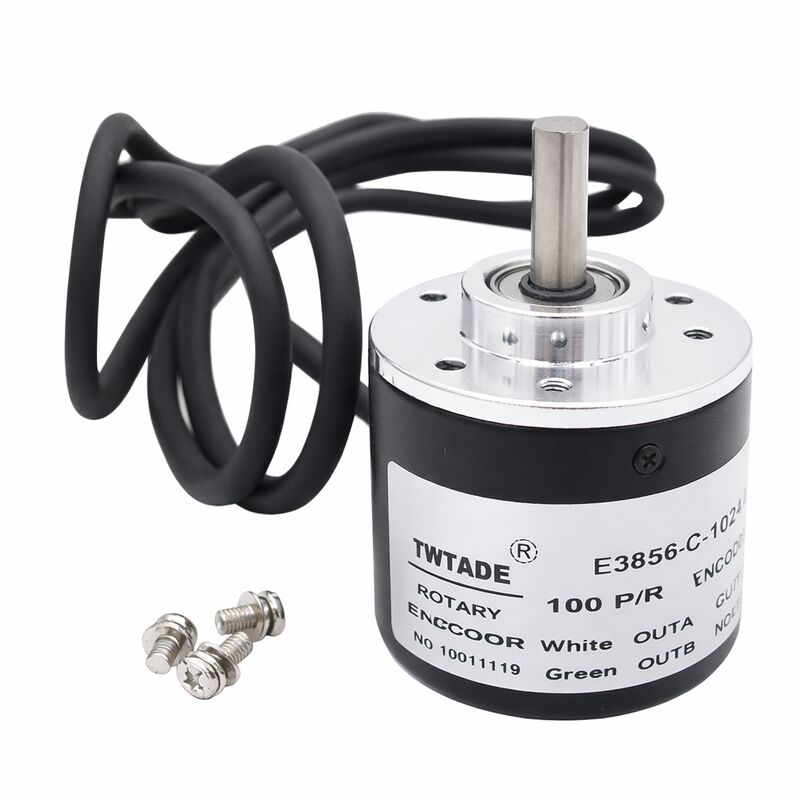
FANUC A860-0310-T023 | 3000P Incremental Pulse Coder — S-Series / Early Alpha Servo Motors / Replaced by A290-0561-V568
3000P Incremental — The Key Operating Characteristic
The A860-0310-T023 is a 3,000 ppr incremental pulse coder — the encoder that reads motor shaft rotation and feeds position and speed data to the servo amplifier. At 3,000 ppr, it was among the more precise incremental options available in the S-series and early Alpha motor era.
The incremental type has one defining operational consequence: the encoder has no memory of shaft position between power cycles. At every machine power-up, the CNC must execute a reference return cycle — the axis moves to its fixed hardware reference switch, the encoder count resets to the position datum, and normal CNC operation can proceed from that reference. This is expected behaviour and is not a fault; machines built around this encoder generation have always operated this way.
Key Specifications
| Parameter |
Value |
| Part Number |
A860-0310-T023 |
| Resolution |
3,000 ppr |
| Feedback |
Incremental quadrature |
| Motor Era |
S-series, early Alpha |
| Replacement |
A290-0561-V568 |
| Status |
Discontinued |
Discontinuation and the A290-0561-V568 Replacement
FANUC has officially designated the A290-0561-V568 as the replacement for the A860-0310-T023. The A290 prefix indicates a different mechanical and electrical form factor matched to the successor encoder packaging standard — same functional role (3000P incremental feedback), different physical assembly.
Before ordering the A290-0561-V568 as a replacement, confirm three things: first, it physically mounts on the specific motor in the machine (shaft coupling, fastening pattern, and mechanical adapter must match); second, its signal interface connects to the existing amplifier and feedback cable without modification; and third, the CNC's servo encoder resolution parameter is set correctly for the replacement's pulse count.
Where the A290-0561-V568 is not a direct fit for the specific motor, surplus A860-0310-T023 units remain available through the aftermarket. These should be tested under dynamic load conditions before being committed to production.
Changing Encoder Resolution — Parameter Update Required
If a replacement encoder with a different pulse count is fitted — even by a small margin — the CNC's encoder resolution parameter (expressed as pulses per revolution, or as CMR/DMR gear ratio values) must be updated to match. A mismatch between installed encoder resolution and CNC parameter produces axis positioning errors and servo loop instability.
The machine will cut wrong dimensions without generating a hard alarm if the following-error tolerance masks the drift. Always update the CNC parameter immediately after fitting a different-resolution encoder.
FAQ
Q1: Why was the A860-0310-T023 discontinued, and is the A290-0561-V568 a genuine equivalent?
FANUC regularly retires encoder tooling as motor generations age out of production. The A290-0561-V568 is Fanuc's published official replacement — same 3000P resolution and signal format, different physical packaging. "Equivalent" means the function is the same; mechanical fit on the specific motor must still be confirmed independently before ordering.
Q2: What is the reference return procedure for a machine with this incremental encoder?
Select Reference mode on the CNC and initiate axis travel in the reference return direction. The axis moves at the set feed rate until it contacts the reference switch, then creeps until the encoder's Z-pulse (once-per-revolution index mark) triggers. The CNC latches the position reference at the Z-pulse and displays the home coordinate. This procedure must be repeated for every incremental encoder axis after each machine power cycle.
Q3: What are the symptoms of a failing A860-0310-T023 in service?
Intermittent position errors, servo alarms (SV400-series on Fanuc CNCs), and erratic axis movement at specific speeds are the characteristic early symptoms. A degrading encoder typically fails at specific pulse frequencies — the axis positions correctly at some speeds but alarms at others. Lost encoder counts produce axis drift: the machine cuts wrong dimensions without a hard alarm if the drift stays within the following-error tolerance. Any of these symptoms should prompt encoder inspection with an oscilloscope to check the A, B, and Z-pulse signal quality.
Q4: Can this 3000P encoder be replaced with a different pulse count?
Not without updating the CNC servo parameter for encoder resolution. A mismatch between the installed encoder's pulse count and the CNC parameter produces positioning errors and velocity loop instability. If a different-resolution encoder is physically installed, update the corresponding CNC parameter before running the axis in production.
Q5: How should a surplus A860-0310-T023 be evaluated before installation?
Test electrically with an encoder tester or oscilloscope: confirm clean A, B, and Z-phase pulse trains, correct signal levels, and pulse count accuracy across several revolutions. Inspect the shaft seal and connector for damage or coolant ingress. Check bearing condition by rotating the shaft by hand. After installation, monitor the axis through the first reference return cycle and first production run — position errors that only appear under thermal or load conditions will surface during this initial period.


 Your message must be between 20-3,000 characters!