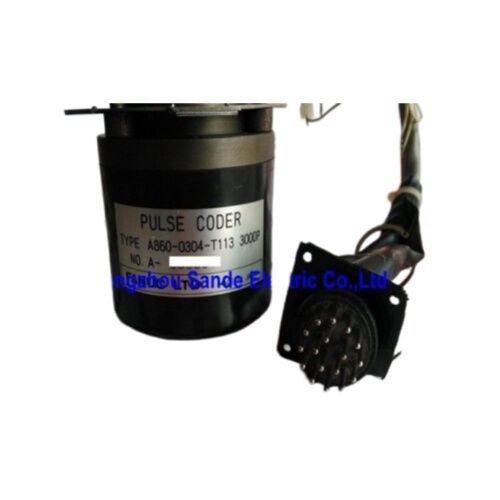
FANUC A860-0300-T001 Pulse Coder — 2000 PPR Incremental Encoder for FANUC DC Servo Motors
Some CNC machines from the 1980s and early 1990s are still producing parts today. They were built to last, and keeping them running means sourcing components that haven't been made in decades. The FANUC A860-0300-T001 — the 2000-pulse incremental pulse coder fitted to the original FANUC DC servo motor series — is exactly that kind of part.
This is the factory-fitted feedback device for FANUC's first-generation DC brushed servo motors, and it remains the correct replacement unit for maintenance teams keeping these machines in production.
What This Encoder Does
The A860-0300-T001 is a 2000 PPR incremental pulse coder that mounts to the rear of FANUC DC servo motors, coupling directly to the motor shaft to deliver continuous position and speed feedback to the CNC controller. Every revolution, it generates 2,000 pulses across quadrature A and B channels, plus a single reference pulse on the Z channel — the standard differential RS-422 output format that FANUC's 3 and 6 series CNC controls were designed to receive.
Without a functioning pulse coder, the FANUC servo drive has no position loop to close. The axis either faults out immediately or, worse, runs uncontrolled. Replacing a worn or damaged A860-0300-T001 is typically the fastest path to restoring a faulting DC servo axis.
Technical Specifications
| Parameter |
Value |
| Part Number |
A860-0300-T001 |
| Manufacturer |
FANUC Co., Ltd. (originally Fujitsu Fanuc) |
| Type |
Incremental Pulse Coder |
| Resolution |
2,000 pulses per revolution (2000P) |
| Output Signals |
PCA (A+), /PCA (A−), PCB (B+), /PCB (B−), PCZ (Z+), /PCZ (Z−) |
| Output Format |
Differential RS-422 |
| Supply Voltage |
5 V DC |
| Connector |
20-29P male |
| Thermal Protection Signals |
OH1, OH2 (motor overtemp monitoring) |
| Compatible Motor Series |
FANUC DC Servo Motors: Model 5M, 10M, 20M, 30M, 30M-2K (A06B series) |
| Compatible CNC Systems |
FANUC CNC System 3, FANUC CNC System 6 |
| Related Variants |
A860-0300-T002 (2500P), A860-0300-T003 (3000P) |
| Origin |
Japan |
The DC Servo Motor Era — Where This Part Lives
FANUC introduced its DC servo motor line in the late 1970s and manufactured it through the 1980s into the early 1990s before transitioning to AC servo systems. These motors — identified by the distinctive black-and-yellow capped housing and model designations like 5M, 10M, 20M, and 30M — were fitted to a generation of FANUC-controlled machining centers, milling machines, and lathes that are still actively used in job shops and maintenance facilities around the world.
The A860-0300-T001 was the standard pulse coder configuration for these motors. It lives on the back of the motor body, coupled directly to the shaft, and communicates with the servo amplifier via a shielded cable terminating in the 20-29P connector. The A, B, and Z differential channel pairs carry position data; the OH1 and OH2 pins monitor motor stator temperature and can trigger a thermal shutdown at the drive level before the windings overheat.
Understanding the 2000 PPR Output
At 2,000 pulses per revolution on the A and B channels, the FANUC control system can achieve a position resolution of 1/2000th of a revolution per pulse — and with quadrature counting (both rising and falling edges of both channels), the effective count can reach 8,000 counts per revolution at the control level. For the feed axis applications these motors powered — table travel, saddle movement, cross-slide positioning — this resolution was well-matched to ballscrew pitches and the positioning tolerances demanded by the FANUC 3 and 6 control families.
The Z channel outputs one reference pulse per revolution, used by the CNC controller during grid-shift homing to establish a precise, repeatable mechanical reference point for each axis. A clean, consistent Z pulse is critical for reliable homing accuracy across machine restarts.
Differential RS-422 Output — What It Means for Wiring
The A860-0300-T001 outputs all signals as differential pairs — each channel has both a positive line and an inverted complement. This differential architecture provides strong noise rejection over cable runs, making it well-suited for the electrically noisy interior of a CNC machine cabinet. The receiver at the servo amplifier end subtracts the two lines, which amplifies the signal and cancels any common-mode noise picked up along the cable.
For any retrofit or third-party drive application, the complementary pairs (A−, B−, Z−) can simply be left unconnected if the receiving drive only accepts single-ended input — though doing so forfeits the noise immunity advantage that differential signaling provides.
The A860-0300 Series — Choosing the Right Variant
The A860-0300 series covers three pulse counts across the same physical form factor:
- A860-0300-T001 — 2,000 pulses per revolution
- A860-0300-T002 — 2,500 pulses per revolution
- A860-0300-T003 — 3,000 pulses per revolution
The correct variant for a given motor is determined by the original motor configuration, not by personal preference. Mixing pulse coder resolutions with a CNC that expects a specific pulse count will result in axis scaling errors or parameter-related faults. Always match the replacement to the original part number on the motor or its maintenance records.
Applications This Encoder Supports
CNC Milling Machines — X, Y, and Z axis positioning on FANUC-controlled vertical and horizontal machining centers from the 1980s generation
CNC Turning Centers — Z and X axis servo feedback on FANUC-controlled lathes using DC servo drives
Jig Boring Machines — precision positioning on high-accuracy boring applications where DC servo systems were standard
Transfer Lines — multi-station transfer machinery built around FANUC DC servo technology in automotive and heavy manufacturing environments
Retrofit Projects — third-party servo systems and retrofit controllers that accept 5V differential RS-422 quadrature encoder input can often work with this pulse coder's output signals
FAQ
Q1: Is the A860-0300-T001 an absolute or incremental encoder?
It is an incremental encoder. It generates position pulses as the shaft rotates but does not retain absolute position data when power is removed. The FANUC CNC controller re-establishes the axis reference position during homing at each machine startup using the Z (marker) pulse in combination with a home limit switch.
Q2: Which FANUC DC servo motors use the A860-0300-T001?
This pulse coder was factory-fitted to the FANUC DC servo motor series — Model 5M, 10M, 20M, 30M, and 30M-2K, identified by A06B series part numbers. These are the first-generation brushed DC servo motors, distinct from FANUC's later AC servo motor families. If your motor carries an A06B-06xx type number with a DC designation, the A860-0300-T001 is likely the correct encoder.
Q3: What CNC controls are compatible with this pulse coder?
The A860-0300-T001 was designed for FANUC CNC System 3 and System 6 controllers, which were the primary CNC platforms paired with FANUC DC servo drives in that era. Its 5V differential RS-422 output is a standard format, and it can interface with many modern servo drives and retrofit controllers that accept differential quadrature encoder signals.
Q4: What is the difference between the A860-0300-T001, T002, and T003?
All three are 5V differential incremental pulse coders in the same physical housing, differing only in resolution: T001 = 2,000 PPR, T002 = 2,500 PPR, and T003 = 3,000 PPR. The correct variant is determined by the original motor and control configuration — substituting a different resolution will cause axis position scaling errors unless drive and control parameters are recalculated to match.
Q5: Can the A860-0300-T001 be repaired if it fails?
Yes — specialist repair services familiar with FANUC pulse coders can restore failed units by replacing worn bearings, repairing the optical disk assembly, and re-soldering damaged connector pins. Given that this part is no longer manufactured, repair is often the most practical route alongside sourcing tested used or new-old-stock units. A repaired unit should be functionally tested against a known-good motor before being returned to service.


 Your message must be between 20-3,000 characters!