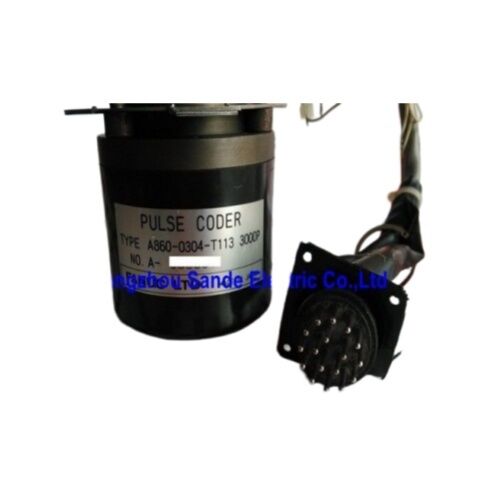
FANUC A860-0300-T002 — 2500-Pulse DC Servo Motor Encoder (Incremental Pulse Coder) | Available in Bulk
At a Glance
Part Number: A860-0300-T002 (also referenced as A8600300T002)
Description: 2500 Pulse DC Encoder — Incremental Pulse Coder
Type: Incremental rotary encoder (pancake form factor)
Compatibility: FANUC Yellow Cap and Black Cap DC axis servo motors — Model series 0M, 5M, 10M, 20M, 30M (motor designation Bx12)
What This Encoder Is and Where It Comes From
The FANUC A860-0300-T002 is a 2,500-pulse-per-revolution incremental rotary encoder — commonly referred to in the field as a pancake pulse coder — designed for use with FANUC's first-generation DC brush servo motors. These motors, identifiable by their distinctive yellow or black end caps, were the backbone of FANUC CNC machine tool drives through the 1980s and into the early 1990s. They powered machining centres, milling machines, and turning centres running FANUC Series 3 and Series 6 CNC controls, among others.
The A860-0300-T002 mounts to the rear face of these DC servo motor bodies (Bx12 designation), sitting in a compact disc-shaped housing that gives it the "pancake" description used in the field. It delivers A/B quadrature phase signals plus a Z-channel one-revolution index pulse back to the servo drive, giving the CNC control both speed information and a per-revolution position reference for axis positioning and feedrate control.
Within the A860-0300 family, this T002 variant carries 2,500 pulses per revolution. Its siblings are the T001 (2,000 ppr) and the T003 (3,000 ppr). Selecting the correct pulse count is essential — fitting the wrong resolution encoder disrupts the drive's speed and position calibration and will generate following errors or velocity alarms at the control.
Technical Reference
| Parameter |
Value |
| FANUC Part Number |
A860-0300-T002 |
| Encoder Type |
Incremental rotary encoder (pulse coder) |
| Resolution |
2,500 pulses per revolution |
| Output Signal |
A/B quadrature phase + Z (one-revolution) index |
| Motor Compatibility |
FANUC DC servo motors — Yellow Cap and Black Cap |
| Compatible Motor Models |
0M, 5M, 10M, 20M, 30M (Bx12 series) |
| Physical Form |
Pancake (disc) — rear-mount to DC motor body |
| Signal Type |
Incremental (not absolute) |
| CNC System Compatibility |
FANUC Series 3, Series 6 and equivalent era controls |
| Connector Style |
MS-type circular sealed connector |
| Related Part Numbers |
A860-0300-T001 (2000P), A860-0300-T003 (3000P) |
The Yellow Cap and Black Cap DC Motor Legacy
FANUC's DC brush servo motors represent the first generation of the company's in-house drive hardware — built and deployed at a time when brushless AC technology was still maturing for machine tool applications. Two physical variants became standard across FANUC's installed base during this era:
The Yellow Cap motors came first. They used early-generation pulse coder feedback and were paired with FANUC's 0632, 0641, 0642, and equivalent drive amplifier units. Motor models in this group ran from the small 00M and 0M frames up through the larger 20M and 30M configurations.
The Black Cap motors followed, sharing the same basic brushed DC architecture but with updated mechanical housings and refined drive electronics. Both generations used the same family of rear-mounted pancake pulse coders, and the A860-0300-T002 serves both.
Today, an enormous number of these motors remain in service worldwide. Machine tools built in the 1980s — Makino, Kitamura, Mori Seiki, Cincinnati, and many others — ran FANUC DC drives and are still operating in job shops and manufacturing facilities that have no compelling reason to replace a mechanically sound machine. For every one of those machines, the pulse coder is a consumable maintenance item. Bearings wear, optical discs degrade, connectors corrode. When the encoder fails, the machine stops — and the A860-0300-T002 is what brings it back.
Why Bulk Procurement Makes Sense
For distributors, machine tool dealers, service organisations, and facilities maintaining a fleet of older FANUC DC motor machines, stocking the A860-0300-T002 in quantity is a straightforward risk management decision.
Several factors make bulk inventory practical and commercially logical:
Supply is finite and declining. FANUC DC motors and their associated pulse coders are long out of production. The global stock of original A860-0300-T002 units is not replenished — every unit sold or consumed reduces the available pool. Prices for remaining new-old-stock inventory have risen steadily as the installed base continues to demand replacements while supply contracts.
Encoder failures are predictable and frequent. The pancake encoder in these DC motors is a precision optical assembly with bearings. After decades of continuous service, bearing wear and optical element degradation are normal failure modes. Any machine operating on original encoder hardware is carrying latent risk. Facilities that service multiple machines of this vintage know from experience that encoder failures cluster — replacing one typically means another will follow within months.
Downtime cost justifies stocking. The operational cost of an unplanned machine stoppage — lost production hours, emergency sourcing at premium prices, expedited shipping — consistently exceeds the holding cost of a spare encoder on the shelf. For service companies responding to emergency breakdowns, having units in hand is a direct competitive and financial advantage.
Third-party alternatives exist but original is preferred. Drop-in replacement encoders from specialist suppliers can substitute for the A860-0300-T002 when OEM stock is unavailable. However, many facilities and OEM service networks specify original FANUC hardware for warranty, documentation, and reliability reasons. When OEM units are available in bulk at current market rates, building stock ahead of scarcity makes practical sense.
A860-0300 Series Pulse Coder Variant Guide
| Part Number |
Pulses per Revolution |
Motor Compatibility |
| A860-0300-T001 |
2,000 ppr |
FANUC DC servo motors (Bx12) |
| A860-0300-T002 |
2,500 ppr |
FANUC DC servo motors (Bx12) |
| A860-0300-T003 |
3,000 ppr |
FANUC DC servo motors (Bx12) |
| A860-0301-T002 |
2,500 ppr |
FANUC ballscrew pulse coder (separate encoder, not motor-mounted) |
Matching pulse count to the original encoder specification is mandatory. The drive amplifier's velocity and position loop gains are calibrated to the encoder's pulse count. Substituting a different resolution without re-parameterising the servo drive will produce incorrect speed scaling and positioning errors that cannot be resolved through tuning alone.
Installation Notes for Field Technicians
The A860-0300-T002 mounts to the rear of the DC motor body via the encoder bracket and a flexible coupling that connects the encoder shaft to the motor shaft. Several points deserve attention during installation:
Coupling alignment. The flexible coupling between the motor shaft and encoder shaft must be centred correctly. Misalignment introduces periodic noise on the A/B channels that shows up as velocity ripple and, at higher speeds, can trigger velocity fault alarms at the drive. Check run-out on the encoder shaft after assembly.
Connector sealing. The MS-type circular connector on the A860-0300-T002 is designed to resist coolant ingress when fully engaged and locked. Incomplete connector engagement — a common cause of signal noise and intermittent encoder faults — lets moisture into the signal lines. After replacement, confirm the connector is fully seated and the locking ring is secure.
Zero-point reference. Because this is an incremental encoder, there is no stored absolute position. After any encoder replacement, the machine must complete a full reference-return cycle (zero-point return) on the affected axis before normal operation can resume. The Z-pulse establishes the per-revolution reference; the CNC builds its absolute position count from there.
Drive amplifier parameter check. On older FANUC drive electronics (particularly units in the 6047 and similar families), the encoder pulse count is set by parameter or DIP switch. Confirm the drive is configured for 2,500 pulses per revolution before running the axis after encoder replacement. A mismatched setting at the drive will not damage hardware but will produce gross positioning errors that are immediately apparent during the test cycle.
FAQ
Q1: What FANUC DC servo motor models is the A860-0300-T002 compatible with, and how do I confirm my motor takes this specific pulse count?
The A860-0300-T002 is designed for FANUC DC brush servo motors with the Bx12 encoder designation — covering the Yellow Cap and Black Cap motor families in model sizes 0M, 5M, 10M, 20M, and 30M. The most reliable way to confirm the correct pulse count for a specific motor is to check the motor nameplate and the original encoder body. The encoder itself will have its pulse count (2500P or equivalent) marked on the housing label. If the original encoder is missing or damaged, the machine's maintenance documentation or the FANUC drive parameter settings for the axis will specify the encoder resolution. Using a 2,500-pulse encoder on a machine parameterised for 2,000 or 3,000 pulses will produce positioning and velocity errors; the pulse count must match the drive configuration.
Q2: Is the A860-0300-T002 an absolute encoder or an incremental encoder, and what does that mean for machine operation after replacement?
It is an incremental encoder — it generates A/B quadrature signals and a Z one-revolution index pulse, but it does not store or retain axis position when power is removed. This has a direct practical consequence: after every encoder replacement (and after every power cycle on a machine without absolute position retention), the machine must perform a reference-return (zero-point return) on the affected axis before the CNC can establish a known position. The CNC uses the encoder's Z-pulse as the per-revolution reference and counts pulses from there. There is no battery backup involved and no stored position to lose — the axis simply needs to re-home after installation. Machines running this generation of FANUC hardware typically have a dedicated reference-point-return operation in the CNC, and the operator is prompted to complete it before switching to automatic mode.
Q3: Can a third-party replacement encoder substitute for the original A860-0300-T002, and what are the trade-offs?
Third-party replacement encoders designed as drop-in substitutes for the A860-0300-T002 are commercially available and used in service work when OEM units are not obtainable. A well-designed third-party unit replicates the mechanical dimensions, shaft coupling interface, connector type, and electrical output format of the original. The operational difference, when the replacement is correctly specified, is minimal. The trade-offs to consider are: original FANUC hardware offers known compatibility with no integration uncertainty and is preferred in OEM warranty scenarios or where documentation of exact parts used is required; third-party units may use modern sealed bearings that offer improved longevity in contaminated environments; and in situations where OEM stock at reasonable cost is available, it remains the lower-risk choice. For bulk stocking, original A860-0300-T002 units are generally preferred precisely because they eliminate specification uncertainty across a fleet of machines.
Q4: My FANUC drive is showing a velocity or positioning alarm immediately after encoder replacement with what appears to be a correct A860-0300-T002. What should be checked first?
There are four common causes for alarms appearing immediately after encoder installation. First, confirm that the drive amplifier is parameterised for 2,500 pulses per revolution — on older FANUC drives this is often set by parameter number or a physical DIP switch on the drive module itself, and an incorrect setting will produce systematic velocity scaling errors even with a working encoder. Second, inspect the coupling between the encoder shaft and the motor shaft — a misaligned or insufficiently tight coupling introduces noise and dropout on the A/B channels. Third, check the feedback cable and connector for continuity and secure seating at both the encoder connector and the drive interface. Finally, confirm the Z-pulse is present and clean by observing the signal with an oscilloscope at the JF connector if available — a missing or noisy Z-pulse produces reference errors and can prevent successful zero-return, triggering alarms that look like encoder failure but are actually a signal integrity issue.
Q5: For bulk procurement, what storage conditions are recommended to preserve the A860-0300-T002 units, and what is a realistic shelf life?
FANUC pulse coders of this generation should be stored in a dry, temperature-stable indoor environment, ideally between 10°C and 30°C with relative humidity kept below 70% and non-condensing. The primary degradation risk during storage is moisture ingress to the optical assembly and corrosion at the MS connector pins — both are effectively controlled by keeping units in their original packaging or sealed anti-static bags with desiccant. Avoid storage areas subject to vibration, which can cause fretting at the encoder disc mounting over extended periods. Under proper storage conditions, units can remain serviceable for many years; the limiting factors are typically the connector pin plating condition and the internal bearing pre-load, both of which can be assessed during incoming inspection before installation. For high-volume stock, a periodic inspection and function test on a sample of stored units at twelve-month intervals provides early warning of any storage-environment-related issues before units are shipped to customers or used in the field.


 Your message must be between 20-3,000 characters!